
Sign in
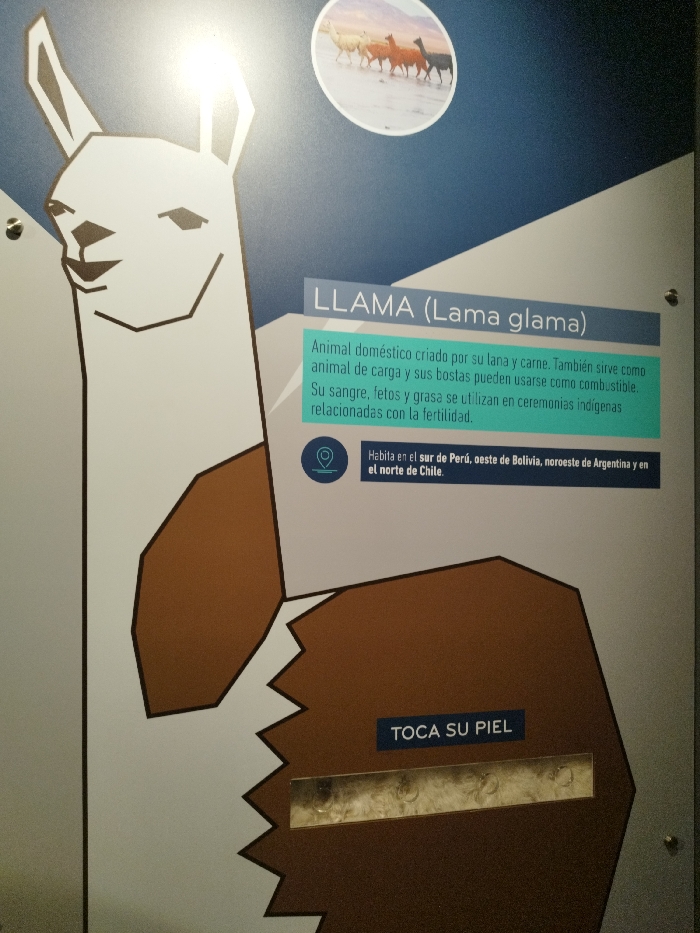
This image displays a brightly lit educational exhibit about llamas, likely located in a museum or interpretive center in Santiago, Chile. The central feature is a large, stylized graphic of a llama with a white head and neck, and brown body patches outlined in black. Its head is depicted in profile, facing left, with a gentle expression.

Above the main text, a small circular photograph shows several actual llamas in varying shades of white, brown, and black, walking across a light, possibly snow-covered or sandy, landscape.

To the right of the graphic llama, two distinct panels provide information in Spanish. The upper panel, set against a teal background, identifies the animal as "LLAMA (Lama glama)". The accompanying text explains: "Animal doméstico criado por su lana y carne. También sirve como animal de carga y sus bostas pueden usarse como combustible. Su sangre, fetos y grasa se utilizan en ceremonias indígenas relacionadas con la fertilidad." (Domestic animal raised for its wool and meat. It also serves as a pack animal, and its dung can be used as fuel. Its blood, fetuses, and fat are used in indigenous ceremonies related to fertility.)

The lower, darker panel, marked with a location pin icon, details the llama's natural habitat: "Habita en el sur de Perú, oeste de Bolivia, noroeste de Argentina y en el norte de Chile." (Inhabits southern Peru, western Bolivia, northwestern Argentina, and northern Chile.)

Below these informational panels, within the brown graphic body of the llama, is an interactive element: a rectangular display box labeled "TOCA SU PIEL" (TOUCH ITS FUR/SKIN). This box contains a sample of what appears to be llama fur, inviting visitors to physically engage with the exhibit. The overall design features a clean aesthetic with a light background and geometric blue and gray shapes. The lighting suggests an indoor setting.
Melani

Jan 7, 2025

Santiago, Chile

Stake attention in this memory

This image displays a brightly lit educational exhibit about llamas, likely located in a museum or interpretive center in Santiago, Chile. The central feature is a large, stylized graphic of a llama with a white head and neck, and brown body patches outlined in black. Its head is depicted in profile, facing left, with a gentle expression. Above the main text, a small circular photograph shows several actual llamas in varying shades of white, brown, and black, walking across a light, possibly snow-covered or sandy, landscape. To the right of the graphic llama, two distinct panels provide information in Spanish. The upper panel, set against a teal background, identifies the animal as "LLAMA (Lama glama)". The accompanying text explains: "Animal doméstico criado por su lana y carne. También sirve como animal de carga y sus bostas pueden usarse como combustible. Su sangre, fetos y grasa se utilizan en ceremonias indígenas relacionadas con la fertilidad." (Domestic animal raised for its wool and meat. It also serves as a pack animal, and its dung can be used as fuel. Its blood, fetuses, and fat are used in indigenous ceremonies related to fertility.) The lower, darker panel, marked with a location pin icon, details the llama's natural habitat: "Habita en el sur de Perú, oeste de Bolivia, noroeste de Argentina y en el norte de Chile." (Inhabits southern Peru, western Bolivia, northwestern Argentina, and northern Chile.) Below these informational panels, within the brown graphic body of the llama, is an interactive element: a rectangular display box labeled "TOCA SU PIEL" (TOUCH ITS FUR/SKIN). This box contains a sample of what appears to be llama fur, inviting visitors to physically engage with the exhibit. The overall design features a clean aesthetic with a light background and geometric blue and gray shapes. The lighting suggests an indoor setting.

transactions
revenues
stakers
Earliest
Latest
Highest stake

No transactions found

More from this user

More from Santiago

Melani

Jan 7, 2025

Santiago, Chile

Licensed under Creative Commons Attribution 4.0 International License. You are free to share and adapt this content with proper attribution.