
Sign in
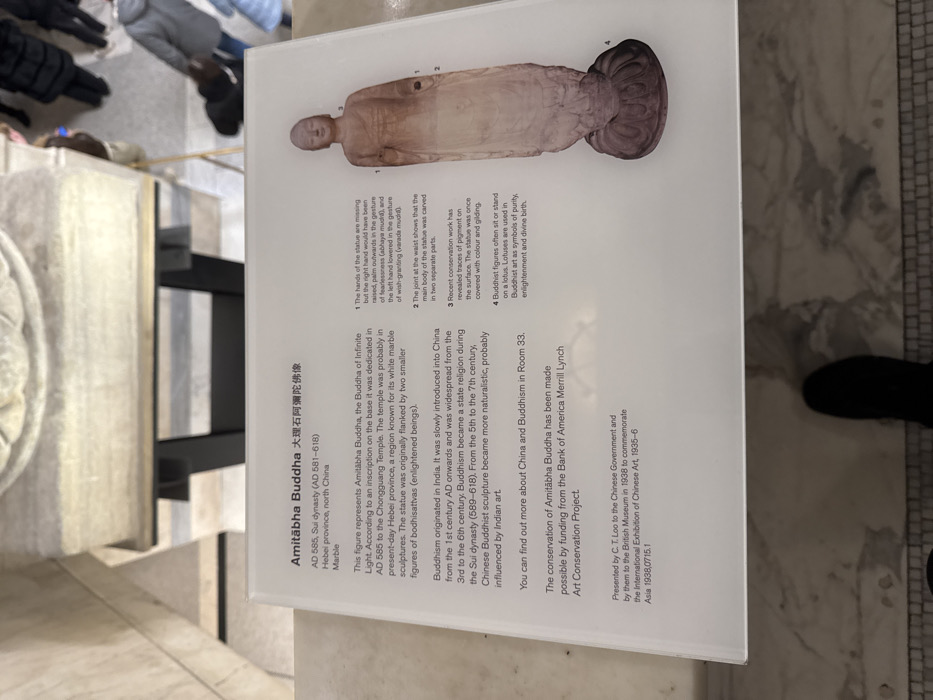
The image captures a glossy display panel within what appears to be a museum or art gallery. The main subject of the panel is an "Amitabha Buddha" statue, specifically a marble figure from the Sui dynasty (AD 581-618), dating to AD 585 and originating from Hebei province, north China. The panel features a photograph of the standing Buddha statue, which is depicted as having a light-colored body, missing hands, and resting on a multi-layered lotus base.

The visible text on the panel provides detailed information, including that the statue represents Amitabha Buddha, the Buddha of Infinite Light, and was dedicated to the Chongguang Temple. It notes that Buddhism became a state religion during the Sui dynasty and influenced Chinese Buddhist sculpture to become more naturalistic. Numbered annotations point to specific features of the statue: its missing hands (originally in specific mudras), a joint at the waist indicating two carved parts, traces of pigment suggesting it was once colored and gilded, and the lotus base as a symbol of purity.

In the blurred background, several people are visible, dressed in winter attire, suggesting they are museum visitors observing exhibits. The floor appears to be tiled, consistent with a public exhibition space. The overall scene indicates an educational or cultural setting, likely in London, United Kingdom, given the prompt's context.
punit03

Dec 13, 2024, 3:43 PM

London, UK

Stake attention in this memory

The image captures a glossy display panel within what appears to be a museum or art gallery. The main subject of the panel is an "Amitabha Buddha" statue, specifically a marble figure from the Sui dynasty (AD 581-618), dating to AD 585 and originating from Hebei province, north China. The panel features a photograph of the standing Buddha statue, which is depicted as having a light-colored body, missing hands, and resting on a multi-layered lotus base. The visible text on the panel provides detailed information, including that the statue represents Amitabha Buddha, the Buddha of Infinite Light, and was dedicated to the Chongguang Temple. It notes that Buddhism became a state religion during the Sui dynasty and influenced Chinese Buddhist sculpture to become more naturalistic. Numbered annotations point to specific features of the statue: its missing hands (originally in specific mudras), a joint at the waist indicating two carved parts, traces of pigment suggesting it was once colored and gilded, and the lotus base as a symbol of purity. In the blurred background, several people are visible, dressed in winter attire, suggesting they are museum visitors observing exhibits. The floor appears to be tiled, consistent with a public exhibition space. The overall scene indicates an educational or cultural setting, likely in London, United Kingdom, given the prompt's context.

Loading AttnAds…

transactions
revenues
stakers
Earliest
Latest
Highest stake

No transactions found

More from this user

More from London

punit03

Dec 13, 2024, 3:43 PM

London, UK

Licensed under Creative Commons Attribution 4.0 International License. You are free to share and adapt this content with proper attribution.