Stake attention in this memory
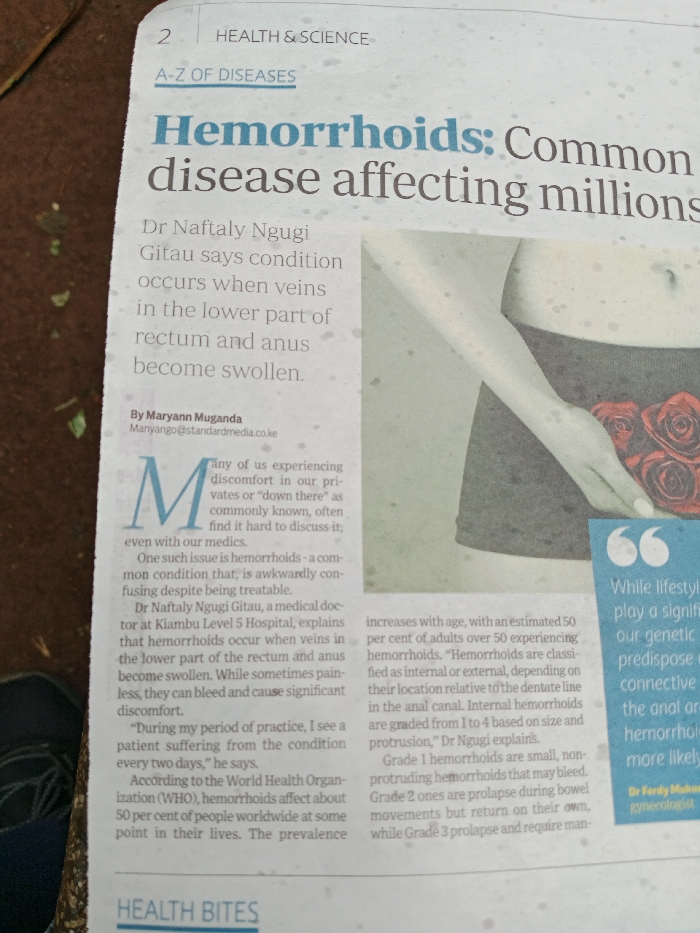
The image displays a close-up photograph of a printed newspaper or magazine page featuring an article under the "HEALTH & SCIENCE" section, specifically "A-Z OF DISEASES." The page number "2" is visible at the top left. The main headline reads, "Hemorrhoids: Common disease affecting millions." Below the main headline, a byline states, "Dr Naftaly Ngugi Gitau says condition occurs when veins in the lower part of rectum and anus become swollen." The author of the article is identified as "By Maryann Muganda" with an email address "Manyango@standardmedia.co.ke." The article's body text discusses the commonality of discomfort in "privates or 'down there'" which people find hard to discuss, even with medics. It identifies hemorrhoids as an "awkwardly confusing despite being treatable" condition. Dr. Naftaly Ngugi Gitau, a medical doctor at Kiambu Level 5 Hospital, explains that hemorrhoids occur when veins in the lower part of the rectum and anus become swollen, sometimes painlessly, but can bleed and cause significant discomfort. He notes seeing patients with the condition every two days in his practice. According to the World Health Organization (WHO), hemorrhoids affect about 50 percent of people worldwide at some point in their lives, with prevalence increasing with age; an estimated 50 percent of adults over 50 experience hemorrhoids. Dr. Ngugi explains that hemorrhoids are classified as internal or external based on their location relative to the dentate line in the anal canal, and internal hemorrhoids are graded from 1 to 4 based on size and protrusion. Grade 1 hemorrhoids are described as small, non-protruding, but may bleed. Grade 2 hemorrhoids prolapse during bowel movements but return on their own, while Grade 3 prolapse and require "man-" (likely manual reduction, as the text is cut off). An abstract image on the right side of the page shows a person's midsection, from the navel down to the upper thighs, with a hand gently resting on the hip/stomach area. The person is wearing dark-colored underwear or clothing with red rose patterns on it. A blue-colored pull-quote box is partially visible in the lower right corner, starting with "While lifestyl play a signifi our genetic predispose connective the anal ar hemorrhoi more likely" and crediting "Dr Ferdy Mukor gynécologist". The page itself appears to be a physical print, showing slight creases and small speckles across its surface, suggesting it might be an older or used newspaper/magazine. The background surface upon which the page rests is dark and textured. A small section at the bottom left reads "HEALTH BITES."
No transactions found