
Sign in
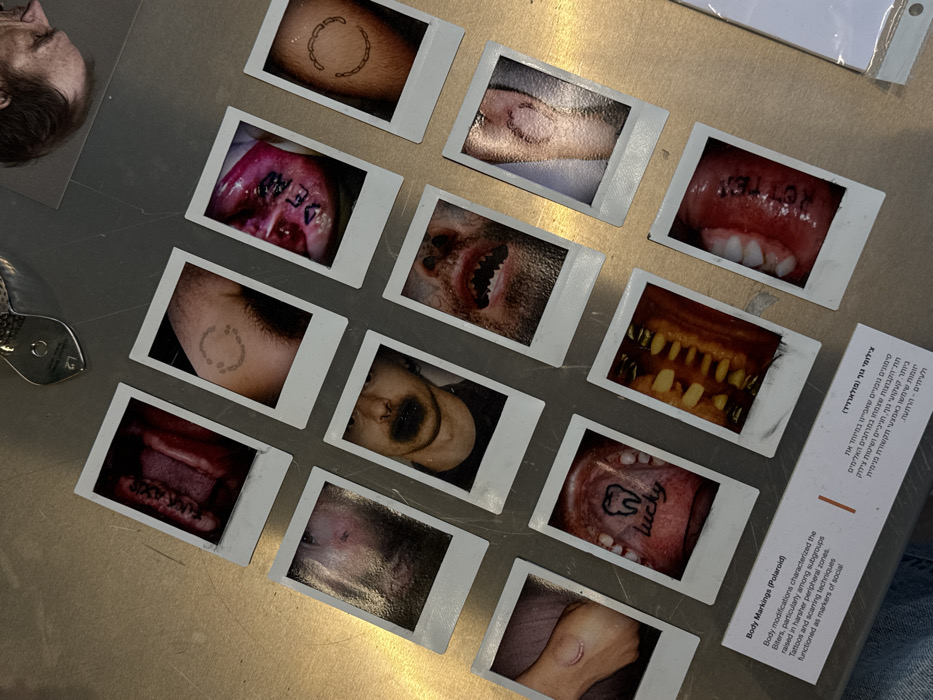
The image displays a forensic-style arrangement of twelve Polaroid photographs, an informational plaque, and a metallic tool on a reflective, brushed metallic surface. This scene is located within the Museum of Israeli Art, Ramat Gan, Israel, and is presented in a well-lit indoor space. The background is out of focus, showing a partial photographic print of a human face at the top right.

The twelve Polaroids are arranged in three rows of four. Each photograph depicts a close-up of extreme human body modifications. These include extensive alterations to the mouth and palate, such as scarification, dark linear tattoos, yellow rounded tongue implants, and teeth filed into sharp, pointed shapes. Other modifications shown are circular skin tattoos resembling tooth-like or spiked elements, crescent-shaped scars, and entirely black lips or surrounding skin. One notable Polaroid shows an open mouth with a palate tattoo of a tooth and the word "lucky" underneath.

An informational white plaque at the bottom left features text in both English and Hebrew. The English portion reads: "Body Markings (Polaroid) Body modifications characterized among subgroups. Bizers, particularly among subgroups raised in harsher periphery zones. Tattoos and scarring techniques functioned as markers of social..." (text truncated). The Hebrew text begins "צילומי גוף (פולארואיד)". Near the top center of the arrangement, a small, polished metallic object resembling a key or specialized dental tool is visible. The entire display suggests an exhibition or informational presentation on human body modifications and their cultural significance.
dianalolaev

Aug 10, 2025, 9:41 AM

Ramat Gan, Israel

Stake attention in this memory

Disgust
Unease
Curiosity
Morbid
Disturbing

The image displays a forensic-style arrangement of twelve Polaroid photographs, an informational plaque, and a metallic tool on a reflective, brushed metallic surface. This scene is located within the Museum of Israeli Art, Ramat Gan, Israel, and is presented in a well-lit indoor space. The background is out of focus, showing a partial photographic print of a human face at the top right. The twelve Polaroids are arranged in three rows of four. Each photograph depicts a close-up of extreme human body modifications. These include extensive alterations to the mouth and palate, such as scarification, dark linear tattoos, yellow rounded tongue implants, and teeth filed into sharp, pointed shapes. Other modifications shown are circular skin tattoos resembling tooth-like or spiked elements, crescent-shaped scars, and entirely black lips or surrounding skin. One notable Polaroid shows an open mouth with a palate tattoo of a tooth and the word "lucky" underneath. An informational white plaque at the bottom left features text in both English and Hebrew. The English portion reads: "Body Markings (Polaroid) Body modifications characterized among subgroups. Bizers, particularly among subgroups raised in harsher periphery zones. Tattoos and scarring techniques functioned as markers of social..." (text truncated). The Hebrew text begins "צילומי גוף (פולארואיד)". Near the top center of the arrangement, a small, polished metallic object resembling a key or specialized dental tool is visible. The entire display suggests an exhibition or informational presentation on human body modifications and their cultural significance.

Loading AttnAds…

transactions
revenues
stakers
Earliest
Latest
Highest stake

No transactions found

More from this user

More from Ramat Gan

dianalolaev

Aug 10, 2025, 9:41 AM

Ramat Gan, Israel

Licensed under Creative Commons Attribution 4.0 International License. You are free to share and adapt this content with proper attribution.