
Sign in
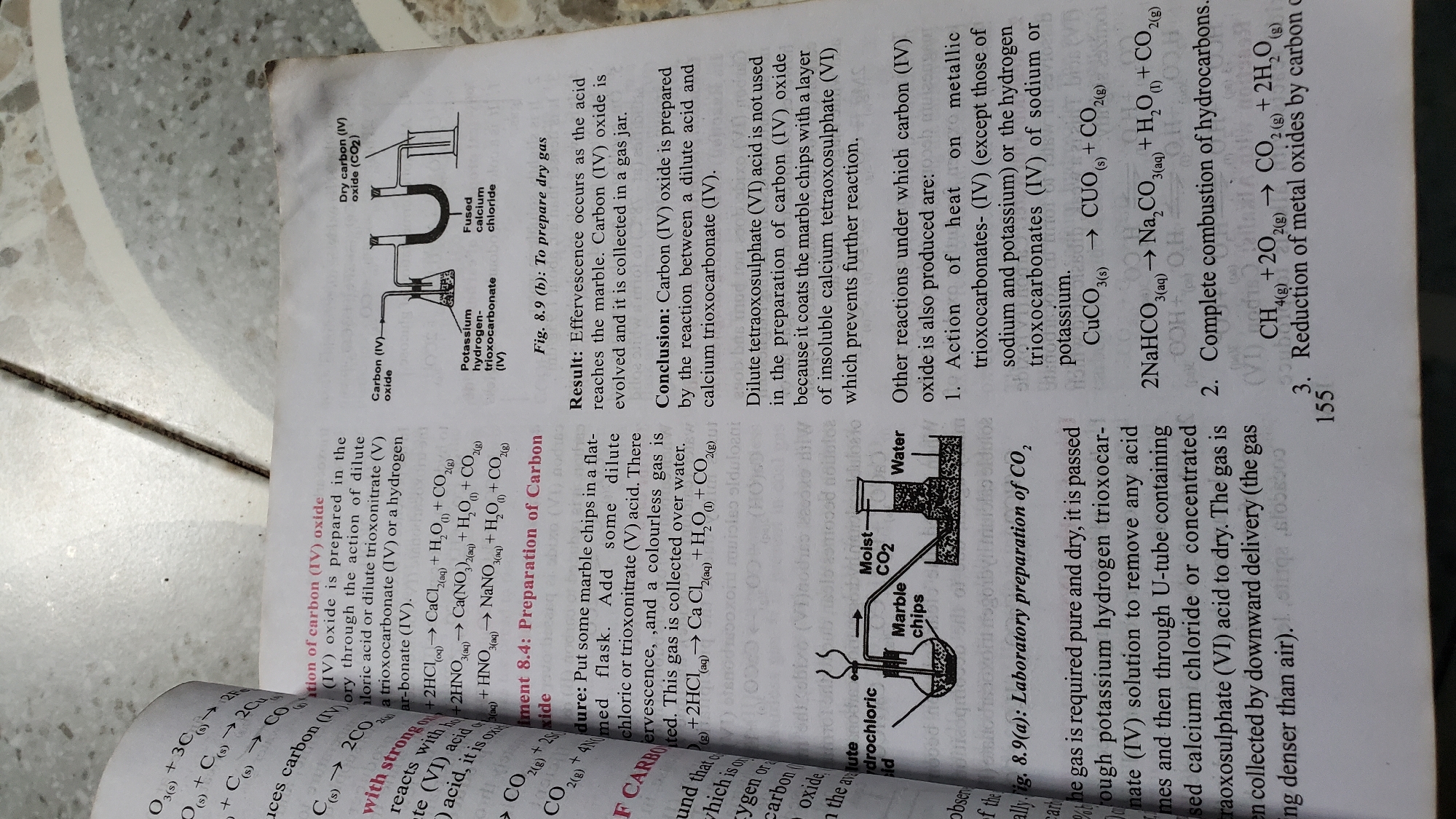
The image shows an open textbook, likely a science or chemistry book, with diagrams and text. The primary focus is on the preparation of carbon dioxide (CO2) gas. **Objects:** * **Diagram 1 (Fig. 8.9 (b)):** This diagram illustrates an experimental setup for preparing dry carbon dioxide. It includes a flask containing potassium hydrogen trioxocarbonate (IV), a delivery tube leading to a U-tube filled with fused calcium chloride, and another tube to collect the dry CO2. The diagram labels are "Carbon (IV) oxide," "Potassium hydrogen trioxocarbonate (IV)," and "Fused calcium chloride." * **Diagram 2:** This diagram shows another setup involving a flask with marble chips, a dropping funnel for dilute hydrochloric acid, and a delivery tube leading to a gas jar where moist CO2 is collected. Labels include "Dilute hydrochloric acid," "Marble chips," and "Moist CO2." * **Text:** The page contains explanations, experimental procedures, results, conclusions, and chemical reactions related to carbon and its compounds, specifically carbon dioxide. **Text Visible:** * "Fig. 8.9 (b): To prepare dry gas" * "Potassium hydrogen trioxocarbonate (IV)" * "Fused calcium chloride" * "Carbon (IV) oxide" * "Result: Effervescence occurs as the acid reaches the marble. Carbon (IV) oxide is evolved and it is collected in a gas jar." * "Conclusion: Carbon (IV) oxide is prepared by the reaction between a dilute acid and calcium trioxocarbonate (IV)." * "Dilute tetraoxosulphate (VI) acid is not used in the preparation of carbon (IV) oxide because it coats the marble chips with a layer of insoluble calcium tetraoxosulphate (VI) which prevents further reaction." * "Other reactions under which carbon (IV) oxide is also produced are:" * "1. Action of heat on metallic trioxocarbonates- (IV) (except those of sodium and potassium) or the hydrogen trioxocarbonates (IV) of sodium or potassium." * "2. Complete combustion of hydrocarbons." * "3. Reduction of metal oxides by carbon" * Chemical equations like: * "2NaHCO3(aq) + H2SO4(aq) → Na2SO4(aq) + H2O(1) + CO2(g)" * "CuCO3(s) → CuO(s) + CO2(g)" * "CH4(g) + 2O2(g) → CO2(g) + 2H2O(g)" * "ment 8.4: Preparation of Carbon of CO2" * "with strong" * "carbonyl" * "oxide" * "The gas is" * "e.g., 8.9 (a): Laboratory preparation of CO2" * "Water" * "155" The scene is a static representation of educational material. There are no people, animals, or explicit setting cues like a specific room or outdoor environment, beyond what is depicted in the diagrams. The context implies an academic
FM-Ssetp2

Jun 30, 2026, 11:43 AM

Jalingo, Nigeria

Stake attention in this memory

studious
analytical
focused
academic
contemplative

The image shows an open textbook, likely a science or chemistry book, with diagrams and text. The primary focus is on the preparation of carbon dioxide (CO2) gas. **Objects:** * **Diagram 1 (Fig. 8.9 (b)):** This diagram illustrates an experimental setup for preparing dry carbon dioxide. It includes a flask containing potassium hydrogen trioxocarbonate (IV), a delivery tube leading to a U-tube filled with fused calcium chloride, and another tube to collect the dry CO2. The diagram labels are "Carbon (IV) oxide," "Potassium hydrogen trioxocarbonate (IV)," and "Fused calcium chloride." * **Diagram 2:** This diagram shows another setup involving a flask with marble chips, a dropping funnel for dilute hydrochloric acid, and a delivery tube leading to a gas jar where moist CO2 is collected. Labels include "Dilute hydrochloric acid," "Marble chips," and "Moist CO2." * **Text:** The page contains explanations, experimental procedures, results, conclusions, and chemical reactions related to carbon and its compounds, specifically carbon dioxide. **Text Visible:** * "Fig. 8.9 (b): To prepare dry gas" * "Potassium hydrogen trioxocarbonate (IV)" * "Fused calcium chloride" * "Carbon (IV) oxide" * "Result: Effervescence occurs as the acid reaches the marble. Carbon (IV) oxide is evolved and it is collected in a gas jar." * "Conclusion: Carbon (IV) oxide is prepared by the reaction between a dilute acid and calcium trioxocarbonate (IV)." * "Dilute tetraoxosulphate (VI) acid is not used in the preparation of carbon (IV) oxide because it coats the marble chips with a layer of insoluble calcium tetraoxosulphate (VI) which prevents further reaction." * "Other reactions under which carbon (IV) oxide is also produced are:" * "1. Action of heat on metallic trioxocarbonates- (IV) (except those of sodium and potassium) or the hydrogen trioxocarbonates (IV) of sodium or potassium." * "2. Complete combustion of hydrocarbons." * "3. Reduction of metal oxides by carbon" * Chemical equations like: * "2NaHCO3(aq) + H2SO4(aq) → Na2SO4(aq) + H2O(1) + CO2(g)" * "CuCO3(s) → CuO(s) + CO2(g)" * "CH4(g) + 2O2(g) → CO2(g) + 2H2O(g)" * "ment 8.4: Preparation of Carbon of CO2" * "with strong" * "carbonyl" * "oxide" * "The gas is" * "e.g., 8.9 (a): Laboratory preparation of CO2" * "Water" * "155" The scene is a static representation of educational material. There are no people, animals, or explicit setting cues like a specific room or outdoor environment, beyond what is depicted in the diagrams. The context implies an academic

Loading AttnAds…

transactions
revenues
stakers
Earliest
Latest
Highest stake

No transactions found

More from this user

More from Jalingo

FM-Ssetp2

Jun 30, 2026, 11:43 AM

Jalingo, Nigeria

Licensed under Creative Commons Attribution 4.0 International License. You are free to share and adapt this content with proper attribution.