
Stake attention in this memory
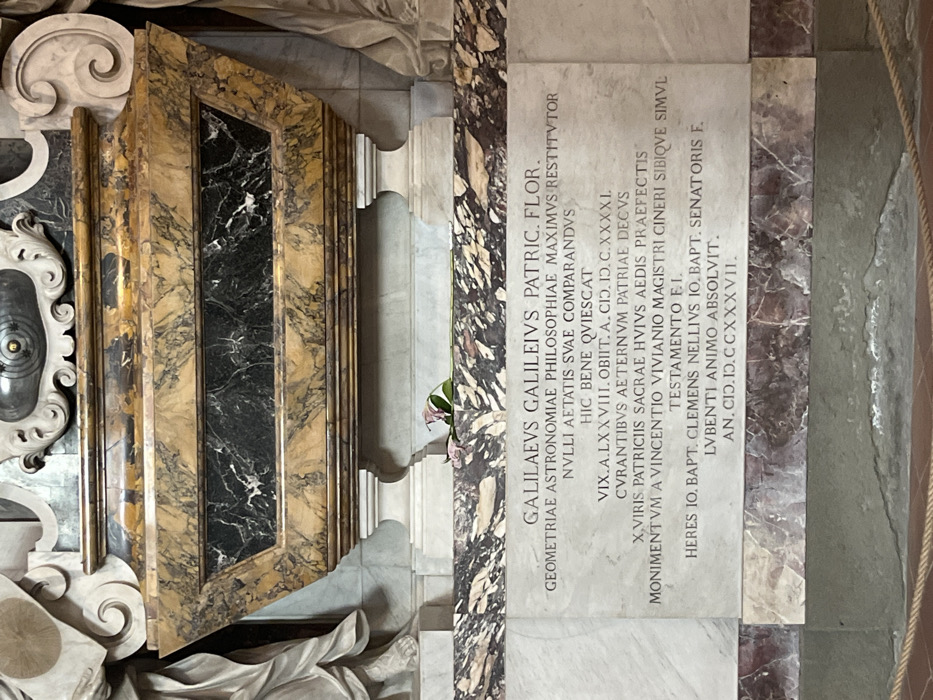
The image displays the tomb of Galileo Galilei, located in Florence, Italy. The central element is a light-colored marble epitaph tablet, inscribed with Latin text, commemorating the famed astronomer and philosopher. To the left, an ornate sarcophagus or monument is visible, constructed from luxurious, multi-colored marble. This monument features rich dark green/black marble panels with white veining, framed by golden-brown marble with darker streaks, all intricately carved with stepped architectural elements and decorative moldings. A small bouquet of pink and white flowers rests at the base of the epitaph, suggesting a recent offering or tribute. No people are visible, but the scene exudes a solemn and historical ambiance. The visible text on the epitaph reads: "GALILAEVS GALILEIVS PATRIC. FLOR. GEOMETRIAE ASTRONOMIAE PHILOSOPHIAE MAXIMVS RESTITVTOR NVLLI AETATIS SVAE COMPARANDVS HIC BENE QUIESCAT VIX.A.LXXVIII. OBIIT.A. CID. ID. C. XXXXL CVRANTIBVS AETERNVM PATRIAE DECVS X,VIRIS PATRICIIS SACRAE HVIVS AEDIS PRAEFECTIS MONIMENTUM A VINCENTIO VIVIANIO MAGISTRI CINERI SIBIQVE SIMVL TESTAMENTO EL. HERES IO. BAPT. CLEMENS NELLIVS IO. BAPT. SENATORIS F. LVBENTI ANIMO ABSOLVIT. AN. CID.IO.CCXXXVII." This inscription identifies Galileo Galilei as a Florentine patrician, "the greatest restorer of geometry, astronomy, and philosophy," states he lived 78 years, died in 1642, and notes the monument was erected by Vincenzo Viviani and dedicated in 1737. The setting is clearly an interior space, likely a church or basilica, given the monumental scale and classical architectural details.
No transactions found