Sign in
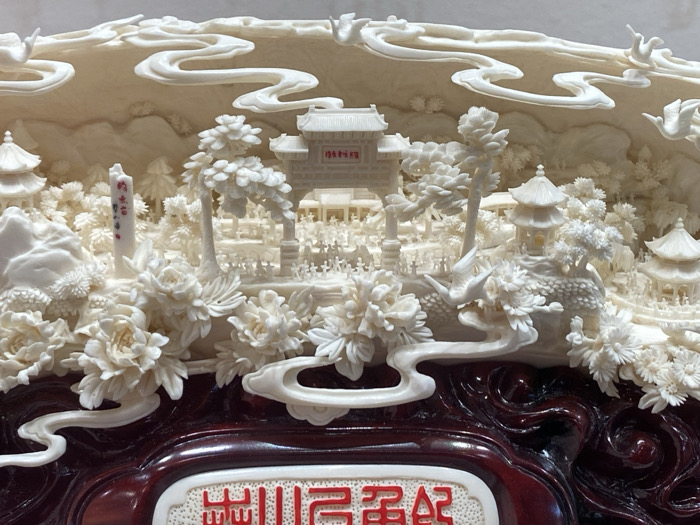
An intricately carved sculpture, likely made of faux ivory or resin, depicts a detailed traditional East Asian landscape scene. The primary color of the carving is off-white or cream, resting on a dark red-brown, glossy wooden base.

The scene features a vibrant landscape with undulating mountains and stylized clouds forming the background and upper borders. Numerous architectural elements are present, including multiple pagodas with multi-tiered roofs, and a prominent central gate or pavilion. This central structure features a plaque above its archway. Scattered throughout the landscape are meticulously carved trees, some resembling pine trees and others with dense foliage, alongside abundant large, layered flowers resembling peonies, especially in the foreground. Miniature human figures are discernible around the central gate and structures, suggesting a bustling yet serene environment. A vertical, stone-like tablet stands to the left of the central gate. In the upper right, a crane-like bird is carved amidst the clouds. The craftsmanship is highly detailed, highlighting the texture of the foliage, the architectural intricacies, and the flowing forms of the clouds.

The base of the sculpture is a rich, dark red-brown with swirling, carved patterns, and it features a rectangular white panel at the bottom with red characters.

Visible text includes:
*   On the plaque of the central gate: "仙苑奇觀" (Xiān Yuàn Qí Guān), meaning "Wonder of the Immortal Garden" or "Marvel of the Fairy Garden".
*   On the vertical tablet (left): "普天同慶" (Pǔ Tiān Tóng Qìng), meaning "Universal Celebration", and "百福具臻" (Bǎi Fú Jù Zhēn), meaning "All Blessings Arrive".
*   On the white panel of the base: "廣廈千萬間" (Guǎng Shà Qiān Wàn Jiān), meaning "Ten thousand mansions" (referencing a line from Du Fu's poem about wishing for housing for all), followed by "大庇天下寒士俱歡顏" (Dà Bì Tiān Xià Hán Shì Jù Huān Yán), meaning "To shelter all the poor scholars in the world and make them joyful". Below this is "祝寿" (Zhù Shòu), meaning "Wishing a long life" or "Happy Birthday".

The sculpture evokes a sense of an idealized, prosperous, and auspicious landscape, possibly created as a celebratory or commemorative piece given the inscriptions. The setting is a traditional Chinese landscape, consistent with the location context of Guang Zhou Shi, China.
F
FM-CaIMM2

Jan 4, 2025, 8:07 AM

Guang Zhou Shi, China

Stake attention in this memory

An intricately carved sculpture, likely made of faux ivory or resin, depicts a detailed traditional East Asian landscape scene. The primary color of the carving is off-white or cream, resting on a dark red-brown, glossy wooden base. The scene features a vibrant landscape with undulating mountains and stylized clouds forming the background and upper borders. Numerous architectural elements are present, including multiple pagodas with multi-tiered roofs, and a prominent central gate or pavilion. This central structure features a plaque above its archway. Scattered throughout the landscape are meticulously carved trees, some resembling pine trees and others with dense foliage, alongside abundant large, layered flowers resembling peonies, especially in the foreground. Miniature human figures are discernible around the central gate and structures, suggesting a bustling yet serene environment. A vertical, stone-like tablet stands to the left of the central gate. In the upper right, a crane-like bird is carved amidst the clouds. The craftsmanship is highly detailed, highlighting the texture of the foliage, the architectural intricacies, and the flowing forms of the clouds. The base of the sculpture is a rich, dark red-brown with swirling, carved patterns, and it features a rectangular white panel at the bottom with red characters. Visible text includes: * On the plaque of the central gate: "仙苑奇觀" (Xiān Yuàn Qí Guān), meaning "Wonder of the Immortal Garden" or "Marvel of the Fairy Garden". * On the vertical tablet (left): "普天同慶" (Pǔ Tiān Tóng Qìng), meaning "Universal Celebration", and "百福具臻" (Bǎi Fú Jù Zhēn), meaning "All Blessings Arrive". * On the white panel of the base: "廣廈千萬間" (Guǎng Shà Qiān Wàn Jiān), meaning "Ten thousand mansions" (referencing a line from Du Fu's poem about wishing for housing for all), followed by "大庇天下寒士俱歡顏" (Dà Bì Tiān Xià Hán Shì Jù Huān Yán), meaning "To shelter all the poor scholars in the world and make them joyful". Below this is "祝寿" (Zhù Shòu), meaning "Wishing a long life" or "Happy Birthday". The sculpture evokes a sense of an idealized, prosperous, and auspicious landscape, possibly created as a celebratory or commemorative piece given the inscriptions. The setting is a traditional Chinese landscape, consistent with the location context of Guang Zhou Shi, China.

Loading AttnAds…

transactions
revenues
stakers
Earliest
Latest
Highest stake

No transactions found

More from this user

More from Guang Zhou Shi

FFM-CaIMM2

Jan 4, 2025, 8:07 AM

Guang Zhou Shi, China

Licensed under Creative Commons Attribution 4.0 International License. You are free to share and adapt this content with proper attribution.