
Sign in
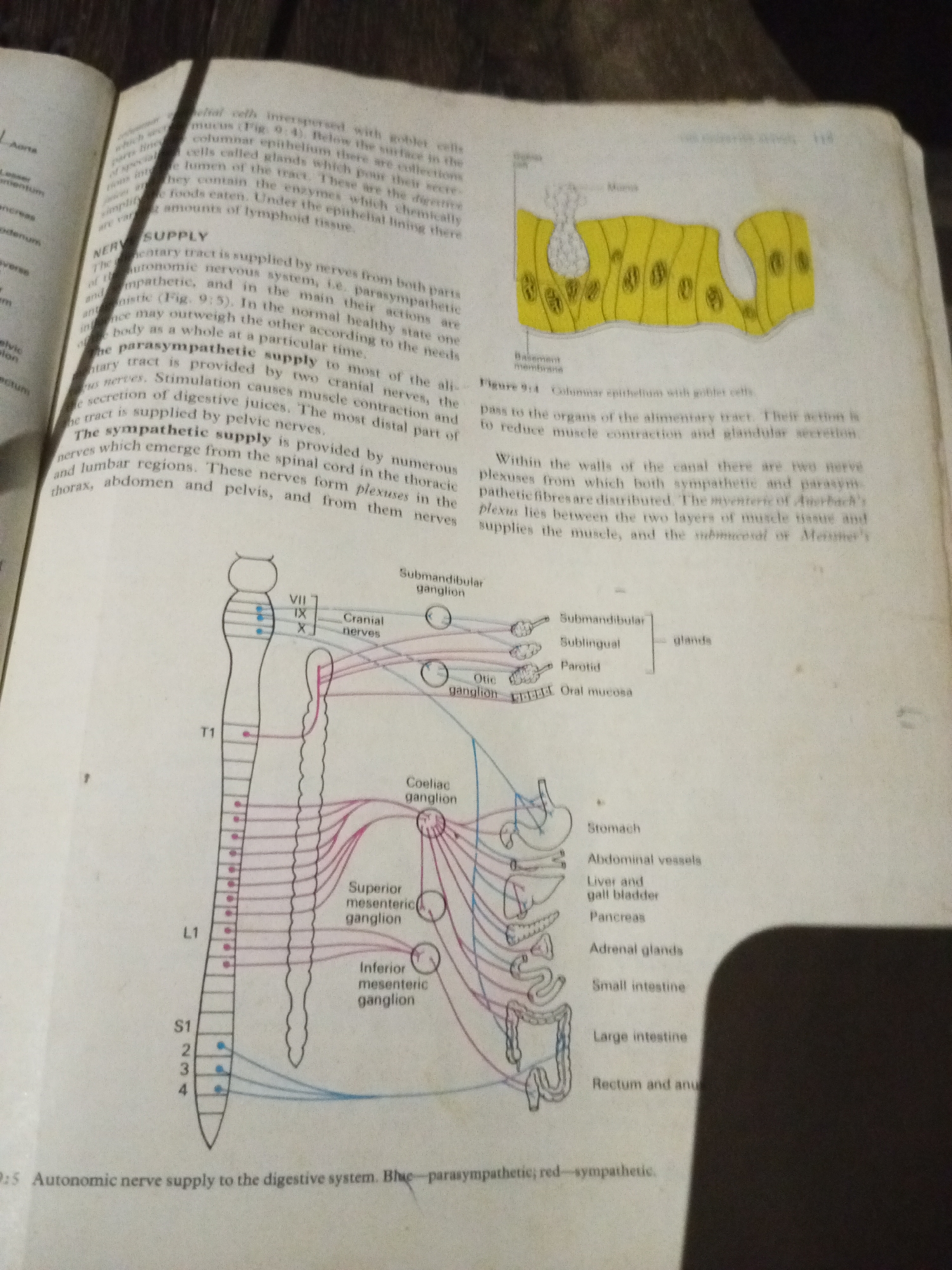
The image contains a page from a textbook. On the left side, there is a diagram illustrating the autonomic nerve supply to the digestive system. It shows the spinal cord with labels indicating thoracic (T1) and lumbar (L1, S1-4) segments, connected by red and blue lines to various ganglia (Superior mesenteric, Inferior mesenteric, Coeliac) and then to organs like the stomach, abdominal vessels, liver and gall bladder, pancreas, adrenal glands, small intestine, large intestine, and rectum and anus. The blue lines represent parasympathetic supply and the red lines represent sympathetic supply.

To the right of the diagram is an illustration of columnar epithelium with goblet cells, labeled as Figure 9.4. Below this figure, text describes the functions of the epithelium and the nerve supply to the alimentary tract, mentioning parasympathetic and sympathetic supply. The text details how these nerves originate from the cranial nerves and spinal cord, forming plexuses within the digestive tract walls.

The page also includes some text from the surrounding pages of the textbook, partially visible on the left and top edges. The overall environment appears to be a flat surface, likely a table, with shadows cast across the page, indicating overhead lighting. The image is taken from a slightly overhead angle. There are no people or identifiable locations other than those depicted within the textbook content.
FM-ceq5D2

Jun 28, 2026

Unknown, Unknown

Short Term

Stake attention in this memory

informative
educational
scientific
diagrammatic
technical

The image contains a page from a textbook. On the left side, there is a diagram illustrating the autonomic nerve supply to the digestive system. It shows the spinal cord with labels indicating thoracic (T1) and lumbar (L1, S1-4) segments, connected by red and blue lines to various ganglia (Superior mesenteric, Inferior mesenteric, Coeliac) and then to organs like the stomach, abdominal vessels, liver and gall bladder, pancreas, adrenal glands, small intestine, large intestine, and rectum and anus. The blue lines represent parasympathetic supply and the red lines represent sympathetic supply. To the right of the diagram is an illustration of columnar epithelium with goblet cells, labeled as Figure 9.4. Below this figure, text describes the functions of the epithelium and the nerve supply to the alimentary tract, mentioning parasympathetic and sympathetic supply. The text details how these nerves originate from the cranial nerves and spinal cord, forming plexuses within the digestive tract walls. The page also includes some text from the surrounding pages of the textbook, partially visible on the left and top edges. The overall environment appears to be a flat surface, likely a table, with shadows cast across the page, indicating overhead lighting. The image is taken from a slightly overhead angle. There are no people or identifiable locations other than those depicted within the textbook content.

Symbol

8E1B2

Volume

11,550

Creator

+$0.17

Revenue

+$0.24

TVL

$14.71

1D
1W
1M
All
transactions
revenues
stakers
Earliest
Latest
Highest stake

1

FM-k0G0G2

Staked 1h ago

$14.62 USD

+$0.09 USD

+0.6%

2

Rev Bot 🤖💰

Injected revenue 53m ago

Revenue bonus for the last stake.

+$0.26 USD

More from this user

More from Unknown

FM-ceq5D2

Jun 28, 2026

Unknown, Unknown

Licensed under Creative Commons Attribution 4.0 International License. You are free to share and adapt this content with proper attribution.