
Sign in
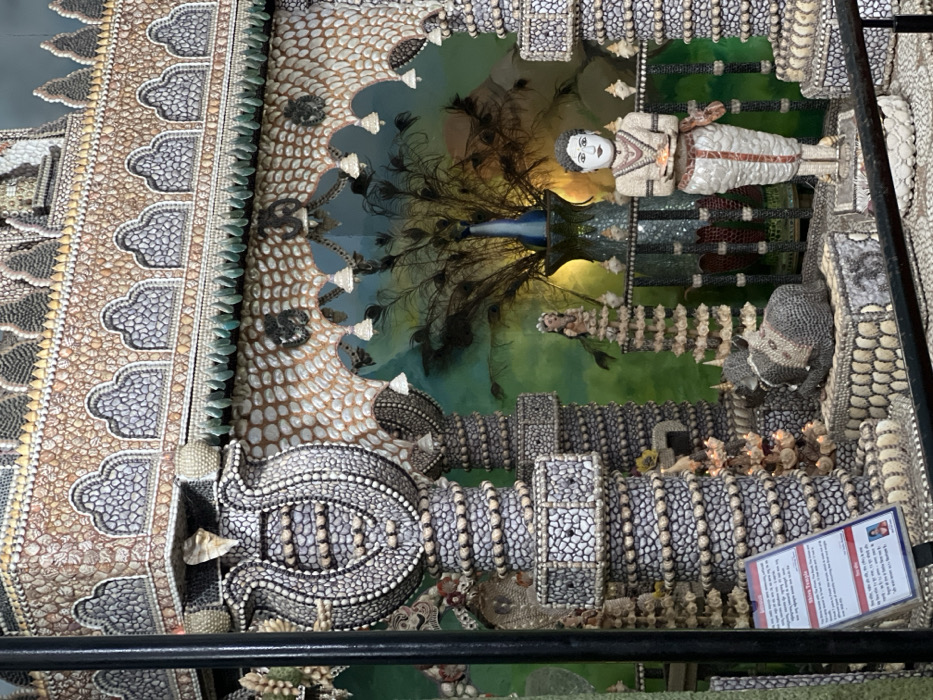
This media file displays an elaborate and intricately detailed diorama, primarily constructed from various types of seashells. The image is oriented 90 degrees clockwise.

The scene depicts a miniature architectural complex, possibly a temple or palace, adorned with meticulously arranged seashells. Prominent features include ornate walls with arched designs, decorative borders, and several robust cylindrical columns, all surfaced with countless small shells forming patterns.

In what would be the upper right section (if rotated correctly), a standing doll-like figure, likely representing a deity or traditional personality, is central. This figure, along with its attire, is entirely crafted from shells. Behind it, a vibrant, fanned structure, reminiscent of a peacock's tail, emerges from a vase, set against a painted backdrop of green, yellow, and blue hues. Near the bottom right, a reptilian or dragon-like figure, also composed of shells, is visible.

The entire artwork showcases exceptional craftsmanship, with shells of different colors, shapes, and sizes used to create textures, shadows, and intricate details. The overall impression is one of dedication and artistic precision.

In the bottom right corner, an informational plaque is visible. The title on the plaque reads "Shiva Temple," and it features a small image of a man. The text explains that this is a replica of a Lord Shiva temple, constructed by artist Mr. S.K. Rathan, using approximately 200,000 shells and various sea creatures over three months. The display is likely housed in a museum or cultural exhibit, consistent with the location context of Mysuru, India.
FM-7y8Ft1

Jan 12, 2025

Mysuru, India

Stake attention in this memory

This media file displays an elaborate and intricately detailed diorama, primarily constructed from various types of seashells. The image is oriented 90 degrees clockwise. The scene depicts a miniature architectural complex, possibly a temple or palace, adorned with meticulously arranged seashells. Prominent features include ornate walls with arched designs, decorative borders, and several robust cylindrical columns, all surfaced with countless small shells forming patterns. In what would be the upper right section (if rotated correctly), a standing doll-like figure, likely representing a deity or traditional personality, is central. This figure, along with its attire, is entirely crafted from shells. Behind it, a vibrant, fanned structure, reminiscent of a peacock's tail, emerges from a vase, set against a painted backdrop of green, yellow, and blue hues. Near the bottom right, a reptilian or dragon-like figure, also composed of shells, is visible. The entire artwork showcases exceptional craftsmanship, with shells of different colors, shapes, and sizes used to create textures, shadows, and intricate details. The overall impression is one of dedication and artistic precision. In the bottom right corner, an informational plaque is visible. The title on the plaque reads "Shiva Temple," and it features a small image of a man. The text explains that this is a replica of a Lord Shiva temple, constructed by artist Mr. S.K. Rathan, using approximately 200,000 shells and various sea creatures over three months. The display is likely housed in a museum or cultural exhibit, consistent with the location context of Mysuru, India.

transactions
revenues
stakers
Earliest
Latest
Highest stake

No transactions found

More from this user

More from Mysuru

FM-7y8Ft1

Jan 12, 2025

Mysuru, India

Licensed under Creative Commons Attribution 4.0 International License. You are free to share and adapt this content with proper attribution.