Sign in
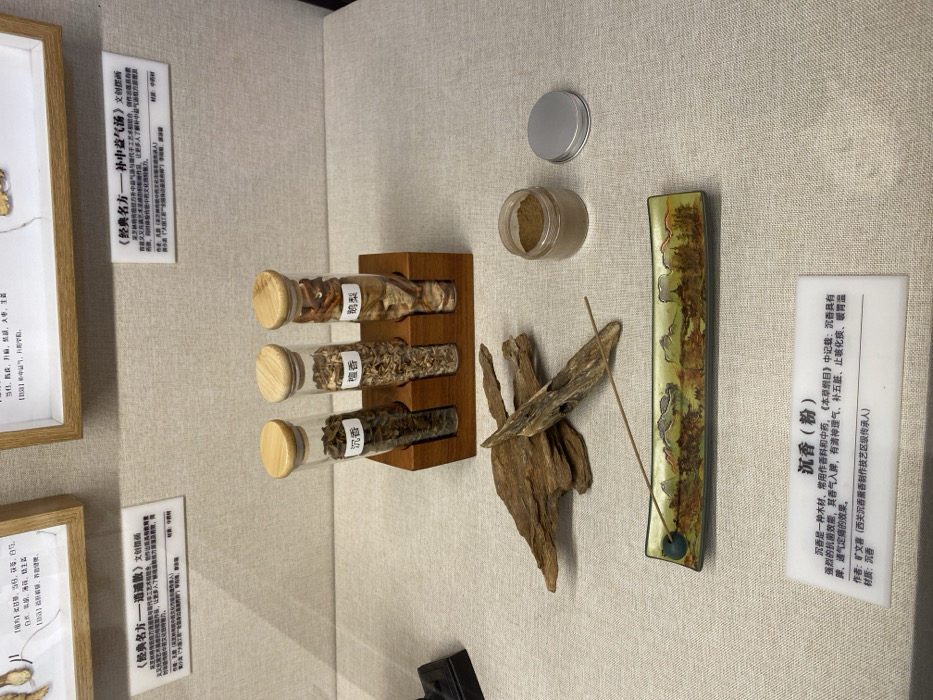
The image captures an indoor display showcasing traditional Chinese incense and herbal medicine elements, likely in Guangzhou, China.

The central focus is a collection of items related to agarwood (沉香). On the right, a white rectangular label provides detailed information about "Agarwood (Powder)," describing it as a wood used in spices and traditional Chinese medicine. It highlights its strong antibacterial properties and benefits for "clearing the mind and regulating qi, nourishing the five internal organs, stopping cough and phlegm, warming the stomach, warming the spleen, and regulating qi to relieve pain," citing the "Compendium of Materia Medica." The label also identifies the author as Kuang Wenxi, a district-level inheritor of the Xiguan Agarwood Lixiang production technique.

To the left of this label is a decorative, painted incense holder, featuring a landscape scene, with a thin incense stick resting on it. Nearby are several pieces of raw, dark, irregularly shaped agarwood. Above these, a small glass jar with a silver lid contains brownish powder, presumably agarwood powder.

Further left, a wooden stand holds three glass vials, each with a wooden stopper. These vials contain dried ingredients, labeled in Chinese as 沉香 (agarwood), 檀香 (sandalwood), and 鹅梨 (possibly a type of dried fruit, herb, or blend component).

Partially visible on the far left are two framed displays with Chinese text. One references "Classic Prescription — Buzhong Yiqi Tang (Decoction for Invigorating the Spleen and Replenishing Qi) Cultural and Creative Display," and the other mentions "Classic Prescription — Xiaoyao San (Powder for Free and Easy Wanderer) Cultural and Creative Improvement." These labels suggest an exhibition connecting ancient medicinal formulas with modern cultural products.

The items are neatly arranged on a light-colored, textured fabric surface, indicating a well-organized exhibit or commercial display. The overall scene provides an educational glimpse into the rich history and cultural significance of aromatics and traditional medicine in China.
F
FM-CaIMM2

Jan 4, 2025, 8:08 AM

Guang Zhou Shi, China

Stake attention in this memory

The image captures an indoor display showcasing traditional Chinese incense and herbal medicine elements, likely in Guangzhou, China. The central focus is a collection of items related to agarwood (沉香). On the right, a white rectangular label provides detailed information about "Agarwood (Powder)," describing it as a wood used in spices and traditional Chinese medicine. It highlights its strong antibacterial properties and benefits for "clearing the mind and regulating qi, nourishing the five internal organs, stopping cough and phlegm, warming the stomach, warming the spleen, and regulating qi to relieve pain," citing the "Compendium of Materia Medica." The label also identifies the author as Kuang Wenxi, a district-level inheritor of the Xiguan Agarwood Lixiang production technique. To the left of this label is a decorative, painted incense holder, featuring a landscape scene, with a thin incense stick resting on it. Nearby are several pieces of raw, dark, irregularly shaped agarwood. Above these, a small glass jar with a silver lid contains brownish powder, presumably agarwood powder. Further left, a wooden stand holds three glass vials, each with a wooden stopper. These vials contain dried ingredients, labeled in Chinese as 沉香 (agarwood), 檀香 (sandalwood), and 鹅梨 (possibly a type of dried fruit, herb, or blend component). Partially visible on the far left are two framed displays with Chinese text. One references "Classic Prescription — Buzhong Yiqi Tang (Decoction for Invigorating the Spleen and Replenishing Qi) Cultural and Creative Display," and the other mentions "Classic Prescription — Xiaoyao San (Powder for Free and Easy Wanderer) Cultural and Creative Improvement." These labels suggest an exhibition connecting ancient medicinal formulas with modern cultural products. The items are neatly arranged on a light-colored, textured fabric surface, indicating a well-organized exhibit or commercial display. The overall scene provides an educational glimpse into the rich history and cultural significance of aromatics and traditional medicine in China.

Loading AttnAds…

transactions
revenues
stakers
Earliest
Latest
Highest stake

No transactions found

More from this user

More from Guang Zhou Shi

FFM-CaIMM2

Jan 4, 2025, 8:08 AM

Guang Zhou Shi, China

Licensed under Creative Commons Attribution 4.0 International License. You are free to share and adapt this content with proper attribution.