
Stake attention in this memory
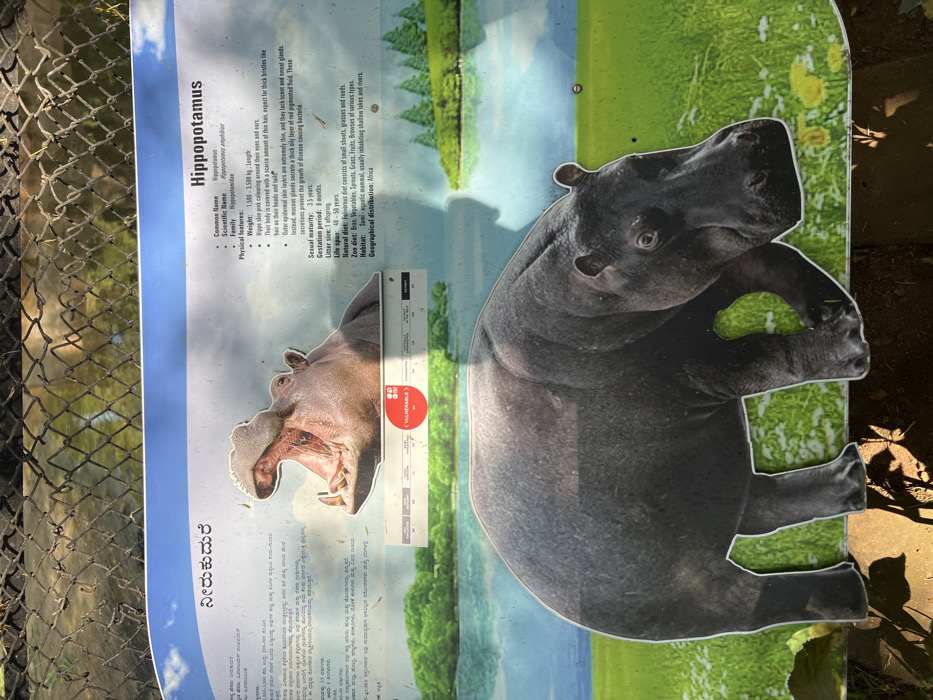
An informational display board about hippopotamuses is prominently featured in a bright outdoor setting, likely a zoo in Mysuru, India. The board is oriented vertically but the image is captured horizontally, showing a chain-link fence to the left. The background of the board depicts a scenic landscape with water, trees, and grass, designed to evoke a natural habitat. Two cut-out images of hippopotamuses are affixed to the board. One on the left shows a hippo with its mouth wide open, revealing its large teeth. The other, larger cut-out on the right, displays a full-bodied hippo in a more static pose. The board provides extensive information about the Hippopotamus, including its Common Name (Hippopotamus), Scientific Name (Hippopotamus amphibius), and Family (Hippopotamidae). Detailed physical features are listed, such as weight (1,500 - 3,500 kg), skin characteristics (pink colouring, scarce hair, thick oily red pigmented fluid secretion for protection). Reproductive information includes sexual maturity (3.5 years), gestation period (8 months), and litter size (1 offspring). Life span is noted as 40-50 years. The diet is broken down into natural diet (shoots, grasses, reeds) and zoo diet (bran, vegetables, fruits, etc.). Habitat is described as semi-aquatic, in shallow lakes and rivers, with its geographical distribution being Africa. A prominent red label indicates the species' conservation status as "VULNERABLE". Kannada text, including "ನೀರು ಕುದುರೆ" (Neeru Kudure - Water Horse), which is the local name for hippopotamus, is visible on the left side of the board. The bright sunlight creates sharp shadows, indicating clear weather during daytime.
No transactions found