
Sign in
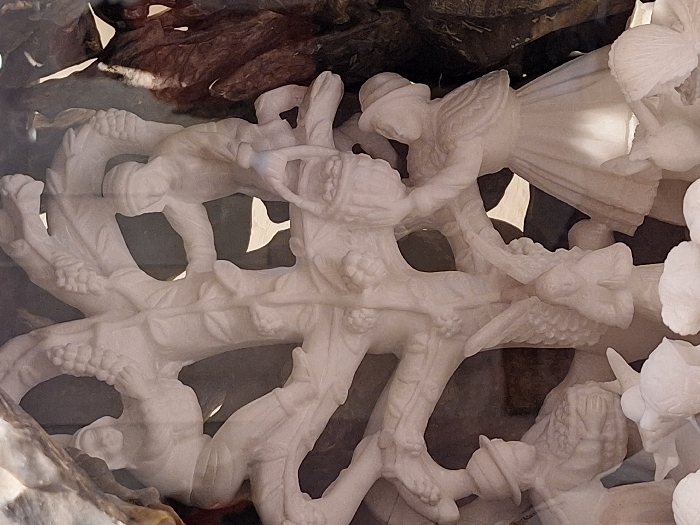
The image presents a detailed close-up of an intricate, three-dimensional sculpture crafted from a translucent, light-colored material, strongly suggesting alabaster or white marble, commonly associated with the artistic traditions of Arequipa, Peru.

The primary subject is a dense, organic carving depicting intertwining branches or a grape vine, abundant with clusters of what appear to be grapes or berries. Several human figures are skillfully integrated into this botanical landscape. One prominent figure in the upper right wears a hat, a full skirt, and a cloak, leaning forward as if actively harvesting or tending the fruit on the vine. Another figure is partially visible on the left side, also appearing to interact with the branches, while a third figure, wearing a hat, is discernible in the lower section.

The carving showcases remarkable craftsmanship, evident in the delicate drapery of the figures' clothing, the textured details of the gnarled branches, and the precise rendering of the fruit clusters. The figures are depicted in period-style attire, suggesting a historical or traditional pastoral scene centered around agricultural labor.

The background is dark and indistinct, indicating an indoor setting, possibly a museum, gallery, or display case, where light sources illuminate the sculpture's translucent qualities. The overall impression is one of graceful movement and meticulous detail, highlighting the artisan's skill. No text is visible within the image, and due to its nature as an indoor art piece, there are no indicators of time of day or weather. The location context of Arequipa, Peru, underscores the likely use of local alabaster, a signature material of the region.
L E E L O O 🇵🇪

Dec 23, 2024

Arequipa, Peru

Stake attention in this memory

The image presents a detailed close-up of an intricate, three-dimensional sculpture crafted from a translucent, light-colored material, strongly suggesting alabaster or white marble, commonly associated with the artistic traditions of Arequipa, Peru. The primary subject is a dense, organic carving depicting intertwining branches or a grape vine, abundant with clusters of what appear to be grapes or berries. Several human figures are skillfully integrated into this botanical landscape. One prominent figure in the upper right wears a hat, a full skirt, and a cloak, leaning forward as if actively harvesting or tending the fruit on the vine. Another figure is partially visible on the left side, also appearing to interact with the branches, while a third figure, wearing a hat, is discernible in the lower section. The carving showcases remarkable craftsmanship, evident in the delicate drapery of the figures' clothing, the textured details of the gnarled branches, and the precise rendering of the fruit clusters. The figures are depicted in period-style attire, suggesting a historical or traditional pastoral scene centered around agricultural labor. The background is dark and indistinct, indicating an indoor setting, possibly a museum, gallery, or display case, where light sources illuminate the sculpture's translucent qualities. The overall impression is one of graceful movement and meticulous detail, highlighting the artisan's skill. No text is visible within the image, and due to its nature as an indoor art piece, there are no indicators of time of day or weather. The location context of Arequipa, Peru, underscores the likely use of local alabaster, a signature material of the region.

transactions
revenues
stakers
Earliest
Latest
Highest stake

No transactions found

More from this user

More from Arequipa

L E E L O O 🇵🇪

Dec 23, 2024

Arequipa, Peru

Licensed under Creative Commons Attribution 4.0 International License. You are free to share and adapt this content with proper attribution.