Sign in
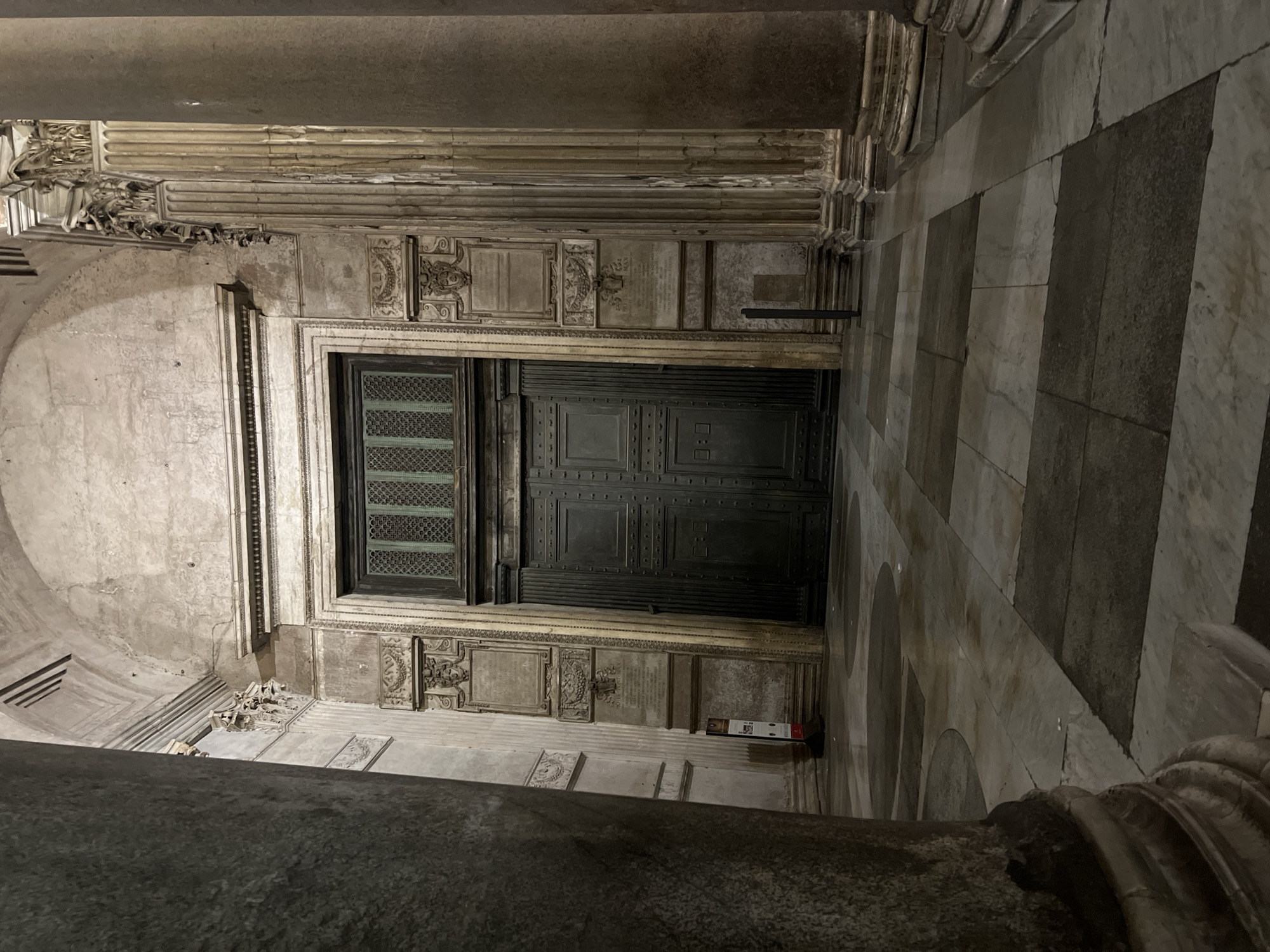
An interior view of a grand historical building in Rome, Italy, is captured in low light. The central subject is a colossal, dark metal double door, featuring a grid pattern on its left panel and a series of rectangular panels with raised bosses on its right panel. The door is framed by richly detailed marble or stone architecture, including intricately carved pilasters and a frieze adorned with various decorative elements and what appear to be commemorative plaques.

Above the door, a series of rectangular marble plaques are embedded into the wall, interspersed with carved ornate motifs. Visible Latin inscriptions on these plaques include references to "ANTONIUS LAXVS," "ANNO SALVTIS MDCXXXII" (Year of Salvation 1632), and "VRBANVS VIII PONT MAX" (Urban VIII, Pontifex Maximus), indicating a restoration or work carried out by Pope Urban VIII in 1632. Further details mention "S. P. Q. R." (Senātus Populusque Rōmānus) and "RESTITVIT" (restored).

To the left of the door, a large archway is visible, part of the building's robust stone structure. The floor, partially obscured by a large stone balustrade or beam in the foreground, is made of alternating light and dark marble tiles arranged in a geometric pattern of rectangles and semicircles. The overall impression is one of immense scale, historical significance, and solemn grandeur, typical of ancient Roman architecture like the Pantheon, which fits the location context and historical inscriptions. A small white and red sign, possibly an information board with a QR code, leans against the wall near the lower right of the door. No people are visible, and the scene is static.
feeeeeeeeeeel

Jun 4, 2026, 12:13 AM

Rome, Italy

Stake attention in this memory

solemn
grandeur
historic
mysterious
awe-inspiring

An interior view of a grand historical building in Rome, Italy, is captured in low light. The central subject is a colossal, dark metal double door, featuring a grid pattern on its left panel and a series of rectangular panels with raised bosses on its right panel. The door is framed by richly detailed marble or stone architecture, including intricately carved pilasters and a frieze adorned with various decorative elements and what appear to be commemorative plaques. Above the door, a series of rectangular marble plaques are embedded into the wall, interspersed with carved ornate motifs. Visible Latin inscriptions on these plaques include references to "ANTONIUS LAXVS," "ANNO SALVTIS MDCXXXII" (Year of Salvation 1632), and "VRBANVS VIII PONT MAX" (Urban VIII, Pontifex Maximus), indicating a restoration or work carried out by Pope Urban VIII in 1632. Further details mention "S. P. Q. R." (Senātus Populusque Rōmānus) and "RESTITVIT" (restored). To the left of the door, a large archway is visible, part of the building's robust stone structure. The floor, partially obscured by a large stone balustrade or beam in the foreground, is made of alternating light and dark marble tiles arranged in a geometric pattern of rectangles and semicircles. The overall impression is one of immense scale, historical significance, and solemn grandeur, typical of ancient Roman architecture like the Pantheon, which fits the location context and historical inscriptions. A small white and red sign, possibly an information board with a QR code, leans against the wall near the lower right of the door. No people are visible, and the scene is static.

transactions
revenues
stakers
Earliest
Latest
Highest stake

No transactions found

More from this user

More from Rome

feeeeeeeeeeel

Jun 4, 2026, 12:13 AM

Rome, Italy

Licensed under Creative Commons Attribution 4.0 International License. You are free to share and adapt this content with proper attribution.