
Sign in
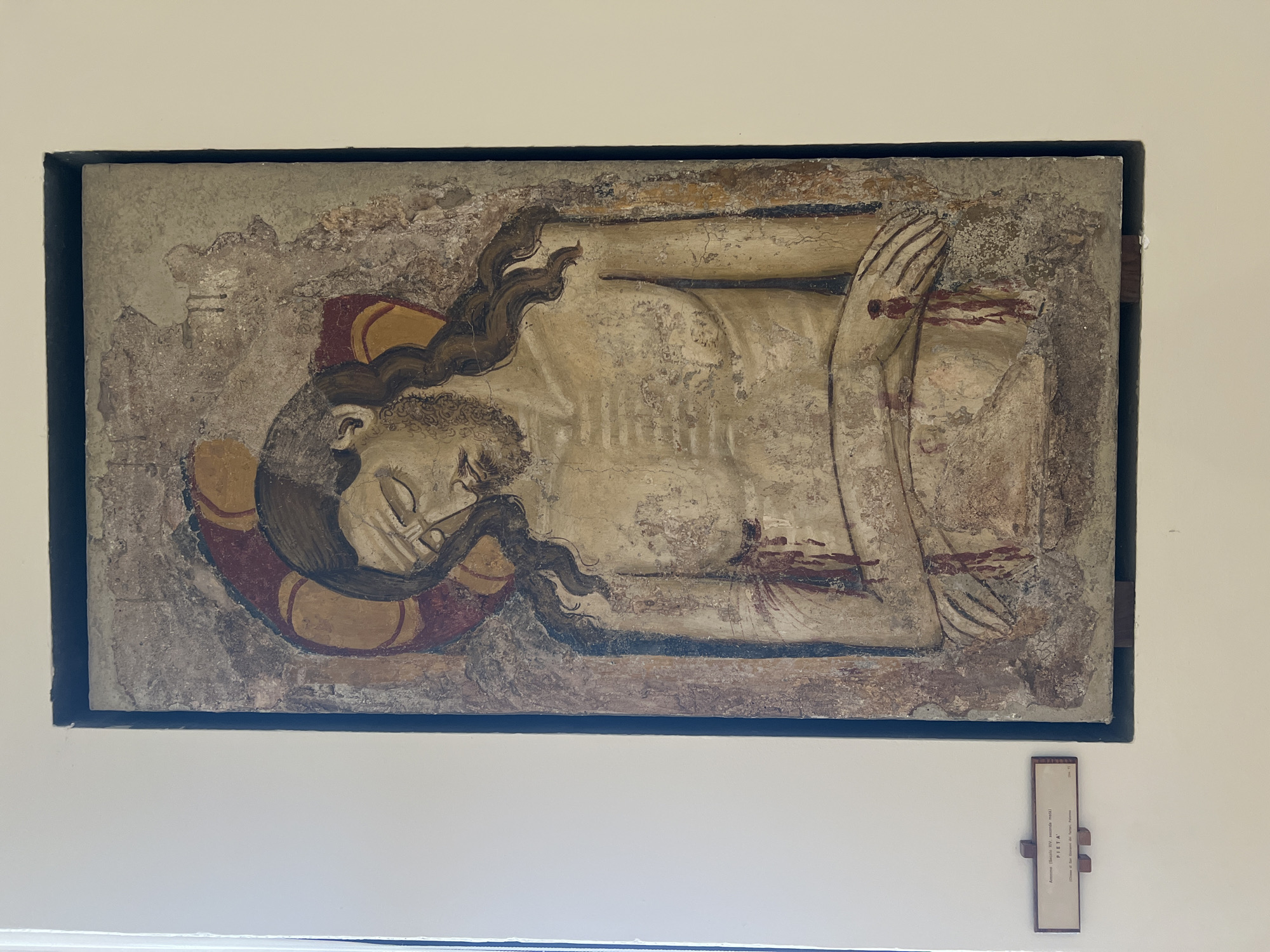
An ancient fresco, framed by a dark border, depicts a figure of Jesus Christ in a state of suffering, likely representing the Pietà. The figure is rendered in muted earth tones, with visible signs of age and deterioration, including cracking and flaking paint. Jesus has long, dark hair and a beard, and his eyes are closed, conveying a sense of sorrow or peace. His body is emaciated, and his chest shows visible ribs. The fresco depicts wounds, with visible red bloodstains on his hands and chest, suggesting crucifixion. His arms are crossed over his torso. Behind his head, a halo is rendered with concentric circles of red and gold. At the top right corner of the fresco, a Roman numeral "II" is visible.

Beneath the fresco, a small wooden plaque with a faded inscription provides contextual information. The inscription reads: "Anonimo (Secolo XIV, seconda metà) PIETA’ (Omonimo di San Giovanni dei Batisti, Palermo) Tav. II". This indicates that the artwork is an anonymous fresco dating from the second half of the 14th century, titled "Pietà." It is noted to be from the "Omonimo di San Giovanni dei Batisti" in Palermo, Sicily, Italy, and is labeled as "Tav. II."
feeeeeeeeeeel

Jun 24, 2026

Palermo, Italy

Stake attention in this memory

sorrowful
solemn
sacred
melancholy
reverent

An ancient fresco, framed by a dark border, depicts a figure of Jesus Christ in a state of suffering, likely representing the Pietà. The figure is rendered in muted earth tones, with visible signs of age and deterioration, including cracking and flaking paint. Jesus has long, dark hair and a beard, and his eyes are closed, conveying a sense of sorrow or peace. His body is emaciated, and his chest shows visible ribs. The fresco depicts wounds, with visible red bloodstains on his hands and chest, suggesting crucifixion. His arms are crossed over his torso. Behind his head, a halo is rendered with concentric circles of red and gold. At the top right corner of the fresco, a Roman numeral "II" is visible. Beneath the fresco, a small wooden plaque with a faded inscription provides contextual information. The inscription reads: "Anonimo (Secolo XIV, seconda metà) PIETA’ (Omonimo di San Giovanni dei Batisti, Palermo) Tav. II". This indicates that the artwork is an anonymous fresco dating from the second half of the 14th century, titled "Pietà." It is noted to be from the "Omonimo di San Giovanni dei Batisti" in Palermo, Sicily, Italy, and is labeled as "Tav. II."

transactions
revenues
stakers
Earliest
Latest
Highest stake

No transactions found

More from this user

More from Palermo

feeeeeeeeeeel

Jun 24, 2026

Palermo, Italy

Licensed under Creative Commons Attribution 4.0 International License. You are free to share and adapt this content with proper attribution.