
Sign in
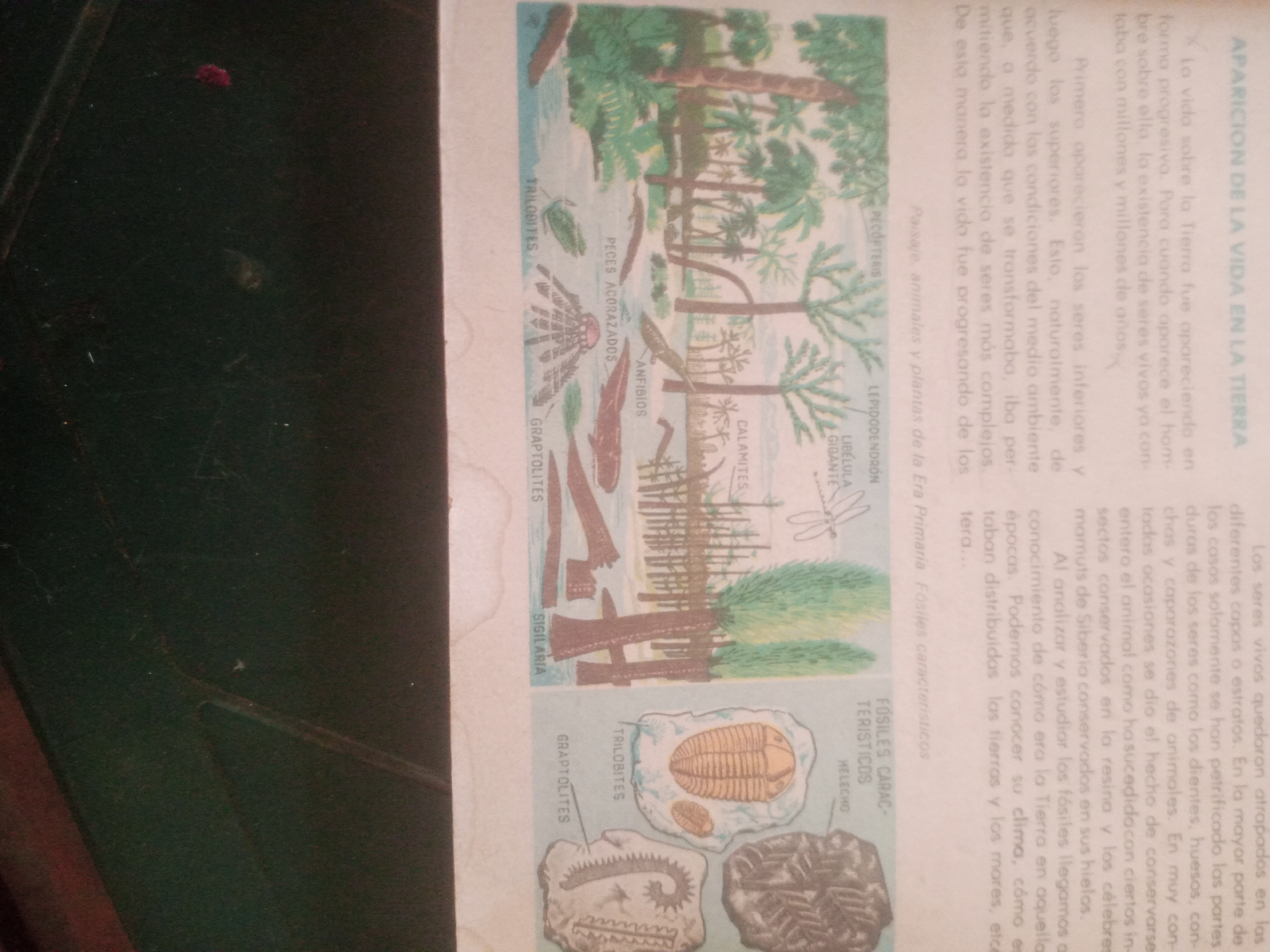
This is an illustration depicting the evolution of life on Earth, as indicated by the Spanish text "APARICION DE LA VIDA EN LA TIERRA" (Appearance of Life on Earth). The scene is divided into two main sections.

The upper section shows a prehistoric landscape with various flora, including ferns, cycads, and towering trees like Lepidodendron and Sigillaria, suggesting a primitive forest environment. Several ancient creatures are labeled, such as "PECES ACORAZADOS" (armored fish), "ANFIBIOS" (amphibians), and "LIBÉLULA GIGANTE" (giant dragonfly), illustrating the progression of life forms. The text explains that life appeared progressively, starting with simpler organisms and evolving into more complex ones as the environment changed. It also mentions the preservation of ancient life forms as fossils, such as petrified bones, shells, insects in resin, and mammoths in ice.

The lower section focuses on fossils. Prominently displayed are fossils of "TRILOBITES" (trilobites), an extinct marine arthropod, and "GRAPTOLITES" (graptolites), another type of extinct marine organism. The text states that by analyzing these fossils, we can understand the Earth's past climate, geography, and seas. The fossils are depicted on rocky surfaces, implying their discovery in geological strata.

The overall tone is educational, aiming to inform about the history of life and the importance of paleontology. The scene is set in a generic prehistoric environment, without specific geographical cues from Santa Ana, Venezuela, unless implied by the context of the original source of the image. There are no people visible in the illustration.
cucha

Jun 23, 2026, 11:16 AM

Santa Ana, Venezuela

Stake attention in this memory

historical
educational
prehistoric
scientific
naturalistic

This is an illustration depicting the evolution of life on Earth, as indicated by the Spanish text "APARICION DE LA VIDA EN LA TIERRA" (Appearance of Life on Earth). The scene is divided into two main sections. The upper section shows a prehistoric landscape with various flora, including ferns, cycads, and towering trees like Lepidodendron and Sigillaria, suggesting a primitive forest environment. Several ancient creatures are labeled, such as "PECES ACORAZADOS" (armored fish), "ANFIBIOS" (amphibians), and "LIBÉLULA GIGANTE" (giant dragonfly), illustrating the progression of life forms. The text explains that life appeared progressively, starting with simpler organisms and evolving into more complex ones as the environment changed. It also mentions the preservation of ancient life forms as fossils, such as petrified bones, shells, insects in resin, and mammoths in ice. The lower section focuses on fossils. Prominently displayed are fossils of "TRILOBITES" (trilobites), an extinct marine arthropod, and "GRAPTOLITES" (graptolites), another type of extinct marine organism. The text states that by analyzing these fossils, we can understand the Earth's past climate, geography, and seas. The fossils are depicted on rocky surfaces, implying their discovery in geological strata. The overall tone is educational, aiming to inform about the history of life and the importance of paleontology. The scene is set in a generic prehistoric environment, without specific geographical cues from Santa Ana, Venezuela, unless implied by the context of the original source of the image. There are no people visible in the illustration.

Loading AttnAds…

transactions
revenues
stakers
Earliest
Latest
Highest stake

No transactions found

More from this user

More from Santa Ana

cucha

Jun 23, 2026, 11:16 AM

Santa Ana, Venezuela

Licensed under Creative Commons Attribution 4.0 International License. You are free to share and adapt this content with proper attribution.