Sign in
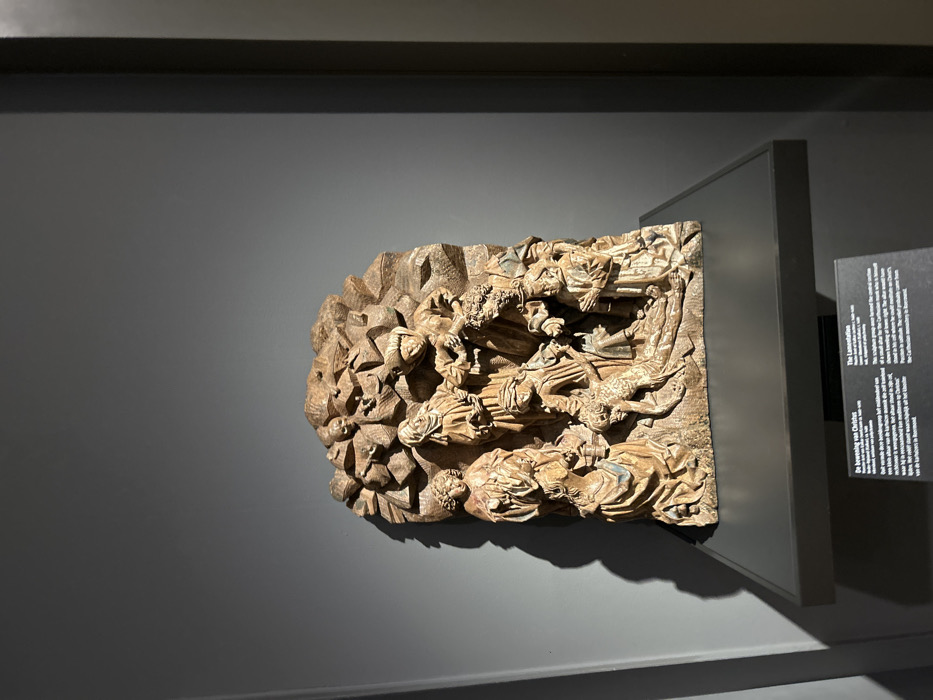
A finely detailed, ornate wooden relief sculpture, identified as "The Lamentation of Christ," is prominently displayed on a plain dark gray wall in what appears to be a museum or gallery. The sculpture is oriented horizontally, depicting a crowded and emotionally charged scene with numerous human figures carved in high relief.

The central activity portrays the biblical event where Christ is taken down from the cross and laid into the arms of his mother, Mary. Figures surrounding them exhibit profound sorrow and grief, with some supporting Christ's body, others mourning, and several actively involved in the deposition. The intricate carving details expressive faces, flowing drapery, and various textures, highlighting the craftsmanship involved. The warm, earthy tones of the wood are accentuated by direct lighting, which also casts a subtle shadow on the wall, emphasizing the sculpture's three-dimensional depth.

To the right of the sculpture, a black information panel with white text provides context. Visible English text explicitly states the work is "The Lamentation" or "The Lamentation of Christ." It further explains that the sculpture was carved by two craftsmen from Brussels, likely from a model by another artist, and formed the central section of a large wooden altarpiece. The panel notes that the relief probably originated from the Carthusian monastery in Brussels, detailing the specific moment depicted as "when Christ is taken down from the cross and laid in the arms of his mother." The Dutch title "De Bewening van Christus" is also visible.
F
FM-uqmbw2

Dec 30, 2024

Amsterdam, Netherlands

Stake attention in this memory

A finely detailed, ornate wooden relief sculpture, identified as "The Lamentation of Christ," is prominently displayed on a plain dark gray wall in what appears to be a museum or gallery. The sculpture is oriented horizontally, depicting a crowded and emotionally charged scene with numerous human figures carved in high relief. The central activity portrays the biblical event where Christ is taken down from the cross and laid into the arms of his mother, Mary. Figures surrounding them exhibit profound sorrow and grief, with some supporting Christ's body, others mourning, and several actively involved in the deposition. The intricate carving details expressive faces, flowing drapery, and various textures, highlighting the craftsmanship involved. The warm, earthy tones of the wood are accentuated by direct lighting, which also casts a subtle shadow on the wall, emphasizing the sculpture's three-dimensional depth. To the right of the sculpture, a black information panel with white text provides context. Visible English text explicitly states the work is "The Lamentation" or "The Lamentation of Christ." It further explains that the sculpture was carved by two craftsmen from Brussels, likely from a model by another artist, and formed the central section of a large wooden altarpiece. The panel notes that the relief probably originated from the Carthusian monastery in Brussels, detailing the specific moment depicted as "when Christ is taken down from the cross and laid in the arms of his mother." The Dutch title "De Bewening van Christus" is also visible.

transactions
revenues
stakers
Earliest
Latest
Highest stake

No transactions found

More from this user

More from Amsterdam

FFM-uqmbw2

Dec 30, 2024

Amsterdam, Netherlands

Licensed under Creative Commons Attribution 4.0 International License. You are free to share and adapt this content with proper attribution.