Stake attention in this memory
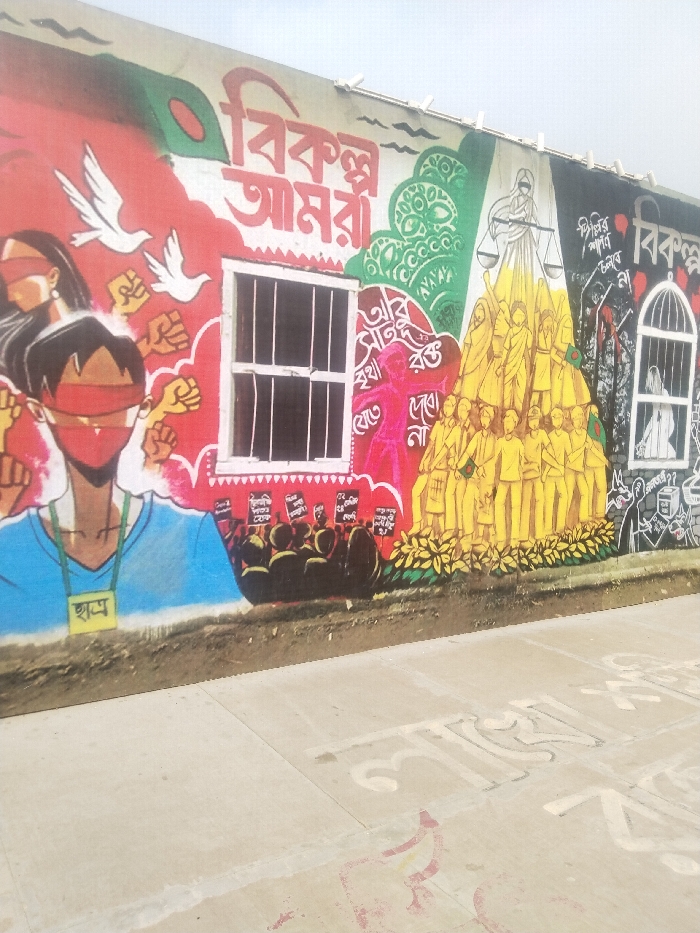
This image captures a vibrant and politically charged mural painted on a wall in Purbacahal, Bangladesh, likely depicting themes of protest, justice, and democratic rights. The sky is visible at the top, and a paved ground area with faint white and red text runs along the bottom. The mural is divided into distinct sections. On the far left, a prominent figure, possibly a student, is depicted with a red blindfold covering their eyes and mouth, wearing a blue shirt with a badge that reads "ছাত্র" (Chatro, meaning "Student"). Behind this figure, another individual with a blindfold and raised fists is shown, alongside two white doves symbolizing peace. Below this, a group of protestors with placards is visible. Some placards clearly display Bengali text such as "ভোট চুরি" (Vot Churi, "Vote theft/rigging"), "আমার ভোট আমি দেব" (Amar Vot Ami Debo, "I will cast my vote myself"), "গণতন্ত্র মুক্তি পাক" (Gonotontro Mukti Pak, "Let democracy be freed"), and "বাকস্বাধীনতা চাই" (Bakshadhinota Chai, "We want freedom of speech"). A white-framed window is painted within this section. The central part of the mural features a large golden-yellow mass of people, some holding small Bangladeshi flags, symbolizing unity and national identity. Above them, a blindfolded Lady Justice figure balances scales, representing impartiality and the pursuit of justice. To the left of this central group, a pink human-like figure is depicted with text that includes "আর সইব না" (Ar Soibo Na, "Will not tolerate anymore") and possibly "রক্ত দেবো না" (Rokto Debo Na, "Will not shed blood"). Green decorative patterns are visible at the top of this section. The rightmost section of the mural is predominantly dark. It shows a figure, possibly a woman, trapped within a white cage, symbolizing oppression or imprisonment. Text in this section includes "বিচার চাই" (Bichar Chai, "We want justice") and "বিকল্প নেই" (Bikalpo Nei, "No alternative"), as well as the word "বিকল্প" (Bikalpo, "Alternative"). The top part of the wall prominently displays the Bengali phrase "বিকল্প আমরা" (Bikalpo Amra), meaning "We are the alternative," likely the overarching message of the mural. The overall scene strongly suggests a call for social and political change, highlighting issues such as electoral integrity, freedom of speech, justice, and human rights through powerful visual metaphors and direct textual messages. The weather appears bright, likely daytime.
Loading AttnAds…
No transactions found