
Stake attention in this memory
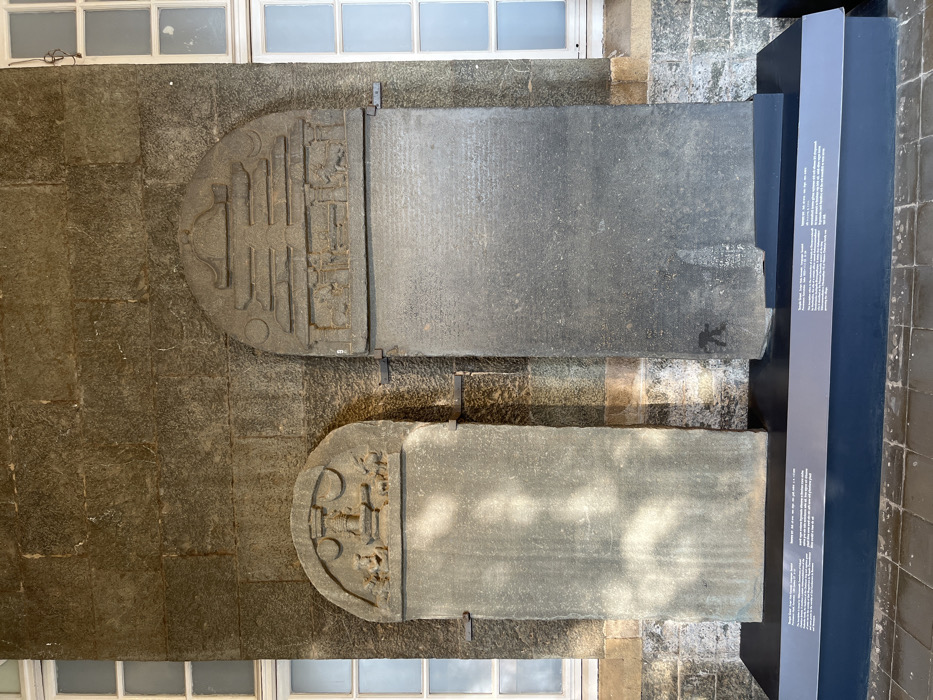
Two large, ancient stone steles are displayed upright against a textured stone wall in what appears to be a museum or historical building in Mumbai, India. The image is taken indoors, with natural daylight filtering through large windows visible in the background, casting reflections and shadows on the exhibits. Each stele is primarily rectangular with a semi-circular top. Both are crafted from dark grey stone. The semi-circular tops feature intricate, raised carvings that appear symbolic or decorative, showcasing various patterns and possibly stylized figures. Below these carvings, the rectangular bodies of both steles are extensively covered with lines of carved text. The script is ancient, distinct, and visible despite some wear, suggesting a significant historical record. The steles are mounted to the wall with several dark metal brackets. To the right of the steles, a dark-colored display stand provides contextual information. Visible text on this stand, primarily in white, identifies the exhibit. Headings include "PALEOGRAPHICAL CHART," "INSCRIPTION," and "TRANSLATION." The descriptive text explains that "The two panels display two important stone inscriptions of the local Christian community in Goa, written in Grantha and Vatteluttu scripts. They were found in churches at Old Goa and are preserved here for their historical and cultural significance. The first Panel is dated Saka 1599 (1677 AD) and the second Panel is dated Saka 1610 (1688 AD). These are the earliest known stone inscriptions of the local Christian community found in Goa." The scene captures a historical exhibit, presenting significant epigraphic artifacts from Old Goa, thoughtfully displayed for public viewing and study.
No transactions found