Stake attention in this memory
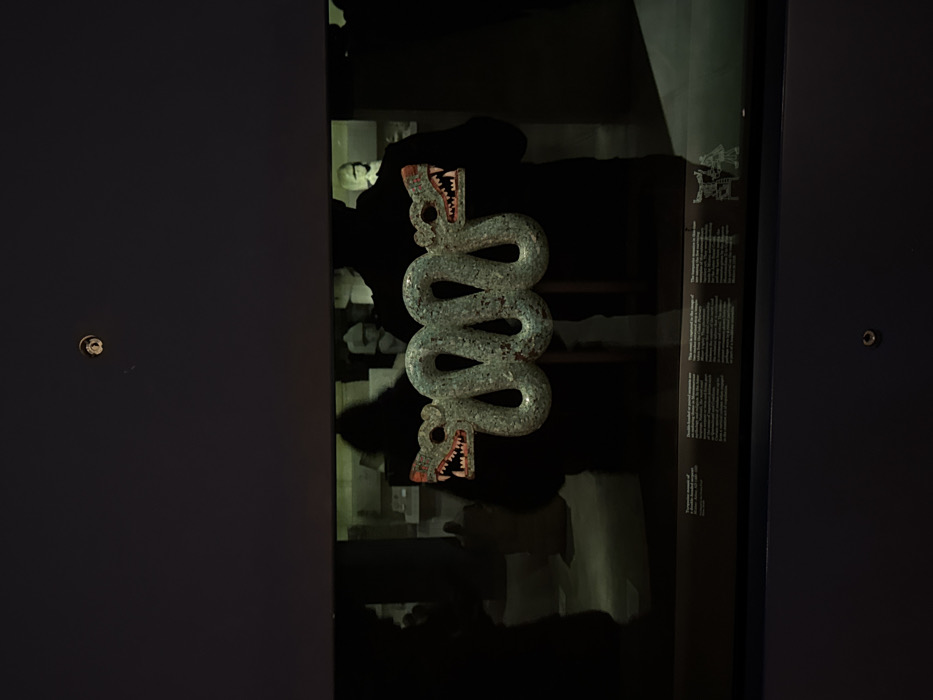
The image displays a double-headed serpent sculpture, an ancient artifact, presented vertically within a dimly lit museum display case. The serpent's body is coiled and appears to be fashioned from a mosaic of small, greenish-blue tesserae, likely turquoise or jade. It features two distinct heads, one at the top and one at the bottom, each with an open mouth revealing reddish features and white teeth. The sculpture is the central focus, illuminated against a dark background, suggesting a specialized exhibit. Reflections are visible on the glass of the display case, indicating the presence of a viewer and the surrounding environment, which also appears dark. On the left side of the image is a solid, dark, featureless panel or wall, with a small brass-colored fitting (possibly a screw or lock) visible. On the right side of the display case, an information panel provides details about the artifact. Despite the low light and slight blur, some text is legible. It identifies the object as a "Double-headed serpent," notes its origin as "Mixtec or Aztec," and specifies it was "Made in Mexico." The materials are listed as a "mosaic of turquoise" with "wood, shell, conus, spondylus," and its creation date as "c. 1400-1521 AD." The panel also details its acquisition: "Purchased by H. Christy from E. Guillemin in Paris, 1860," and "Presented to the British Museum by H. Christy's trustees, 1869." A "British Museum" logo is visible at the top of the panel, confirming the location in London, United Kingdom. The overall lighting creates a somber, reverent atmosphere, highlighting the historical significance of the artifact. The original photograph appears to have been taken in landscape orientation and subsequently rotated 90 degrees clockwise, placing the coiled serpent in a vertical position in the frame.
Loading AttnAds…
No transactions found