
Sign in
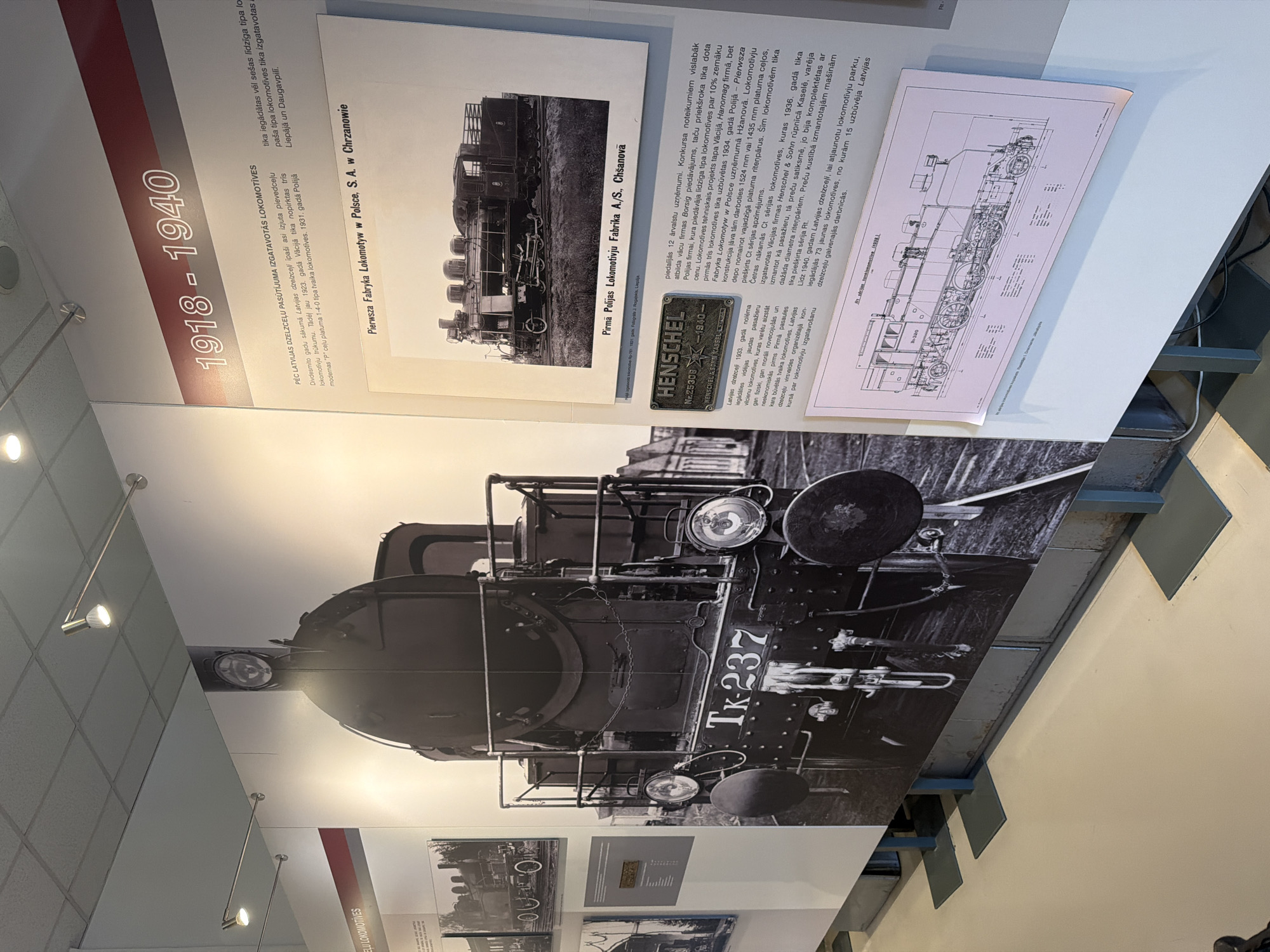
This media file captures an exhibition display in Riga, Latvia, focusing on the history of locomotives between 1918 and 1940. The main subject is a large, black and white photograph of a steam locomotive, prominently featuring the number "TK-237" on its front.

Surrounding the central image are several information panels with text in Latvian and Polish, smaller historical photographs, a technical drawing, and a metal plaque. The large title banner at the top left reads "1918-1940". One panel, titled "PÉC LATVIJAS DZELZCEĻU PASŪTĪJUMA IZGATAVOTAS LOKOMOTIVES" (Locomotives Manufactured by Order of Latvian Railways), describes the Latvian railway's need for locomotives in the 1920s, mentioning purchases from Germany in 1923 and Poland in 1931, and manufacturing in Liepāja and Daugavpils. It also names "Pierwsza Fabryka Lokomotyw w Polsce, S. A. w Chrzanowie" (First Locomotive Factory in Poland, S. A. in Chrzanów).

Another panel details the acquisition of medium-power passenger locomotives in 1933, noting a competition involving 12 foreign companies. It states that German firm Hanomag designed the technical project, and the first three locomotives were built in 1934 in Chrzanów, Poland. These "Ct series" locomotives could operate on different track gauges. Four subsequent Ct series locomotives were built in 1936 by Henschel & Sohn in Kassel, designated as "Rt series" for freight. By 1940, Latvian railways had acquired 73 new locomotives, 15 of which were built in Latvian railway workshops.

A small metal plaque displays "HENSCHEL", "Nr.25308 -1940-", and "HENSCHEL & SOHN KASSEL". A technical schematic is labeled "At sērijas tvaika lokomotive (1938)" (At series steam locomotive (1938)). The lighting suggests an indoor setting, typical of a museum.
Natali

Jun 3, 2026

Riga, Latvia

Stake attention in this memory

nostalgia
historical
educational
industrial
discovery

This media file captures an exhibition display in Riga, Latvia, focusing on the history of locomotives between 1918 and 1940. The main subject is a large, black and white photograph of a steam locomotive, prominently featuring the number "TK-237" on its front. Surrounding the central image are several information panels with text in Latvian and Polish, smaller historical photographs, a technical drawing, and a metal plaque. The large title banner at the top left reads "1918-1940". One panel, titled "PÉC LATVIJAS DZELZCEĻU PASŪTĪJUMA IZGATAVOTAS LOKOMOTIVES" (Locomotives Manufactured by Order of Latvian Railways), describes the Latvian railway's need for locomotives in the 1920s, mentioning purchases from Germany in 1923 and Poland in 1931, and manufacturing in Liepāja and Daugavpils. It also names "Pierwsza Fabryka Lokomotyw w Polsce, S. A. w Chrzanowie" (First Locomotive Factory in Poland, S. A. in Chrzanów). Another panel details the acquisition of medium-power passenger locomotives in 1933, noting a competition involving 12 foreign companies. It states that German firm Hanomag designed the technical project, and the first three locomotives were built in 1934 in Chrzanów, Poland. These "Ct series" locomotives could operate on different track gauges. Four subsequent Ct series locomotives were built in 1936 by Henschel & Sohn in Kassel, designated as "Rt series" for freight. By 1940, Latvian railways had acquired 73 new locomotives, 15 of which were built in Latvian railway workshops. A small metal plaque displays "HENSCHEL", "Nr.25308 -1940-", and "HENSCHEL & SOHN KASSEL". A technical schematic is labeled "At sērijas tvaika lokomotive (1938)" (At series steam locomotive (1938)). The lighting suggests an indoor setting, typical of a museum.

transactions
revenues
stakers
Earliest
Latest
Highest stake

No transactions found

More from this user

More from Riga

Natali

Jun 3, 2026

Riga, Latvia

Licensed under Creative Commons Attribution 4.0 International License. You are free to share and adapt this content with proper attribution.