
Sign in
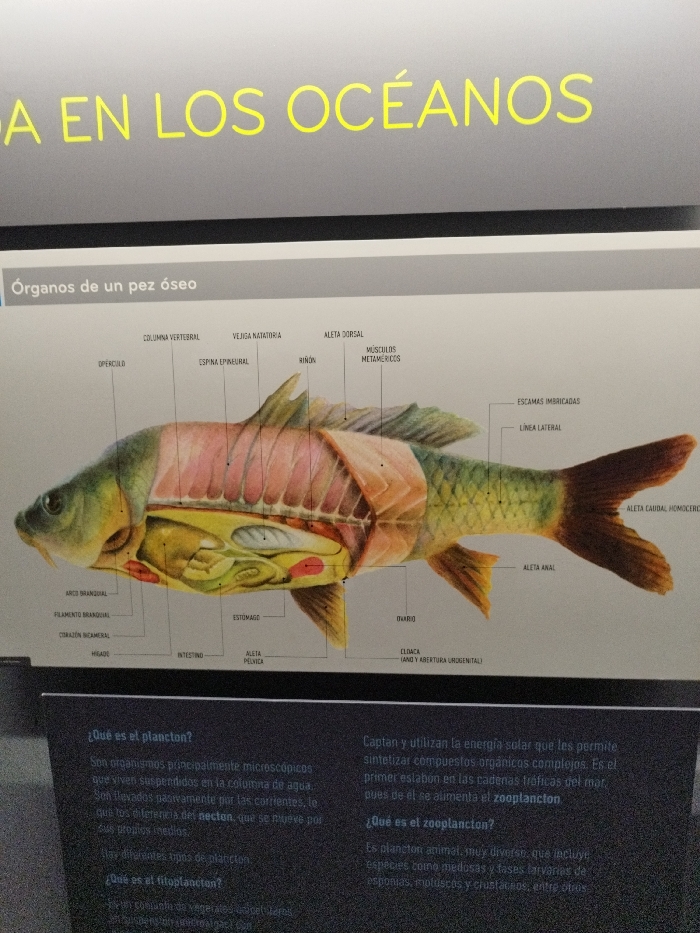
An informational display board, likely from a museum or educational exhibit in Santiago, Chile, showcases biological concepts. The top banner features part of a title in bright yellow letters on a gray background, reading "A EN LOS OCÉANOS" (likely part of "LA VIDA EN LOS OCÉANOS" - Life in the Oceans).

The main section of the display is an anatomical illustration of a bony fish ("Órganos de un pez óseo"). The image is a detailed cross-section, revealing internal organs and external features. Labeled parts include the "columna vertebral" (vertebral column), "vejiga natatoria" (swim bladder), "riñón" (kidney), "corazón bicameral" (two-chambered heart), "estómago" (stomach), and "intestino". External features like the "aleta dorsal" (dorsal fin), "aleta caudal homocerca" (homocercal caudal fin), "línea lateral" (lateral line), "escamas imbricadas" (imbricated scales), and "opérculo" are also indicated.

Below the fish illustration, there are sections of text in Spanish providing information about plankton. One section asks "¿Qué es el plancton?" (What is plankton?) and defines them as microscopic organisms suspended in water, passively carried by currents, distinguishing them from nekton. Another section, "¿Qué es el fitoplancton?", explains that these organisms use solar energy to synthesize organic compounds, forming the base of marine food chains by feeding zooplankton. A third section, "¿Qué es el zooplancton?", describes it as diverse animal plankton, including jellyfish and larval stages of sponges, mollusks, and crustaceans. The text is printed in white on a dark gray background.
Mrv

Jan 7, 2025

Santiago, Chile

Stake attention in this memory

An informational display board, likely from a museum or educational exhibit in Santiago, Chile, showcases biological concepts. The top banner features part of a title in bright yellow letters on a gray background, reading "A EN LOS OCÉANOS" (likely part of "LA VIDA EN LOS OCÉANOS" - Life in the Oceans). The main section of the display is an anatomical illustration of a bony fish ("Órganos de un pez óseo"). The image is a detailed cross-section, revealing internal organs and external features. Labeled parts include the "columna vertebral" (vertebral column), "vejiga natatoria" (swim bladder), "riñón" (kidney), "corazón bicameral" (two-chambered heart), "estómago" (stomach), and "intestino". External features like the "aleta dorsal" (dorsal fin), "aleta caudal homocerca" (homocercal caudal fin), "línea lateral" (lateral line), "escamas imbricadas" (imbricated scales), and "opérculo" are also indicated. Below the fish illustration, there are sections of text in Spanish providing information about plankton. One section asks "¿Qué es el plancton?" (What is plankton?) and defines them as microscopic organisms suspended in water, passively carried by currents, distinguishing them from nekton. Another section, "¿Qué es el fitoplancton?", explains that these organisms use solar energy to synthesize organic compounds, forming the base of marine food chains by feeding zooplankton. A third section, "¿Qué es el zooplancton?", describes it as diverse animal plankton, including jellyfish and larval stages of sponges, mollusks, and crustaceans. The text is printed in white on a dark gray background.

transactions
revenues
stakers
Earliest
Latest
Highest stake

No transactions found

More from this user

More from Santiago

Mrv

Jan 7, 2025

Santiago, Chile

Licensed under Creative Commons Attribution 4.0 International License. You are free to share and adapt this content with proper attribution.