Sign in
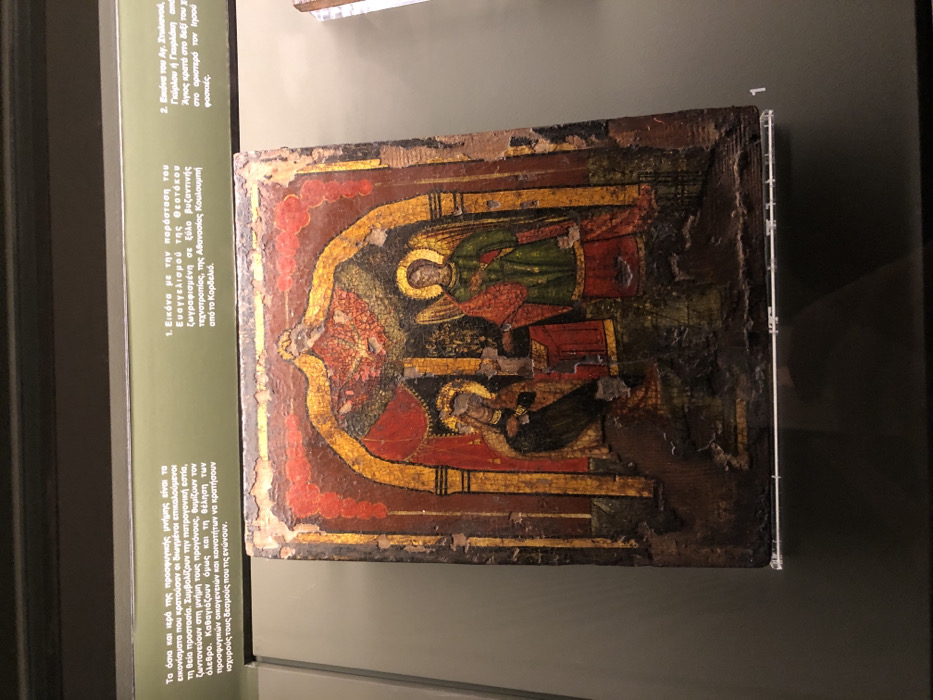
This media file features an ancient, weathered religious icon, displayed upright in what appears to be a museum or exhibition in Nea Filadelfia, Greece. The icon is severely damaged, with significant paint loss and exposed wood, particularly along its edges and in the darker areas.

The icon depicts the Annunciation, a pivotal event in Christian theology. The central figures are the Archangel Gabriel on the right, shown with wings and a halo, wearing a green tunic and a red robe. He holds an object, possibly a staff or lily, commonly associated with the Annunciation. Opposite him, on the left, sits the Virgin Mary, also with a halo, dressed in a dark garment, in a posture of humility or prayer. Above the angel, a divine figure, likely representing God the Father or the Holy Spirit, is depicted as an older, bearded man within a radiant halo, surrounded by red and gold clouds, signifying the divine presence. The background of the painting suggests architectural elements through gold and red lines, now largely obscured by wear.

The icon is mounted in a clear display case, with reflections visible on the surface. To the left of the icon, a text panel in Greek provides context. The visible text describes icons as sacred objects of refugee memory, cherished by displaced people seeking divine protection. It notes that icons symbolize ancestral homes, preserve memories, and remind of hardships, yet also sanctify the will of refugee communities to maintain their bonds. One part of the text explicitly states: "1. Icon with the depiction of the Annunciation of the Theotokos..." and also mentions "from Kordelio." Another partial entry for "2. Icon of St. Stylianos" is visible but refers to a different artwork not fully in frame. The overall condition and display suggest a historical artifact of significant cultural and religious value.
FM-nSho83

Jan 10, 2025

Nea Filadelfia, Greece

Stake attention in this memory

This media file features an ancient, weathered religious icon, displayed upright in what appears to be a museum or exhibition in Nea Filadelfia, Greece. The icon is severely damaged, with significant paint loss and exposed wood, particularly along its edges and in the darker areas. The icon depicts the Annunciation, a pivotal event in Christian theology. The central figures are the Archangel Gabriel on the right, shown with wings and a halo, wearing a green tunic and a red robe. He holds an object, possibly a staff or lily, commonly associated with the Annunciation. Opposite him, on the left, sits the Virgin Mary, also with a halo, dressed in a dark garment, in a posture of humility or prayer. Above the angel, a divine figure, likely representing God the Father or the Holy Spirit, is depicted as an older, bearded man within a radiant halo, surrounded by red and gold clouds, signifying the divine presence. The background of the painting suggests architectural elements through gold and red lines, now largely obscured by wear. The icon is mounted in a clear display case, with reflections visible on the surface. To the left of the icon, a text panel in Greek provides context. The visible text describes icons as sacred objects of refugee memory, cherished by displaced people seeking divine protection. It notes that icons symbolize ancestral homes, preserve memories, and remind of hardships, yet also sanctify the will of refugee communities to maintain their bonds. One part of the text explicitly states: "1. Icon with the depiction of the Annunciation of the Theotokos..." and also mentions "from Kordelio." Another partial entry for "2. Icon of St. Stylianos" is visible but refers to a different artwork not fully in frame. The overall condition and display suggest a historical artifact of significant cultural and religious value.

transactions
revenues
stakers
Earliest
Latest
Highest stake

No transactions found

More from this user

More from Nea Filadelfia

FM-nSho83

Jan 10, 2025

Nea Filadelfia, Greece

Licensed under Creative Commons Attribution 4.0 International License. You are free to share and adapt this content with proper attribution.