Stake attention in this memory
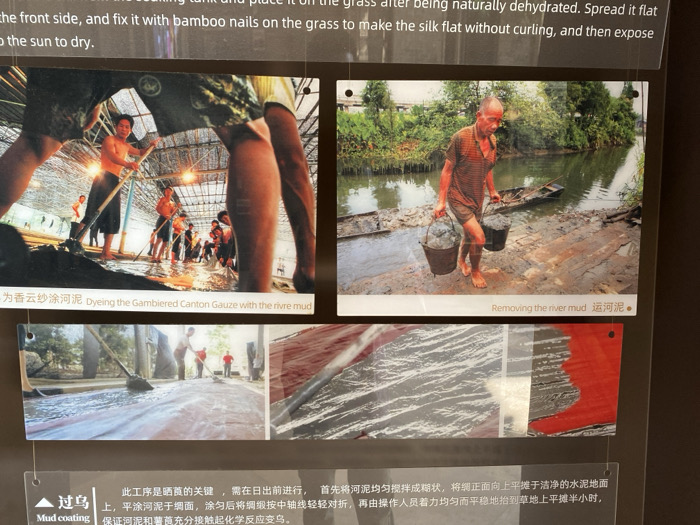
The image captures a display featuring several photographs and explanatory text about a traditional fabric dyeing process, likely Gambiered Canton Gauze, conducted in Guang Zhou Shi, China. The top-left photograph shows several bare-chested men working inside a large, brightly lit shed with an exposed beam structure. They are seen manually applying a dark, thick mud-like substance onto a large fabric sheet laid on a muddy floor, using long poles or shovels. This scene is identified as "Dyeing the Gambiered Canton Gauze with the river mud." Adjacent to it, the top-right photo depicts an older, bare-chested man, covered in mud and red dye, emerging from a muddy riverbank while carrying two heavy buckets filled with mud. A small, dark wooden boat is partially visible in the river behind him, which is lined with green foliage. This activity is labeled "Removing the river mud." Below, a series of images detail the "Mud coating" (过乌) stage. One photo shows multiple individuals spreading a large sheet of fabric on a clean concrete surface, applying the mud evenly. A close-up image next to it illustrates the textured appearance of the dark mud on the fabric, which appears to be a reddish-brown color in areas where the mud is thinner or removed. Accompanying text further explains the process: the fabric is spread flat, fixed with bamboo nails on grass to dry in the sun after natural dehydration. The mud coating step is crucial and must be done before sunrise; river mud is stirred into a paste, spread evenly on the silk's front side on a clean concrete surface, then the silk is gently folded and moved to grass for half an hour to ensure chemical reactions. The display highlights the manual, labor-intensive nature of this traditional craft.
Loading AttnAds…
No transactions found