
Stake attention in this memory
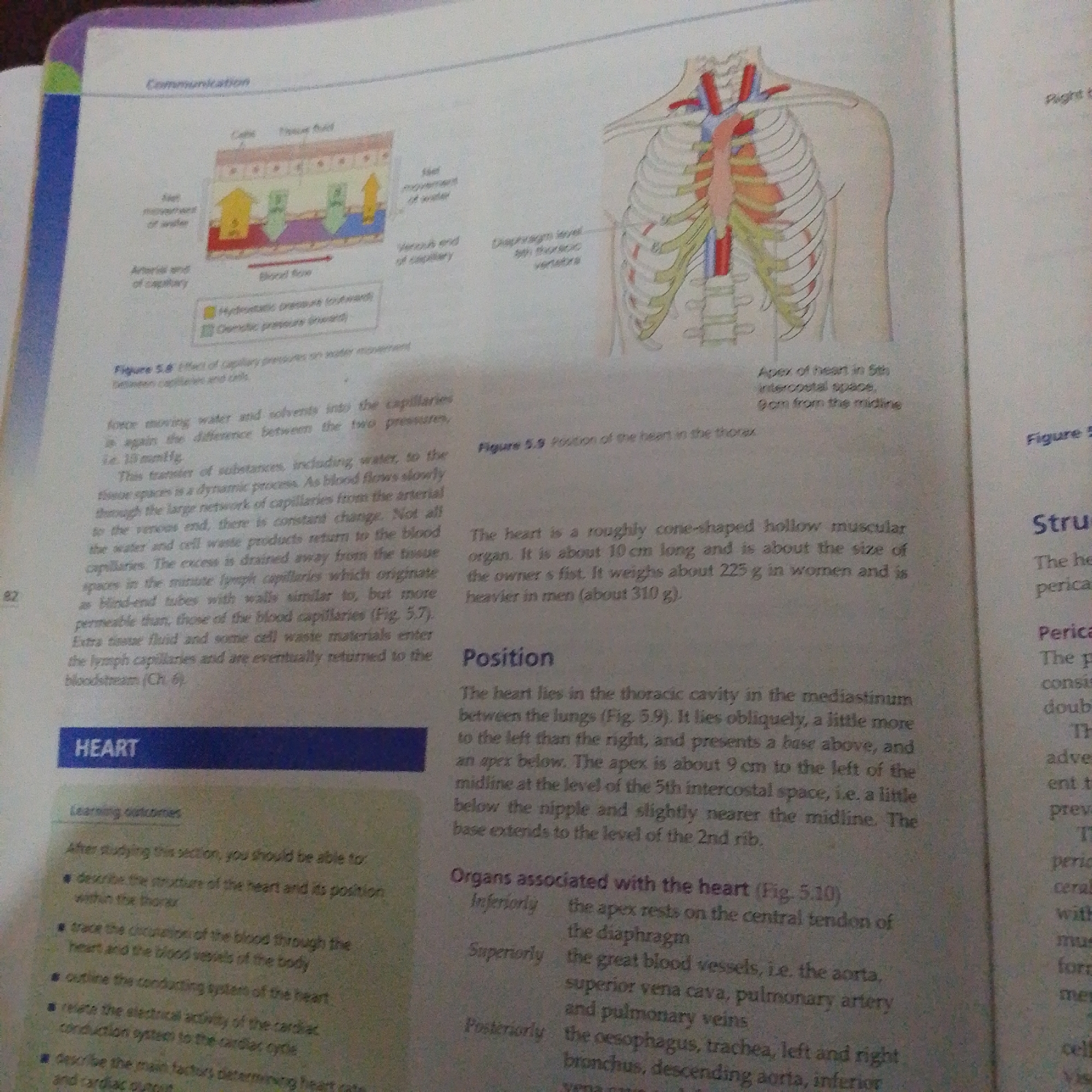
The image is a page from a biology textbook, likely discussing the human circulatory system and the heart. **Subjects:** The primary subjects are anatomical illustrations of the human torso and heart, along with diagrams illustrating the movement of fluids in capillaries. There are no people visible. **Objects:** The objects are medical illustrations and diagrams. Key elements include a diagram of the rib cage with the heart positioned within it, a detailed illustration of the heart's position relative to the thoracic vertebrae and diaphragm, and a schematic showing the exchange of fluids (water and solutes) between blood capillaries and tissue fluid. There are also labels and captions associated with these illustrations. **Scene/Setting:** The setting is the interior of a biology textbook. The layout suggests a typical educational resource with text, figures, and captions. **Activity or Event:** The "activity" is educational, aiming to convey information about the heart's structure, position, and the dynamics of capillary exchange. The illustrations and text are designed to explain complex biological processes. **Notable Details:** * **Time of day/Weather:** Not applicable, as this is an illustration. * **Location Cues:** The text mentions anatomical locations like "thoracic cavity," "mediastinum," "intercostal space," and "diaphragm," indicating a focus on human anatomy. Specific measurements like "9 cm from the midline" are given. * **Emotions:** Not applicable. **Visible Text:** A significant amount of text is visible, including headings like "Communication," "HEART," "Learning outcomes," "Position," and "Organs associated with the heart." There are also figure captions such as "Figure 5.8 Effect of capillary pressures on water movement between capillaries and cells" and "Figure 5.9 Position of the heart in the thorax." The descriptive text explains the functions of capillaries and the location and characteristics of the heart.
Loading AttnAds…
No transactions found