
Sign in
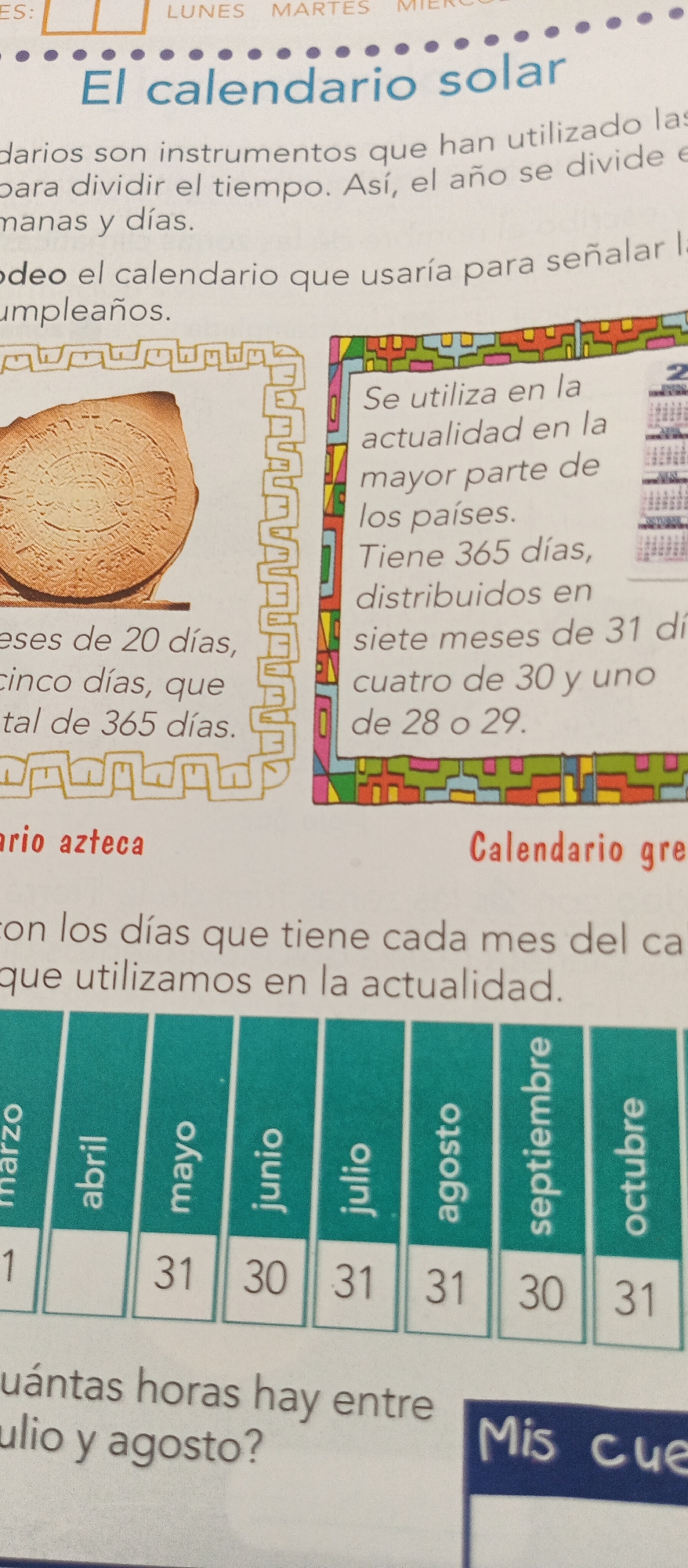
This media file shows a close-up of a page from a Spanish-language educational book. The page focuses on calendars.

The main subjects are text and illustrations related to calendars. The top section features the title "El calendario solar" (The solar calendar) in large blue lettering. Below this, there is descriptive text explaining what calendars are used for, mentioning that they help divide time into years, weeks, and days. An illustration of what appears to be an Aztec calendar stone is visible on the left.

To the right, there is a section titled "Se utiliza en la actualidad en la mayor parte de los países" (It is used today in most countries), which describes the Gregorian calendar, stating it has 365 days distributed among seven months of 31 days, four months of 30 days, and one month of 28 or 29 days.

The bottom portion of the page displays a grid of months and their corresponding number of days, presented vertically. The months visible are "Marzo" (March), "Abril" (April), "Mayo" (May), "Junio" (June), "Julio" (July), "Agosto" (August), "Septiembre" (September), and "Octubre" (October), with their respective day counts (31, 30, 31, 30, 31, 31, 30, 31). Below this grid, there is a question in Spanish: "Cuántas horas hay entre julio y agosto?" (How many hours are there between July and August?).

On the far right, a blue box with white text reads "Mis cue", suggesting the start of another section or activity. The overall scene is that of a typical textbook page, with clear, colorful illustrations and legible text, aimed at a young audience learning about time and calendars. There are no people, specific time of day, weather, or location cues beyond what is implied by the book's subject matter.
Ramón

Jun 23, 2026, 1:15 PM

La Tagua, Venezuela

Stake attention in this memory

educational
informative
curious
historical
practical

This media file shows a close-up of a page from a Spanish-language educational book. The page focuses on calendars. The main subjects are text and illustrations related to calendars. The top section features the title "El calendario solar" (The solar calendar) in large blue lettering. Below this, there is descriptive text explaining what calendars are used for, mentioning that they help divide time into years, weeks, and days. An illustration of what appears to be an Aztec calendar stone is visible on the left. To the right, there is a section titled "Se utiliza en la actualidad en la mayor parte de los países" (It is used today in most countries), which describes the Gregorian calendar, stating it has 365 days distributed among seven months of 31 days, four months of 30 days, and one month of 28 or 29 days. The bottom portion of the page displays a grid of months and their corresponding number of days, presented vertically. The months visible are "Marzo" (March), "Abril" (April), "Mayo" (May), "Junio" (June), "Julio" (July), "Agosto" (August), "Septiembre" (September), and "Octubre" (October), with their respective day counts (31, 30, 31, 30, 31, 31, 30, 31). Below this grid, there is a question in Spanish: "Cuántas horas hay entre julio y agosto?" (How many hours are there between July and August?). On the far right, a blue box with white text reads "Mis cue", suggesting the start of another section or activity. The overall scene is that of a typical textbook page, with clear, colorful illustrations and legible text, aimed at a young audience learning about time and calendars. There are no people, specific time of day, weather, or location cues beyond what is implied by the book's subject matter.

Loading AttnAds…

transactions
revenues
stakers
Earliest
Latest
Highest stake

No transactions found

More from this user

More from La Tagua

Ramón

Jun 23, 2026, 1:15 PM

La Tagua, Venezuela

Licensed under Creative Commons Attribution 4.0 International License. You are free to share and adapt this content with proper attribution.