
Sign in
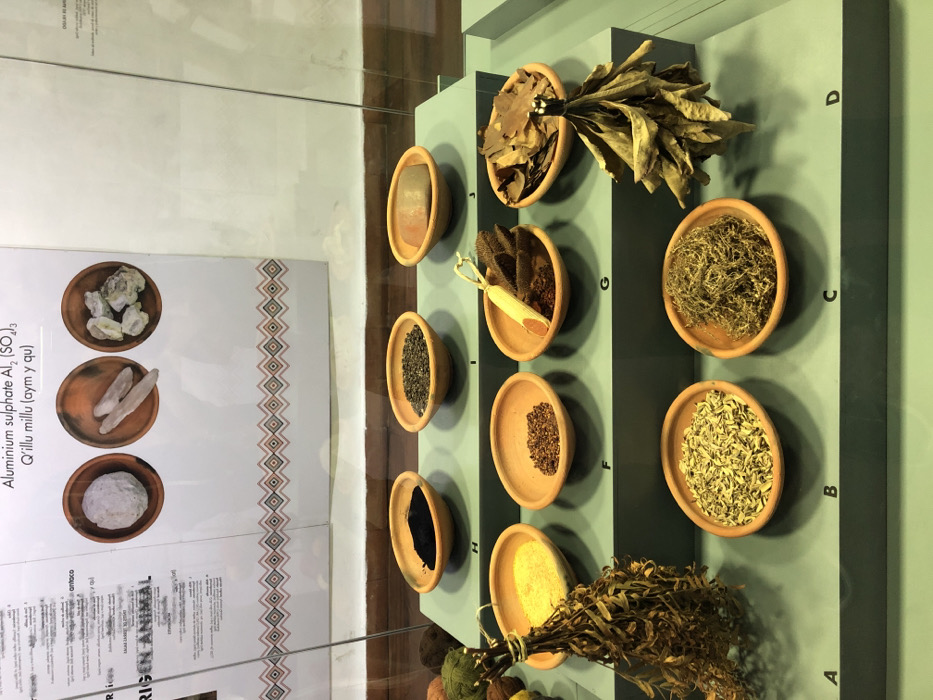
This image captures an indoor museum or exhibition display, likely showcasing natural materials used in traditional practices. The main part of the display features a stepped or tiered surface, possibly dark green or grey, on which numerous small, shallow terracotta bowls are arranged.

The bowls on the rightmost column contain various dried plant materials: the top bowl (labeled 'D') holds what appears to be dried leaves, possibly coca leaves, with a bundle of larger dried leaves; below it (labeled 'C') is a bowl of fine, dried fibrous plant material; the next (labeled 'B') contains light-colored dried seeds or small leaves; and the bottom bowl (labeled 'A') holds a yellow powdery substance, possibly a pigment or spice, accompanied by a bundle of dried leafy branches.

In the adjacent column to the left, also on the green-grey display, are more bowls. One bowl (labeled 'G') contains dark, coarse fibrous material with a light-colored wooden tool. Below it (labeled 'F') is a bowl with small, reddish-brown granules or seeds. Another bowl (labeled 'E') holds a black powdery substance.

On a white panel to the left, which also features a geometric border pattern, three more terracotta bowls are displayed. The top bowl contains irregular, light-colored crystalline rock pieces. The middle bowl holds two elongated, translucent crystal-like pieces. The bottom bowl contains a white, powdery or clay-like substance shaped into a ball.

Visible text on the white panel includes "Aluminium sulphate Al₂(SO₄)₃" and "Q'illu millu (aym y qu)", indicating the indigenous Aymara and Quechua names for the substance, consistent with the location context of La Paz, Bolivia. Other partial texts like "RIGEN", "antaco", and "ORIGIN ANIMAL" are also visible. Labels A, B, C, D, E, F, G, H are used to identify items on the stepped display.

The overall scene suggests an educational exhibit focused on indigenous resources, likely for dyeing, medicinal purposes, or crafts, highlighting local natural heritage. No people are visible, and the display is static.
MNela

Jan 9, 2025, 7:49 PM

La Paz, Bolivia

Stake attention in this memory

This image captures an indoor museum or exhibition display, likely showcasing natural materials used in traditional practices. The main part of the display features a stepped or tiered surface, possibly dark green or grey, on which numerous small, shallow terracotta bowls are arranged. The bowls on the rightmost column contain various dried plant materials: the top bowl (labeled 'D') holds what appears to be dried leaves, possibly coca leaves, with a bundle of larger dried leaves; below it (labeled 'C') is a bowl of fine, dried fibrous plant material; the next (labeled 'B') contains light-colored dried seeds or small leaves; and the bottom bowl (labeled 'A') holds a yellow powdery substance, possibly a pigment or spice, accompanied by a bundle of dried leafy branches. In the adjacent column to the left, also on the green-grey display, are more bowls. One bowl (labeled 'G') contains dark, coarse fibrous material with a light-colored wooden tool. Below it (labeled 'F') is a bowl with small, reddish-brown granules or seeds. Another bowl (labeled 'E') holds a black powdery substance. On a white panel to the left, which also features a geometric border pattern, three more terracotta bowls are displayed. The top bowl contains irregular, light-colored crystalline rock pieces. The middle bowl holds two elongated, translucent crystal-like pieces. The bottom bowl contains a white, powdery or clay-like substance shaped into a ball. Visible text on the white panel includes "Aluminium sulphate Al₂(SO₄)₃" and "Q'illu millu (aym y qu)", indicating the indigenous Aymara and Quechua names for the substance, consistent with the location context of La Paz, Bolivia. Other partial texts like "RIGEN", "antaco", and "ORIGIN ANIMAL" are also visible. Labels A, B, C, D, E, F, G, H are used to identify items on the stepped display. The overall scene suggests an educational exhibit focused on indigenous resources, likely for dyeing, medicinal purposes, or crafts, highlighting local natural heritage. No people are visible, and the display is static.

Loading AttnAds…

transactions
revenues
stakers
Earliest
Latest
Highest stake

No transactions found

More from this user

More from La Paz

MNela

Jan 9, 2025, 7:49 PM

La Paz, Bolivia

Licensed under Creative Commons Attribution 4.0 International License. You are free to share and adapt this content with proper attribution.