Sign in
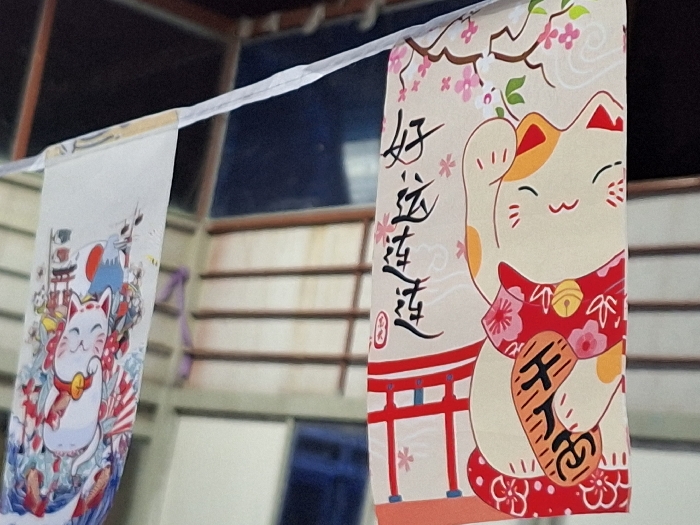
The image displays two decorative fabric banners, or small flags, hanging from a thin, light-colored string. The scene appears to be set indoors or within a covered outdoor area, possibly a corridor or veranda, with dark rectangular openings and structural beams forming the background.

The banner on the right features a prominent Maneki-neko (beckoning cat) with its right paw raised. The cat is predominantly white and orange, wearing a red collar with a bell and a red garment adorned with pink flowers. It holds a gold coin. Cherry blossoms and a red torii gate structure are visible in the background of this banner. The banner on the left, partially obscured, showcases a stylized white cat-like figure, possibly another Maneki-neko or a Kitsune, with a gold bell collar. This figure is set against a backdrop that includes Mount Fuji, a red sunburst pattern, and red torii gates.

No specific activity is taking place; the banners are simply displayed, serving as decoration.

Notable details include the clear Japanese cultural motifs present on both banners, such as the Maneki-neko, cherry blossoms, Mount Fuji, and torii gates, indicating a themed aesthetic. The color scheme is vibrant, primarily featuring reds, whites, creams, and pinks, which stand out against the darker, somewhat indistinct background. The lighting suggests a somewhat dim or shaded environment. Despite the Japanese imagery, the context specifies the location as Arequipa, Peru.

Visible text on the right banner includes vertical Chinese/Japanese characters that read "好运连连" (Hǎo yùn lián lián), translating to "Good luck, continually" or "Good luck one after another." The coin held by the Maneki-neko on the right banner also bears characters, which appear to be "千万両" (Sen man ryō), a common phrase meaning "ten million gold coins," symbolizing wealth and prosperity.
L E E L O O 🇵🇪

Dec 15, 2024

Arequipa, Peru

Stake attention in this memory

The image displays two decorative fabric banners, or small flags, hanging from a thin, light-colored string. The scene appears to be set indoors or within a covered outdoor area, possibly a corridor or veranda, with dark rectangular openings and structural beams forming the background. The banner on the right features a prominent Maneki-neko (beckoning cat) with its right paw raised. The cat is predominantly white and orange, wearing a red collar with a bell and a red garment adorned with pink flowers. It holds a gold coin. Cherry blossoms and a red torii gate structure are visible in the background of this banner. The banner on the left, partially obscured, showcases a stylized white cat-like figure, possibly another Maneki-neko or a Kitsune, with a gold bell collar. This figure is set against a backdrop that includes Mount Fuji, a red sunburst pattern, and red torii gates. No specific activity is taking place; the banners are simply displayed, serving as decoration. Notable details include the clear Japanese cultural motifs present on both banners, such as the Maneki-neko, cherry blossoms, Mount Fuji, and torii gates, indicating a themed aesthetic. The color scheme is vibrant, primarily featuring reds, whites, creams, and pinks, which stand out against the darker, somewhat indistinct background. The lighting suggests a somewhat dim or shaded environment. Despite the Japanese imagery, the context specifies the location as Arequipa, Peru. Visible text on the right banner includes vertical Chinese/Japanese characters that read "好运连连" (Hǎo yùn lián lián), translating to "Good luck, continually" or "Good luck one after another." The coin held by the Maneki-neko on the right banner also bears characters, which appear to be "千万両" (Sen man ryō), a common phrase meaning "ten million gold coins," symbolizing wealth and prosperity.

transactions
revenues
stakers
Earliest
Latest
Highest stake

No transactions found

More from this user

More from Arequipa

L E E L O O 🇵🇪

Dec 15, 2024

Arequipa, Peru

Licensed under Creative Commons Attribution 4.0 International License. You are free to share and adapt this content with proper attribution.