
Stake attention in this memory
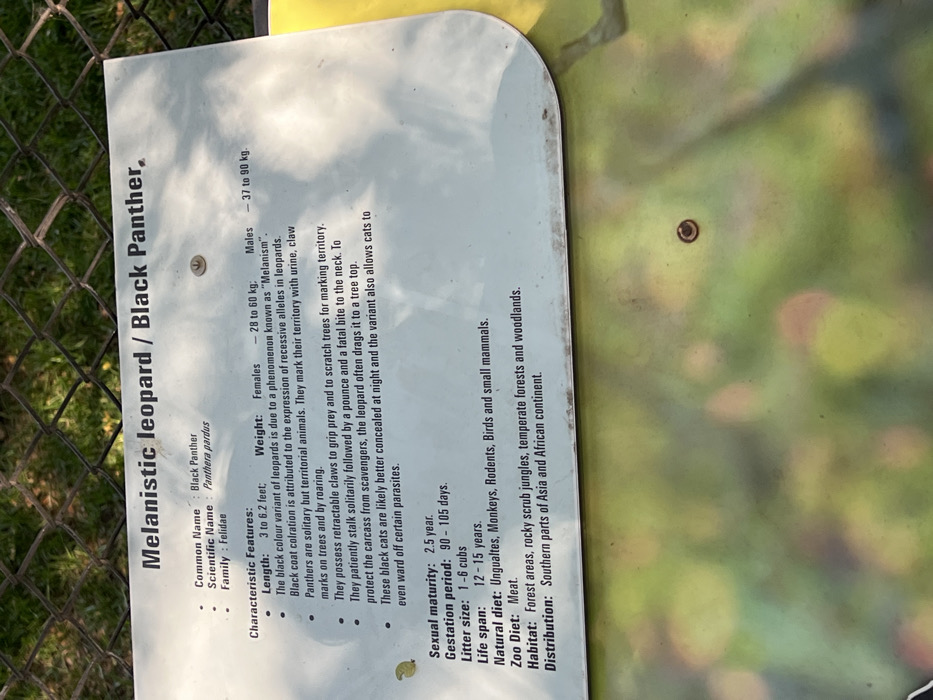
The image displays an informational sign about a "Melanistic leopard / Black Panther" at an outdoor location, likely a zoo or wildlife park in Mysuru, India. A metal fence runs across the foreground, partially obscuring the top left of the sign. The background behind the sign is a blurred expanse of green and yellow, indicating foliage under bright daylight. The sign, presented vertically, provides comprehensive details about the animal. It lists the Common Name as Black Panther, Scientific Name as *Panthera pardus*, and Family as Felidae. Characteristic features include a weight range of 28-60 kg for females and 37-90 kg for males, and a length of 3 to 6.2 feet. The black coloration is attributed to "Melanism," a phenomenon caused by recessive alleles. Panthers are described as solitary and territorial, marking their domain with urine and claw marks. They possess retractable claws for gripping prey and climbing, and hunt by stalking, pouncing, and delivering a fatal bite to the neck. They often drag prey to treetops to protect it from scavengers. The black coat is noted for providing better concealment at night and possibly warding off parasites. Further information includes a sexual maturity of 2.5 years, a gestation period of 90-105 days, a litter size of 1-6 cubs, and a life span of 12-15 years. Their natural diet comprises ungulates, monkeys, rodents, birds, and small mammals, while their zoo diet is meat. They inhabit forest areas, rocky scrub jungles, temperate forests, and woodlands, with a distribution across southern parts of Asia and the African continent.
No transactions found