Sign in
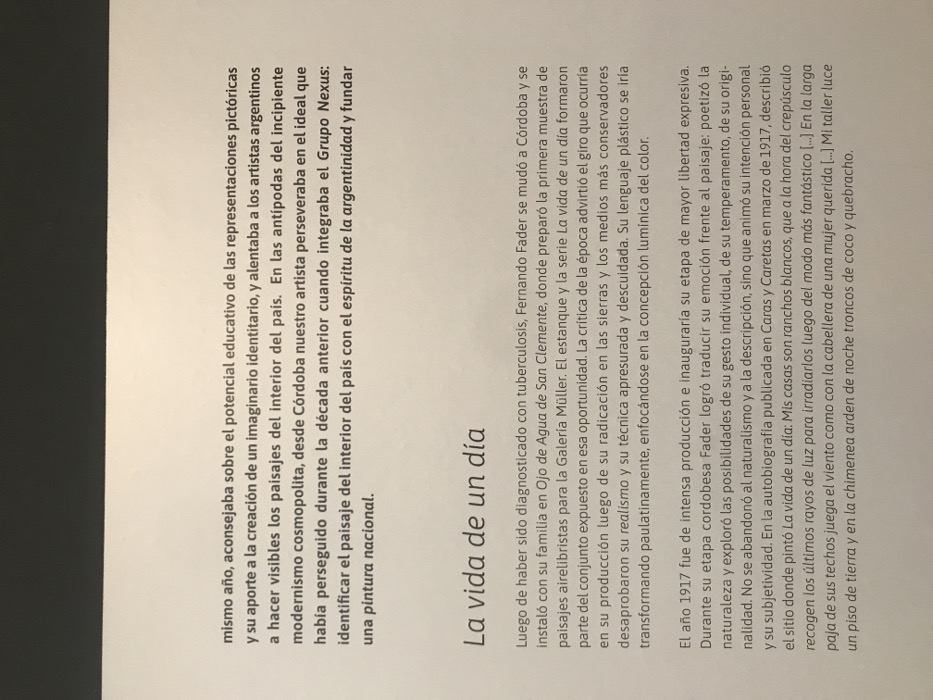
The image displays a document containing text in Spanish, likely an exhibition label or an excerpt from a publication, presented in three paragraphs and a title. The text is printed in black font against a light background, and the document is rotated.

The main subject of the text is the Argentine artist Fernando Fader and his artistic philosophy and work. The title "La vida de un día" (The life of a day) is prominently featured.

The text describes Fader's artistic journey, particularly his focus on depicting the landscapes of the Argentine interior. It mentions his relocation to Córdoba and Ojo de Agua de San Clemente after being diagnosed with tuberculosis, where he prepared his first exhibition of *airelibrista* (open-air painting) landscapes for the Galería Müller. The series "La vida de un día" was part of this exhibition. The text also touches on the critical reception of his work, noting that more conservative critics disapproved of his realism and "hasty and neglected technique," while he progressively refined his artistic language, emphasizing the luminous quality of color.

Furthermore, the text highlights Fader's intensely productive year in 1917, marking a period of greater expressive freedom. He translated his emotion into landscape, exploring nature, individual gesture, temperament, and originality, embracing personal intention and subjectivity rather than mere naturalism. An excerpt from his autobiography, published in *Caras y Caretas* in March 1917, describes his painting location: white ranches that capture the last rays of light at twilight, straw roofs where the wind plays "as with the hair of a beloved woman," and a workshop with a dirt floor and a fireplace where "coco y quebracho" logs burn at night. The text also links Fader to the "Grupo Nexus," emphasizing his pursuit to connect the interior landscape with Argentine identity and establish a national painting style.

The image shows no people or specific objects other than the document itself. The notable details are primarily textual, indicating a historical period (early 20th century, mentioning 1917 and "década anterior"), locations (Córdoba, Ojo de Agua de San Clemente, Galería Müller, "sierras"), and specific artistic terms (*airelibrista*, *modernismo cosmopolita*). The overall setting implied by the text is a rural Argentine landscape, specifically the mountains of Córdoba, and an artist's studio.
F
FM-pWi952

Jan 11, 2025

Rosario, Argentina

Stake attention in this memory

The image displays a document containing text in Spanish, likely an exhibition label or an excerpt from a publication, presented in three paragraphs and a title. The text is printed in black font against a light background, and the document is rotated. The main subject of the text is the Argentine artist Fernando Fader and his artistic philosophy and work. The title "La vida de un día" (The life of a day) is prominently featured. The text describes Fader's artistic journey, particularly his focus on depicting the landscapes of the Argentine interior. It mentions his relocation to Córdoba and Ojo de Agua de San Clemente after being diagnosed with tuberculosis, where he prepared his first exhibition of *airelibrista* (open-air painting) landscapes for the Galería Müller. The series "La vida de un día" was part of this exhibition. The text also touches on the critical reception of his work, noting that more conservative critics disapproved of his realism and "hasty and neglected technique," while he progressively refined his artistic language, emphasizing the luminous quality of color. Furthermore, the text highlights Fader's intensely productive year in 1917, marking a period of greater expressive freedom. He translated his emotion into landscape, exploring nature, individual gesture, temperament, and originality, embracing personal intention and subjectivity rather than mere naturalism. An excerpt from his autobiography, published in *Caras y Caretas* in March 1917, describes his painting location: white ranches that capture the last rays of light at twilight, straw roofs where the wind plays "as with the hair of a beloved woman," and a workshop with a dirt floor and a fireplace where "coco y quebracho" logs burn at night. The text also links Fader to the "Grupo Nexus," emphasizing his pursuit to connect the interior landscape with Argentine identity and establish a national painting style. The image shows no people or specific objects other than the document itself. The notable details are primarily textual, indicating a historical period (early 20th century, mentioning 1917 and "década anterior"), locations (Córdoba, Ojo de Agua de San Clemente, Galería Müller, "sierras"), and specific artistic terms (*airelibrista*, *modernismo cosmopolita*). The overall setting implied by the text is a rural Argentine landscape, specifically the mountains of Córdoba, and an artist's studio.

transactions
revenues
stakers
Earliest
Latest
Highest stake

No transactions found

More from this user

More from Rosario

FFM-pWi952

Jan 11, 2025

Rosario, Argentina

Licensed under Creative Commons Attribution 4.0 International License. You are free to share and adapt this content with proper attribution.