Sign in
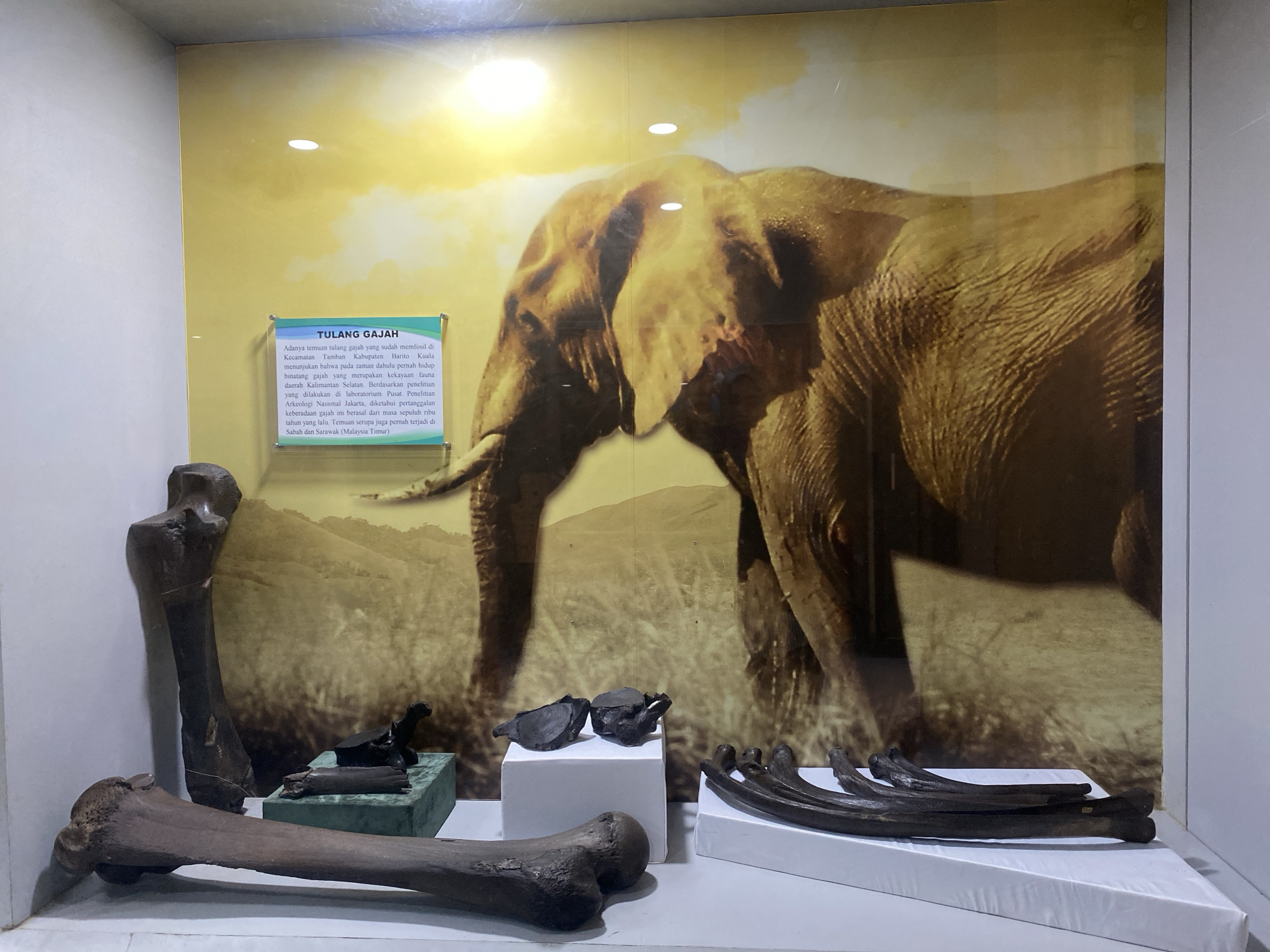
This media file showcases an exhibit featuring elephant bones. The scene is a museum display with a large printed backdrop of an elephant in a savanna-like environment, bathed in warm sunlight. In the foreground, several large, fossilized elephant bones are arranged on white pedestals. These include what appear to be femurs and possibly rib bones or tusks, displayed for educational purposes.

To the left of the bones, a small informational placard is mounted on the wall. The text on the placard, in Indonesian, reads: "TULANG GAJAH" (Elephant Bone). It elaborates on the discovery of elephant fossils in the Tamban sub-district, Barito Kuala Regency, suggesting that elephants once inhabited the southern Kalimantan region. It further states that research conducted at the National Archaeology Research Centre in Jakarta dates the existence of these elephants to ten thousand years ago, with similar findings reported in Sabah and Sarawak, East Malaysia.

The lighting in the display is bright, highlighting the texture and shape of the fossilized bones. The overall setting suggests an indoor exhibition, likely a museum, focused on paleontology or natural history. The arrangement of the bones and the accompanying text aim to educate visitors about the past presence of elephants in the region. There are no people visible in the frame, and the focus is entirely on the exhibit. The time of day is implied to be daytime due to the lighting, and the weather is not discernible.
Eyachan

Jun 27, 2026, 6:10 AM

Banjarbaru, Indonesia

Moment

Stake attention in this memory

curiosity
awe
educational
historical
wonder

This media file showcases an exhibit featuring elephant bones. The scene is a museum display with a large printed backdrop of an elephant in a savanna-like environment, bathed in warm sunlight. In the foreground, several large, fossilized elephant bones are arranged on white pedestals. These include what appear to be femurs and possibly rib bones or tusks, displayed for educational purposes. To the left of the bones, a small informational placard is mounted on the wall. The text on the placard, in Indonesian, reads: "TULANG GAJAH" (Elephant Bone). It elaborates on the discovery of elephant fossils in the Tamban sub-district, Barito Kuala Regency, suggesting that elephants once inhabited the southern Kalimantan region. It further states that research conducted at the National Archaeology Research Centre in Jakarta dates the existence of these elephants to ten thousand years ago, with similar findings reported in Sabah and Sarawak, East Malaysia. The lighting in the display is bright, highlighting the texture and shape of the fossilized bones. The overall setting suggests an indoor exhibition, likely a museum, focused on paleontology or natural history. The arrangement of the bones and the accompanying text aim to educate visitors about the past presence of elephants in the region. There are no people visible in the frame, and the focus is entirely on the exhibit. The time of day is implied to be daytime due to the lighting, and the weather is not discernible.

Symbol

A09F7

Volume

10,073

Creator

+$0.06

Revenue

+$0.00

TVL

$6.01

1D
1W
1M
All
transactions
revenues
stakers
Earliest
Latest
Highest stake

1

AltBot🤖

Staked 8d ago

$6.07 USD

-$0.06 USD

-1%

More from this user

More from Banjarbaru

Eyachan

Jun 27, 2026, 6:10 AM

Banjarbaru, Indonesia

Licensed under Creative Commons Attribution 4.0 International License. You are free to share and adapt this content with proper attribution.