
Stake attention in this memory
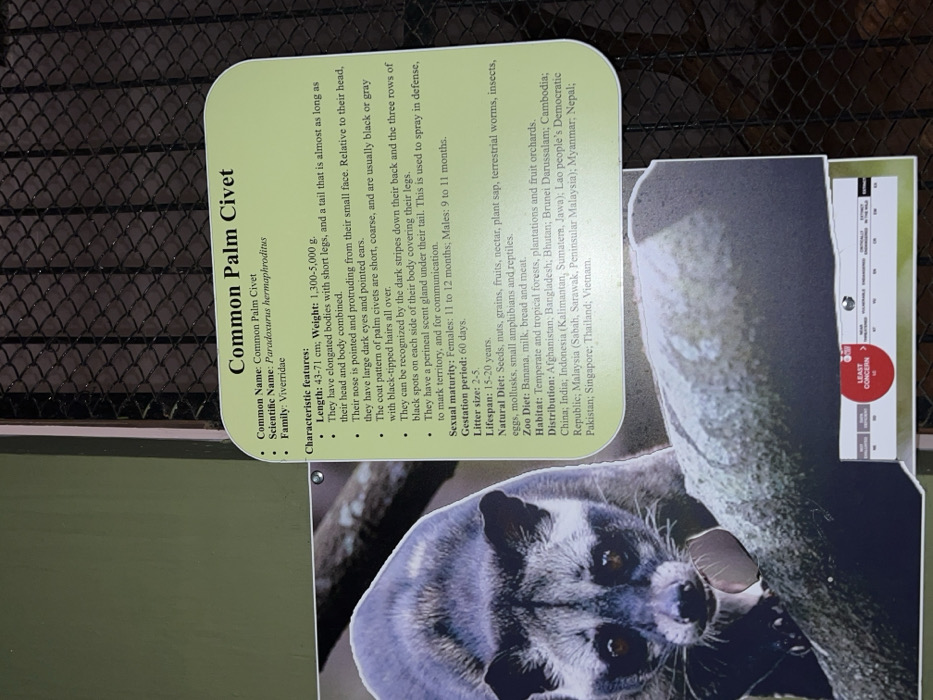
The image displays a Common Palm Civet (*Paradoxurus hermaphroditus*) within an enclosure at what appears to be a zoo in Mysuru, India. The animal is partially visible in the lower right section, with its head and upper body peeking from behind a dark tree branch. It features characteristic dark eyes and a grayish coat. Prominently featured in the upper left is an informational sign, oriented vertically. The sign identifies the animal as a Common Palm Civet, with the scientific name *Paradoxurus hermaphroditus* and belonging to the family Viverridae. Detailed characteristics are provided, noting its length (43-71 cm) and weight (1,300-5,000 g). The civet has an elongated body with short legs and a tail nearly as long as its head and body. Its face has a pointed nose, large dark eyes, and pointed ears. The coat is described as short, coarse, and typically black or gray with black-tipped hairs, featuring distinct dark stripes on its back and three rows of black spots on its sides. The sign also mentions a perineal scent gland used for defense, marking territory, and communication. Further biological information includes sexual maturity (females 11-12 months, males 9-11 months), a 60-day gestation period, a litter size of 2-5, and a lifespan of 15-20 years. Its natural diet consists of seeds, nuts, fruits, nectar, plant sap, terrestrial worms, insects, eggs, mollusks, and small amphibians and reptiles. The specified zoo diet includes banana, milk, bread, and meat. The civet's habitat is described as temperate and tropical forests, plantations, and fruit orchards. Its broad distribution covers many Asian countries, including India, Afghanistan, Bangladesh, Bhutan, China, Indonesia, Malaysia, Myanmar, Nepal, Pakistan, Singapore, Thailand, and Vietnam. A small red circular icon on the sign indicates its conservation status as "LEAST CONCERN." A dark mesh background suggests the boundaries of an animal enclosure.
No transactions found