
Stake attention in this memory
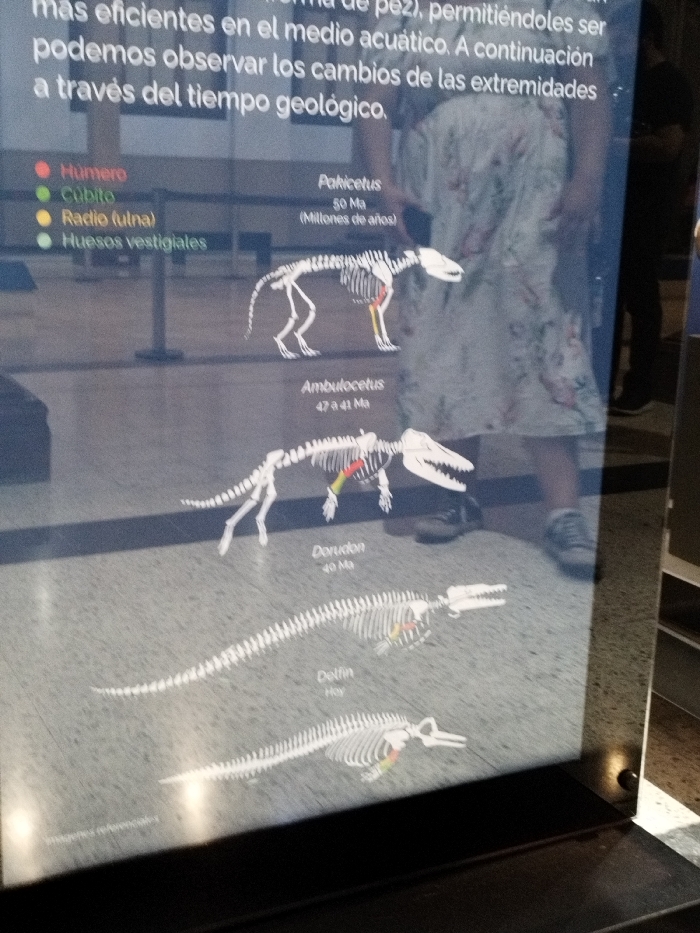
An indoor, eye-level shot captures a reflective educational display board, likely in a museum in Santiago, Chile. The display illustrates the evolution of cetacean limbs through geological time, transitioning from land mammals to modern dolphins. The main subjects on the board are skeletal diagrams of four species in chronological order: Pakicetus (50 Ma), Ambulocetus (47-41 Ma), Dorudon (40 Ma), and a modern Dolphin (Hoy). Each skeletal illustration highlights specific bones in color, corresponding to a legend: red for the Húmero (Humerus), green for the Cúbito (Ulna), yellow for the Radio (Radius), and light green for Huesos vestigiales (Vestigial bones), which are prominent in the pelvic region of the aquatic species. The top text, partially visible, explains that "we can observe the changes of the extremities through geological time" as creatures became "more efficient in the aquatic environment." Reflections on the glossy surface show a person in a floral dress, standing in front of the exhibit, and another person partially visible in the background, suggesting visitors observing the display. The floor appears to be a light-colored, possibly tiled surface. The scene portrays an educational activity, likely a museum visit focused on natural history and evolution.
No transactions found