
Stake attention in this memory
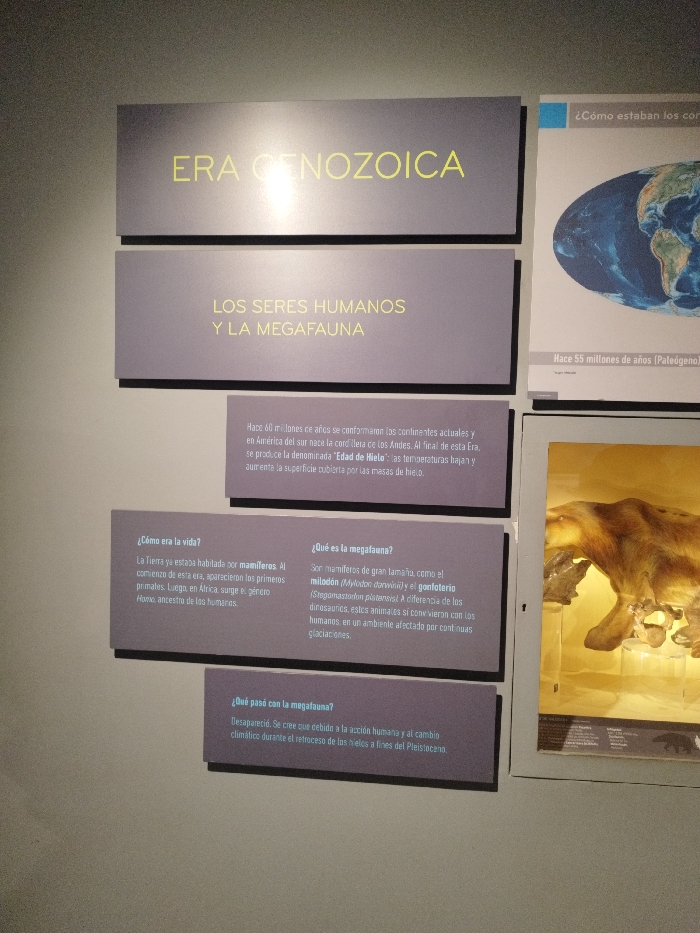
This image captures a museum exhibit focusing on the Cenozoic Era, humans, and megafauna. The scene is indoors, likely in a natural history museum or an exhibition hall in Santiago, Chile. The lighting is artificial, with some glare visible on the top display board, suggesting a flash was used or bright overhead lights. The main subjects are several informative display boards mounted on a light-colored wall. These boards are predominantly dark grey/purple with yellow text. The largest board at the top reads "ERA CENOZOICA" (Cenozoic Era), and the one below it states "LOS SERES HUMANOS Y LA MEGAFAUNA" (Humans and Megafauna). Below these main titles, several smaller boards provide detailed information in Spanish: - A longer paragraph discusses the formation of current continents 60 million years ago, the birth of the Andes, and the "Edad de Hielo" (Ice Age). - A board titled "¿Cómo era la vida?" (What was life like?) explains that Earth was inhabited by mammals, the first primates appeared, and the genus Homo originated in Africa. - Another board, "¿Qué es la megafauna?" (What is megafauna?), defines them as large mammals like the *Mylodon darwinii* (ground sloth) and *Stegomastodon platensis* (gomphothere), noting their coexistence with humans during glaciations. - The bottom board asks "¿Qué pasó con la megafauna?" (What happened to megafauna?) and attributes their disappearance to human action and climate change at the end of the Pleistocene. To the right, a vertical display with an image of Earth and the text "Hace 55 millones de años (Paleógeno)" (55 million years ago (Paleogene)) is partially visible, indicating a timeline or geological context. Below this, part of a lit display case showcases a taxidermied or modeled large, furry mammal, likely representing one of the megafauna discussed in the exhibit. No people are visible in the frame, emphasizing the display itself.
No transactions found