
Sign in
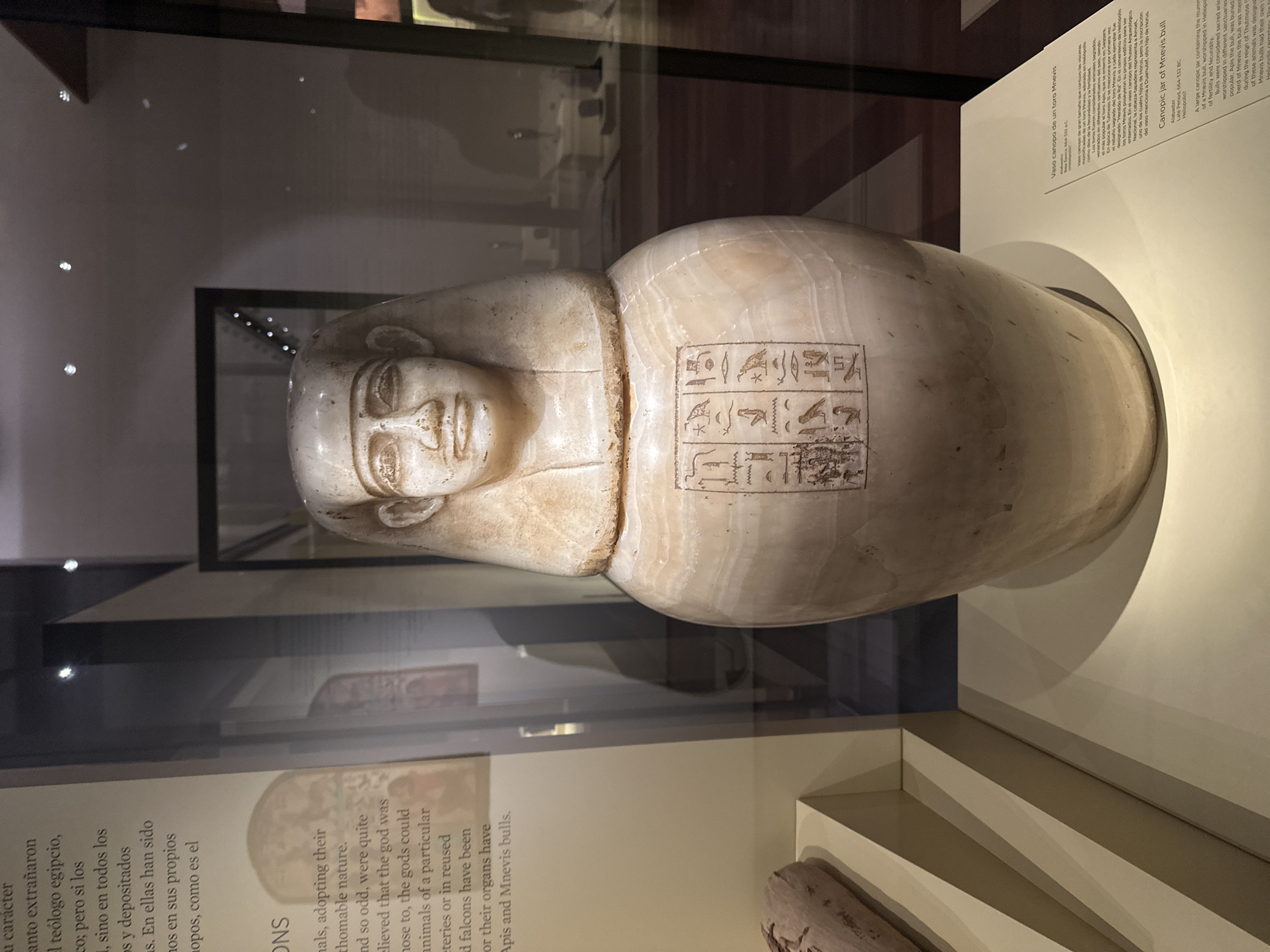
This media file is a vertical, eye-level shot of an ancient Egyptian canopic jar displayed in a museum. The jar, made of alabaster, is off-white with visible striations. It is shaped like a large, rounded vessel topped with a lid that has a sculpted human face, representing one of the four sons of Horus. The face has stylized features with large eyes and a serene expression. Hieroglyphs are inscribed on the upper portion of the jar's body.

The jar is positioned behind a glass display case, with reflections visible on the glass. The setting appears to be a museum exhibition space, with neutral-colored walls and display elements. A portion of a descriptive plaque is visible to the right of the jar, featuring text in both Spanish and English. The Spanish text describes the jar as a "Vaso canopo de un toro Mnevis" from the Late Period, 664-332 BC, from Heliopolis. The English text identifies it as a "Canopic jar of Mnevis bull" from the same period and location, noting it contained the mummified viscera of a Mnevis bull worshipped in Heliopolis. Other artifacts are visible in the background and foreground, including what appears to be a wooden object in the lower right corner, likely another museum artifact. The lighting is subdued, creating an atmospheric museum display.
Tati

Jun 30, 2026

Madrid, Spain

Stake attention in this memory

ancient
mysterious
historical
cultural
reverent

This media file is a vertical, eye-level shot of an ancient Egyptian canopic jar displayed in a museum. The jar, made of alabaster, is off-white with visible striations. It is shaped like a large, rounded vessel topped with a lid that has a sculpted human face, representing one of the four sons of Horus. The face has stylized features with large eyes and a serene expression. Hieroglyphs are inscribed on the upper portion of the jar's body. The jar is positioned behind a glass display case, with reflections visible on the glass. The setting appears to be a museum exhibition space, with neutral-colored walls and display elements. A portion of a descriptive plaque is visible to the right of the jar, featuring text in both Spanish and English. The Spanish text describes the jar as a "Vaso canopo de un toro Mnevis" from the Late Period, 664-332 BC, from Heliopolis. The English text identifies it as a "Canopic jar of Mnevis bull" from the same period and location, noting it contained the mummified viscera of a Mnevis bull worshipped in Heliopolis. Other artifacts are visible in the background and foreground, including what appears to be a wooden object in the lower right corner, likely another museum artifact. The lighting is subdued, creating an atmospheric museum display.

transactions
revenues
stakers
Earliest
Latest
Highest stake

No transactions found

More from this user

More from Madrid

Tati

Jun 30, 2026

Madrid, Spain

Licensed under Creative Commons Attribution 4.0 International License. You are free to share and adapt this content with proper attribution.