
Sign in
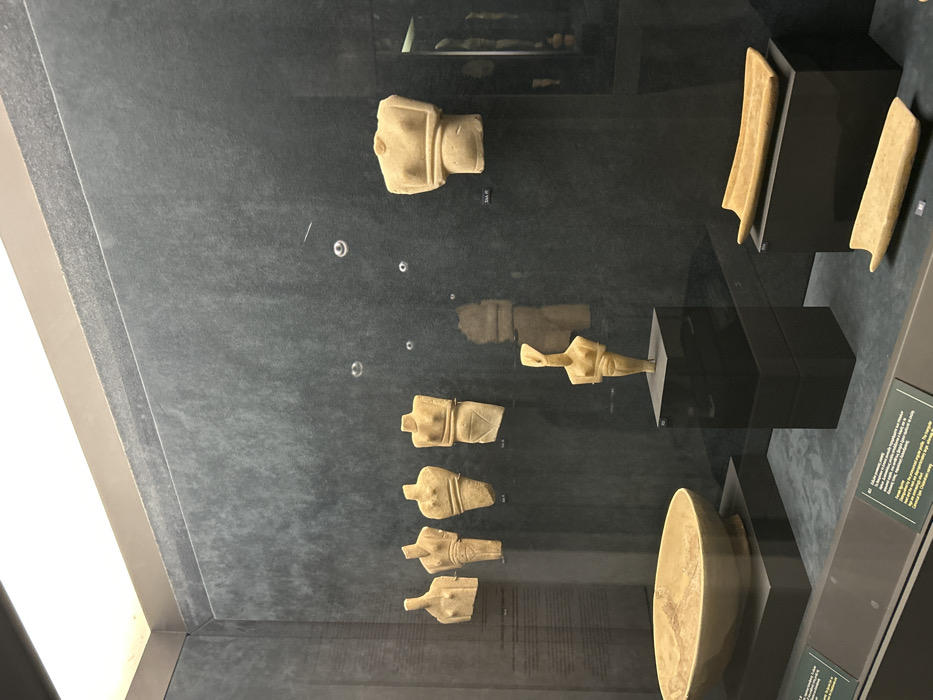
This media file captures a museum exhibit, showcasing ancient artifacts within a glass display case. The primary subjects are small, light-colored figurines and objects, likely made of stone or ceramic. Most prominent are several anthropomorphic torsos, some with rudimentary heads and breasts, suggesting female figures, displayed vertically along the left side. These stylized forms are characteristic of ancient art, possibly Cycladic or Neolithic.

One more complete standing figurine is positioned on a black pedestal in the middle of the display. To the right, two elongated, curved artifacts rest on separate black pedestals, alongside a wide, shallow bowl or dish in the lower right, also elevated on a black base. The artifacts are illuminated, highlighting their texture and form against the dark, textured background of the display case. Reflections, possibly from overhead lights or the museum environment, are visible on the glass surface. Other, out-of-focus artifacts can be seen on shelves in the background, suggesting a larger collection.

The scene is a static presentation in a museum setting, designed for visitors to observe historical objects. Small white labels with alphanumeric identifiers (e.g., "30A", "30B", "30Δ") are placed next to the artifacts. Informational text cards with green borders are visible in the lower right. These cards feature text primarily in Greek, with smaller English translations. Partially visible English phrases include "representation of a female form," "Cycladic Art," "figurines," "earlier in Greece," "Cypriot," and "Neolithic," providing context about the origin and type of artifacts displayed. The location context of Athina, Greece, is consistent with the language and potential nature of these ancient exhibits.
FM-zLJPr2

Jan 11, 2025

Athina, Greece

Stake attention in this memory

This media file captures a museum exhibit, showcasing ancient artifacts within a glass display case. The primary subjects are small, light-colored figurines and objects, likely made of stone or ceramic. Most prominent are several anthropomorphic torsos, some with rudimentary heads and breasts, suggesting female figures, displayed vertically along the left side. These stylized forms are characteristic of ancient art, possibly Cycladic or Neolithic. One more complete standing figurine is positioned on a black pedestal in the middle of the display. To the right, two elongated, curved artifacts rest on separate black pedestals, alongside a wide, shallow bowl or dish in the lower right, also elevated on a black base. The artifacts are illuminated, highlighting their texture and form against the dark, textured background of the display case. Reflections, possibly from overhead lights or the museum environment, are visible on the glass surface. Other, out-of-focus artifacts can be seen on shelves in the background, suggesting a larger collection. The scene is a static presentation in a museum setting, designed for visitors to observe historical objects. Small white labels with alphanumeric identifiers (e.g., "30A", "30B", "30Δ") are placed next to the artifacts. Informational text cards with green borders are visible in the lower right. These cards feature text primarily in Greek, with smaller English translations. Partially visible English phrases include "representation of a female form," "Cycladic Art," "figurines," "earlier in Greece," "Cypriot," and "Neolithic," providing context about the origin and type of artifacts displayed. The location context of Athina, Greece, is consistent with the language and potential nature of these ancient exhibits.

transactions
revenues
stakers
Earliest
Latest
Highest stake

No transactions found

More from this user

More from Athina

FM-zLJPr2

Jan 11, 2025

Athina, Greece

Licensed under Creative Commons Attribution 4.0 International License. You are free to share and adapt this content with proper attribution.