
Stake attention in this memory
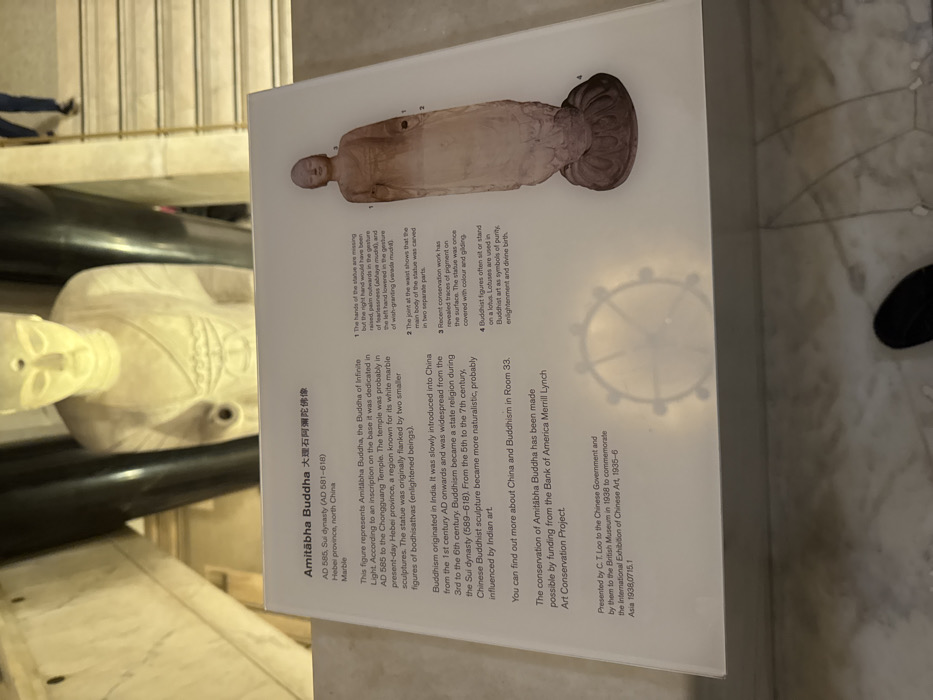
The image captures a white marble statue of Amitābha Buddha displayed in what appears to be a museum exhibition room. The statue itself, shown on an information panel and partially visible in the background, is depicted standing on a lotus base. The information panel provides details about the statue, including a side-view image with numbered annotations. The statue is identified as Amitābha Buddha, dated to AD 585, Sui dynasty (AD 581-618), from Hebei province, north China, and made of marble. The accompanying text states that it was dedicated to the Chongguang Temple and was originally flanked by two smaller bodhisattvas. Notable details from the text indicate that the hands of the statue are missing, but the right hand would have been in the abhaya mudra (fearlessness) and the left in the varada mudra (wish-granting). A joint at the waist shows it was carved in two separate parts. Recent conservation work revealed traces of pigment, indicating the statue was once colored and gilded. The lotus base symbolizes purity, enlightenment, and divine birth. Buddhism's introduction to China and its development, becoming a state religion during the Sui dynasty, are also mentioned, along with the increasing naturalism of Chinese Buddhist sculpture influenced by Indian art from the 5th to 7th centuries. The conservation of the statue was funded by Bank of America Merrill Lynch. It was presented by C. T. Loo to the Chinese Government and by them to the British Museum in 1938 to commemorate the International Exhibition of Chinese Art, 1935-6. A subtle reflection resembling a Dharma wheel is visible on the floor in front of the display. A person's foot is partially visible on the right side of the frame. The location context for this display is London, United Kingdom.
Loading AttnAds…
No transactions found