
Stake attention in this memory
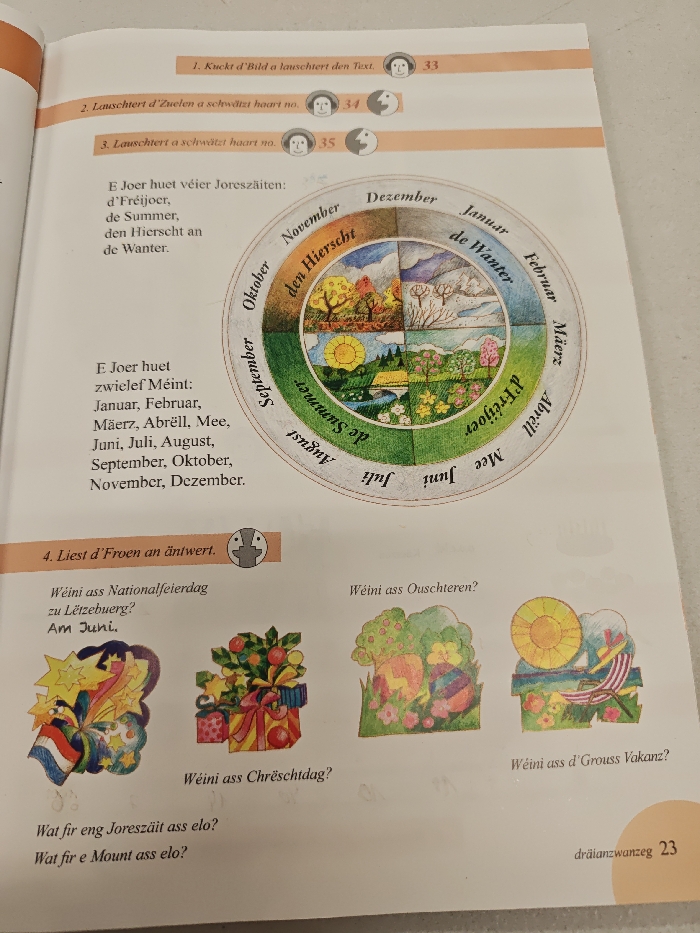
The image displays a page from a textbook, likely for learning the Luxembourgish language, focusing on seasons, months, and holidays. The page has a white background with an orange bar at the top and bottom. The top section features three numbered exercises with instructions: 1. "Kuckt d'Bild a lauschtert den Text." (Look at the picture and listen to the text.) - Accompanied by an icon of a person's head and the number 33. 2. "Lauschtert d'Zuelen a schwätzt haart no." (Listen to the numbers and speak aloud.) - Accompanied by a person's head icon, a world icon, and the number 34. 3. "Lauschtert a schwätzt haart no." (Listen and speak aloud.) - Accompanied by a person's head icon, a world icon, and the number 35. The middle section is dominated by a large circular diagram representing the year, divided into four seasons, each illustrated with a characteristic scene: * "de Wanter" (Winter) is depicted with snowy trees, bare branches, and mountains. The months associated are Januar, Februar, Mäerz, Abrëll. * "d'Fréijoer" (Spring) shows green hills, flowering trees, a river, and colorful flowers. The months are Abrëll, Mee, Juni. * "de Summer" (Summer) features a bright yellow sun, lush green trees, a river, flowers, and a house. The months are Juni, Juli, August. * "den Hierscht" (Autumn/Fall) illustrates trees with orange and brown leaves, a river, and hills. The months are September, Oktober, November, Dezember. The months are also listed around the outer edge of the circular diagram. To the left of the circular diagram, there are two blocks of text: * The first block states: "E Joer huet véier Joreszäiten: d'Fréijoer, de Summer, den Hierscht an de Wanter." (A year has four seasons: Spring, Summer, Autumn, and Winter.) * The second block lists the twelve months: "E Joer huet zwielef Méint: Januar, Februar, Mäerz, Abrëll, Mee, Juni, Juli, August, September, Oktober, November, Dezember." (A year has twelve months: January, February, March, April, May, June, July, August, September, October, November, December.) The bottom section presents exercise number 4: "Liest d'Froen an äntwert." (Read the questions and answer.) This instruction is accompanied by a person icon. Below it are questions about Luxembourgish holidays, each with an illustrative image and some with an answer provided: * "Wéini ass Nationalfeierdag zu Lëtzebuerg?" (When is National Day in Luxembourg?) - Answer: "Am Juni." (In June.) This is accompanied by an illustration of bursting stars and a flag resembling the Luxembourgish flag (red, white, and blue stripes). * "Wéini ass Chrëschtdag?" (When is Christmas?) - This question is next to an illustration of wrapped Christmas presents and a small decorated tree. * "Wéini ass Ouschteren?" (When is Easter?) - This question is positioned next to an illustration of hidden colored Easter eggs among green foliage and flowers. * "Wéini ass d'Grouss Vakanz?" (When is the Big Vacation? / Summer Holiday?) - This question is paired with an illustration of a beach scene including a yellow beach umbrella, a striped deck chair, and the sea. Finally, at the very bottom left, there are two more questions: * "Wat fir eng Joreszäit ass elo?" (What season is it now?) * "Wat fir e Mount ass elo?" (What month is it now?) The bottom right corner of the page shows the page number: "dräianzwanzeg 23" (twenty-three 23).
Loading AttnAds…
No transactions found