
Stake attention in this memory
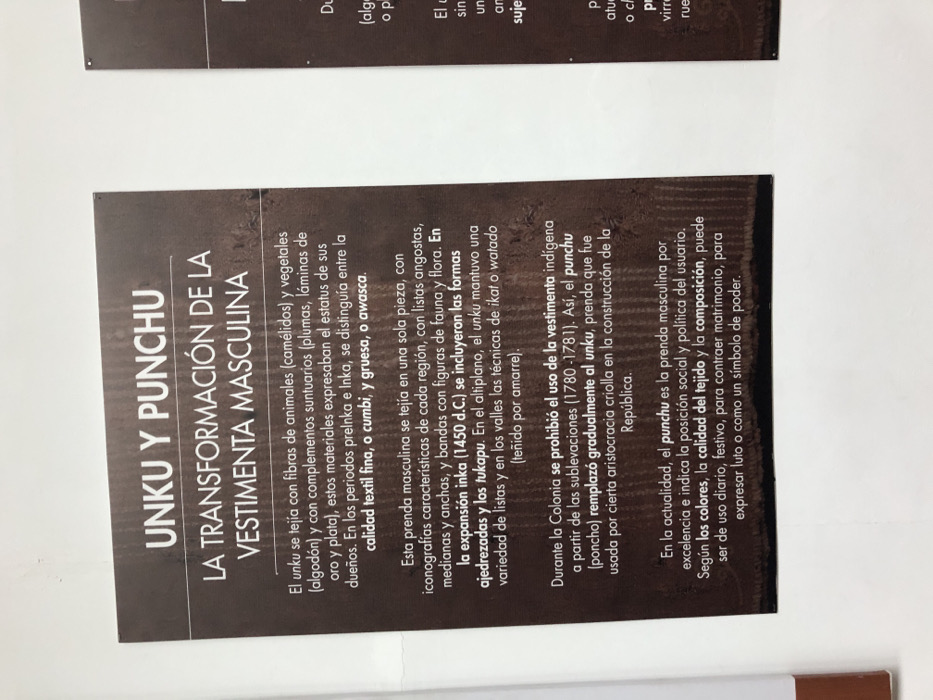
The media file presents a close-up view of an informational exhibit plaque, likely from a museum in La Paz, Bolivia. The central subject is a dark brown rectangular panel featuring white Spanish text, detailing the history and cultural significance of Andean male attire. The prominent title on the plaque reads "UNKU Y PUNCHU LA TRANSFORMACIÓN DE LA VESTIMENTA MASCULINA" (Unku and Poncho: The Transformation of Male Attire). The text below explains that the "unku" was woven from animal fibers (camelids) and plant fibers (cotton), often incorporating luxurious adornments like feathers, gold, and silver to signify the wearer's status in pre-Inka and Inka times. It describes the unku as a single-piece garment with regional iconographies, featuring various stripes and figures of fauna and flora. During the Inka expansion, checkered patterns and "tukapu" designs were introduced, and techniques like ikat (tie-dye) were used in some valleys. The plaque continues by explaining that during the Colonial period, following the rebellions of 1780-1781, the use of indigenous clothing was prohibited. This led to the gradual replacement of the "unku" by the "punchu" (poncho), which was adopted by some Creole aristocracy during the formation of the Republic. The description concludes by noting that today, the poncho remains a quintessential male garment, signifying the user's social and political position. Its colors, weaving quality, and composition determine its use for daily activities, festive occasions, marriage, expressing mourning, or as a symbol of power. Above the main plaque, a second, partially visible exhibit panel is present, also with Spanish text, but its content is largely cut off, showing only fragments such as "Du," "(alg," "El," "sin," "un," "suje," and "virre." The image focuses solely on these informative displays, providing historical and cultural context without depicting any people or specific activities.
Loading AttnAds…
No transactions found