
Sign in
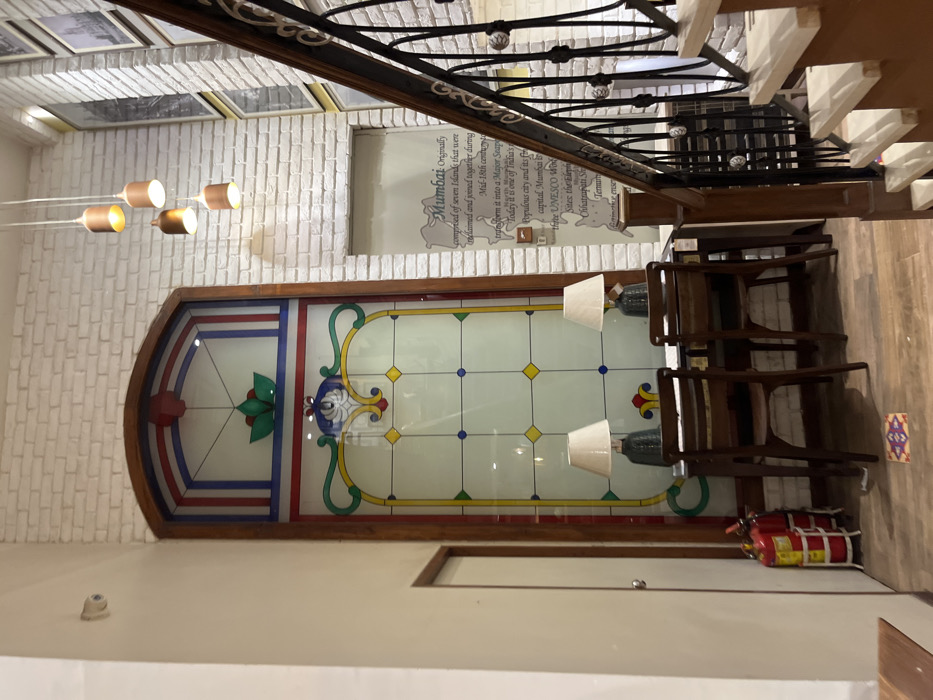
This interior image, set in Mumbai, India, captures a well-lit and decoratively appointed space, likely a cafe or restaurant. The central feature is a large, arched stained glass panel with a dark wooden frame, showcasing clear glass segments outlined by colorful borders in red, blue, green, and yellow, along with ornate floral and geometric patterns.

To the right of the stained glass, a seating area is arranged with dark wooden chairs and tables, each featuring a lamp with a white shade and a dark base. Above this seating, a wooden staircase with black wrought iron railings and white balusters ascends.

The walls throughout the visible area are finished with a textured white brick-like material. On the wall directly above the stained glass, an inscription provides historical context for Mumbai. The text describes Mumbai as originally being formed from seven islands in the mid-18th century, transforming into a major seaport, becoming India's most populous city and financial capital, and being home to three UNESCO World Heritage Sites, including Chhatrapati Shivaji Terminus. Above this text, several framed black and white photographs are displayed.

On the left side of the image, modern pendant lights with copper-colored shades hang from the ceiling, casting a warm glow. The floor is made of light-colored wooden planks. In the bottom right corner, two red fire extinguishers are visible on a stand, mounted against the wall. The illumination is primarily artificial, suggesting an indoor setting independent of natural light or an evening scene. No people are visible, indicating a static shot of the interior.
FM-OhtiC3

Jan 3, 2025

Mumbai, India

Stake attention in this memory

This interior image, set in Mumbai, India, captures a well-lit and decoratively appointed space, likely a cafe or restaurant. The central feature is a large, arched stained glass panel with a dark wooden frame, showcasing clear glass segments outlined by colorful borders in red, blue, green, and yellow, along with ornate floral and geometric patterns. To the right of the stained glass, a seating area is arranged with dark wooden chairs and tables, each featuring a lamp with a white shade and a dark base. Above this seating, a wooden staircase with black wrought iron railings and white balusters ascends. The walls throughout the visible area are finished with a textured white brick-like material. On the wall directly above the stained glass, an inscription provides historical context for Mumbai. The text describes Mumbai as originally being formed from seven islands in the mid-18th century, transforming into a major seaport, becoming India's most populous city and financial capital, and being home to three UNESCO World Heritage Sites, including Chhatrapati Shivaji Terminus. Above this text, several framed black and white photographs are displayed. On the left side of the image, modern pendant lights with copper-colored shades hang from the ceiling, casting a warm glow. The floor is made of light-colored wooden planks. In the bottom right corner, two red fire extinguishers are visible on a stand, mounted against the wall. The illumination is primarily artificial, suggesting an indoor setting independent of natural light or an evening scene. No people are visible, indicating a static shot of the interior.

transactions
revenues
stakers
Earliest
Latest
Highest stake

No transactions found

More from this user

More from Mumbai

FM-OhtiC3

Jan 3, 2025

Mumbai, India

Licensed under Creative Commons Attribution 4.0 International License. You are free to share and adapt this content with proper attribution.