
Sign in
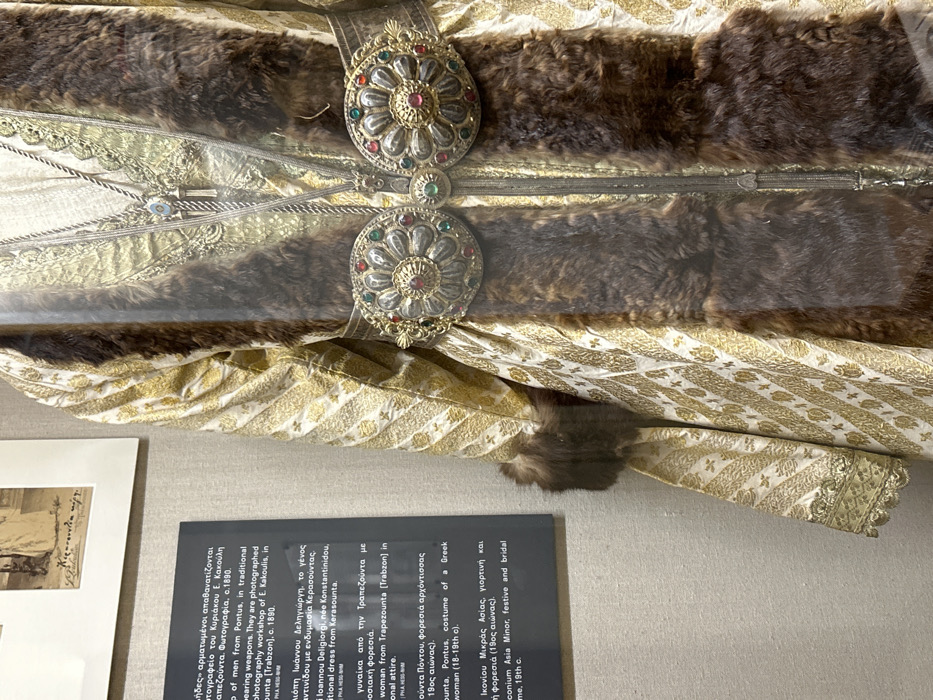
A traditional Greek costume, likely from Pontus (18th-19th century) or Iconium, Asia Minor (19th century), is presented in a museum display case. The garment, possibly a festive or bridal costume, is made of a light-colored, possibly cream or white, fabric intricately patterned with rich golden thread. It is lavishly trimmed with dark brown fur, suggesting warmth and luxury. A prominent, ornate silver-toned belt or embellishment is secured around the waist. This feature includes two large, circular medallions, each adorned with colorful gemstones in shades of red, green, and blue, connected by a smaller central piece. Reflections on the display case's glass surface are visible.

To the left, partially visible, are explanatory labels in both Greek and English. The visible text describes "Pontus, costume of a Greek woman (18-19th c)" and "Iconium Asia Minor, festive and bridal costume, 19th c." Other text refers to "Ioannou Deligiorgi, née Konstantinidou, traditional dress from Kerasounta" and a "woman from Trapezounta (Trabzon) in traditional attire," further contextualizing the origins of traditional Greek attire. The setting is likely a museum in Athina, Greece, exhibiting historical garments.
FM-zLJPr2

Jan 12, 2025

Athina, Greece

Stake attention in this memory

A traditional Greek costume, likely from Pontus (18th-19th century) or Iconium, Asia Minor (19th century), is presented in a museum display case. The garment, possibly a festive or bridal costume, is made of a light-colored, possibly cream or white, fabric intricately patterned with rich golden thread. It is lavishly trimmed with dark brown fur, suggesting warmth and luxury. A prominent, ornate silver-toned belt or embellishment is secured around the waist. This feature includes two large, circular medallions, each adorned with colorful gemstones in shades of red, green, and blue, connected by a smaller central piece. Reflections on the display case's glass surface are visible. To the left, partially visible, are explanatory labels in both Greek and English. The visible text describes "Pontus, costume of a Greek woman (18-19th c)" and "Iconium Asia Minor, festive and bridal costume, 19th c." Other text refers to "Ioannou Deligiorgi, née Konstantinidou, traditional dress from Kerasounta" and a "woman from Trapezounta (Trabzon) in traditional attire," further contextualizing the origins of traditional Greek attire. The setting is likely a museum in Athina, Greece, exhibiting historical garments.

transactions
revenues
stakers
Earliest
Latest
Highest stake

No transactions found

More from this user

More from Athina

FM-zLJPr2

Jan 12, 2025

Athina, Greece

Licensed under Creative Commons Attribution 4.0 International License. You are free to share and adapt this content with proper attribution.