
Sign in
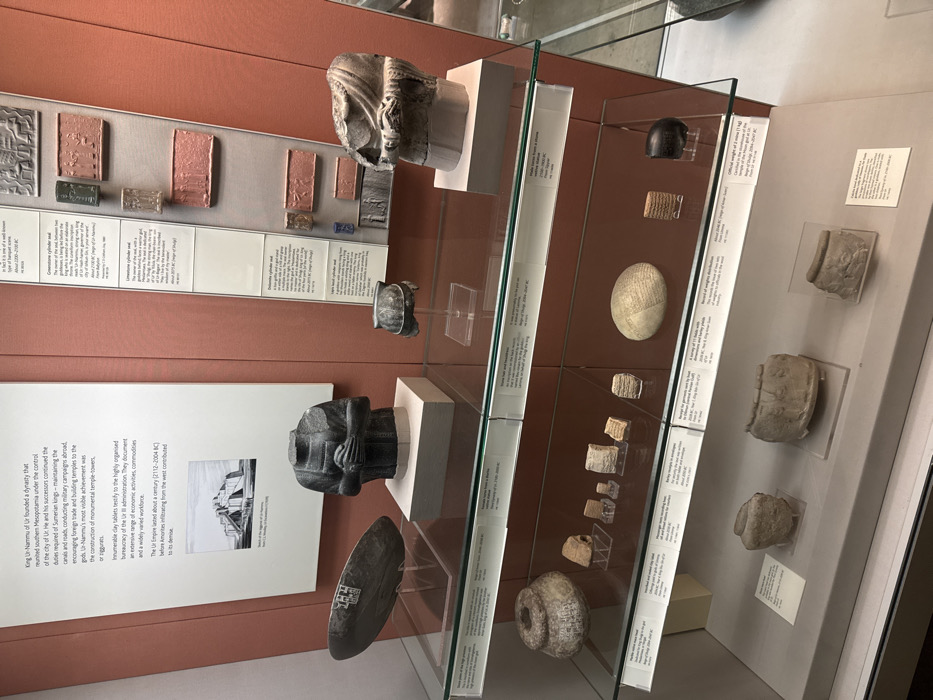
This image captures an indoor museum exhibit showcasing ancient Mesopotamian artifacts, primarily from the Ur III period. The scene features multiple glass display cases against a reddish-brown wall, filled with various objects and informational panels.

A prominent vertical text panel on the left provides historical context about "King Ur-Nammu of Ur," describing his dynasty, achievements like building "monumental temple-towers, or ziggurats," and the administrative "clay tablets" of the "Ur III administration." It notes the "Ur Empire lasted about a century (2112-2004 BC)." An illustration titled "Reconstruction of a ziggurat of Ur-Nammu" accompanies this text.

Below this panel, a dark, sculpted bust or torso of a figure with folded arms is displayed. Above it, another sculpted head is visible. On a lower shelf, a flat, oval-shaped object with carvings is present.

Within the main glass display case, numerous artifacts are arranged on multiple levels. The back wall of the case features a display of cylinder seals and their impressions, with labels such as "Cuneiform cylinder seal" and "Diopside cylinder seal," dating to "c. 2100 BC." On the shelves within the case, various clay tablets of different shapes and sizes are exhibited, many bearing cuneiform script. A large, light-colored, spherical object with inscriptions is centrally placed. Other items include small, dark, possibly stone artifacts and a round, carved object on the bottom shelf. Additional labels provide details, for example, "Round weight of 5 minas (Ur)" and "Building inscription of Shulgi, son of Ur-Nammu, from the Ur III dynasty, c. 2094-2047 BC."

The setting is a well-lit museum, devoid of people, focused entirely on the historical display.
punit03

Dec 13, 2024, 3:27 PM

London, UK

Stake attention in this memory

This image captures an indoor museum exhibit showcasing ancient Mesopotamian artifacts, primarily from the Ur III period. The scene features multiple glass display cases against a reddish-brown wall, filled with various objects and informational panels. A prominent vertical text panel on the left provides historical context about "King Ur-Nammu of Ur," describing his dynasty, achievements like building "monumental temple-towers, or ziggurats," and the administrative "clay tablets" of the "Ur III administration." It notes the "Ur Empire lasted about a century (2112-2004 BC)." An illustration titled "Reconstruction of a ziggurat of Ur-Nammu" accompanies this text. Below this panel, a dark, sculpted bust or torso of a figure with folded arms is displayed. Above it, another sculpted head is visible. On a lower shelf, a flat, oval-shaped object with carvings is present. Within the main glass display case, numerous artifacts are arranged on multiple levels. The back wall of the case features a display of cylinder seals and their impressions, with labels such as "Cuneiform cylinder seal" and "Diopside cylinder seal," dating to "c. 2100 BC." On the shelves within the case, various clay tablets of different shapes and sizes are exhibited, many bearing cuneiform script. A large, light-colored, spherical object with inscriptions is centrally placed. Other items include small, dark, possibly stone artifacts and a round, carved object on the bottom shelf. Additional labels provide details, for example, "Round weight of 5 minas (Ur)" and "Building inscription of Shulgi, son of Ur-Nammu, from the Ur III dynasty, c. 2094-2047 BC." The setting is a well-lit museum, devoid of people, focused entirely on the historical display.

Loading AttnAds…

transactions
revenues
stakers
Earliest
Latest
Highest stake

No transactions found

More from this user

More from London

punit03

Dec 13, 2024, 3:27 PM

London, UK

Licensed under Creative Commons Attribution 4.0 International License. You are free to share and adapt this content with proper attribution.