
Stake attention in this memory
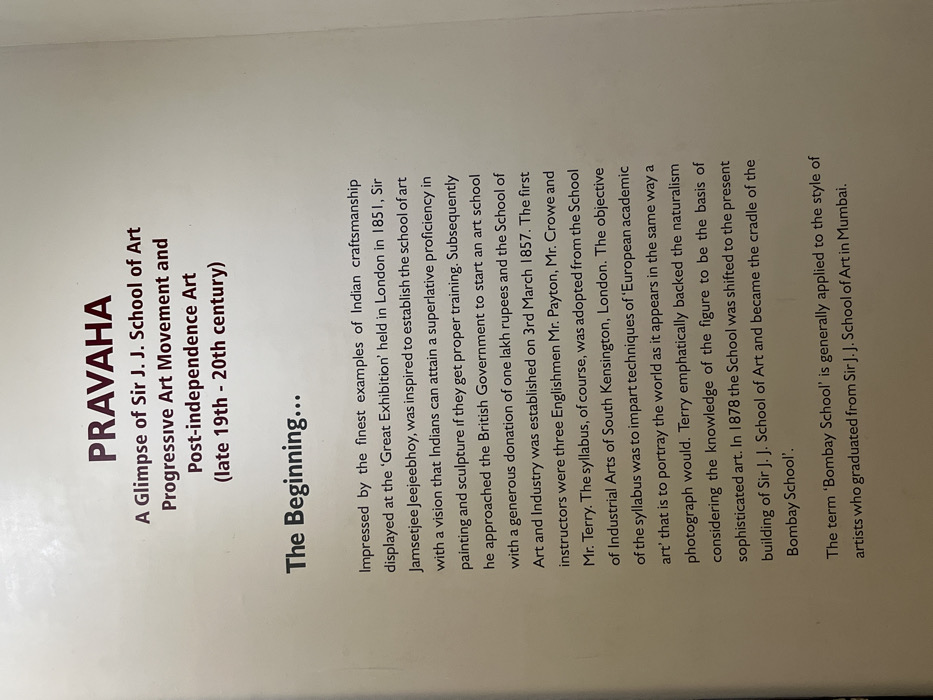
This media file is a slightly rotated image of a printed page from a book or catalog, primarily featuring text. The page is light in color with dark text. The visible text begins with the prominent title "PRAVAHA," followed by "A Glimpse of Sir J. J. School of Art," and "Progressive Art Movement and Post-independence Art (late 19th - 20th century)." A subheading reads "The Beginning..." The main body of the text details the origins of the Sir J. J. School of Art. It states that Sir Jamsetjee Jeejeebhoy was inspired by Indian craftsmanship at the 'Great Exhibition' in London in 1851 to establish an art school in India. His goal was for Indians to achieve "superlative proficiency in painting and sculpture." He donated one lakh rupees, leading to the establishment of the School of Art and Industry on March 3, 1857. Early instructors included Englishmen Mr. Payton, Mr. Crowe, and Mr. Terry. The syllabus was adopted from the School of Industrial Arts of South Kensington, London, focusing on "European academic art" techniques and naturalism, with the human figure as a core element. In 1878, the school moved to its present building and became known as the "cradle of the 'Bombay School'." The term 'Bombay School' is defined as the style of artists who graduated from Sir J. J. School of Art in Mumbai. There are no other discernible objects, people, or activities depicted. The context provided (Mumbai, India) is reflected in the text's mention of "Sir J. J. School of Art in Mumbai."
Loading AttnAds…
No transactions found