
Sign in
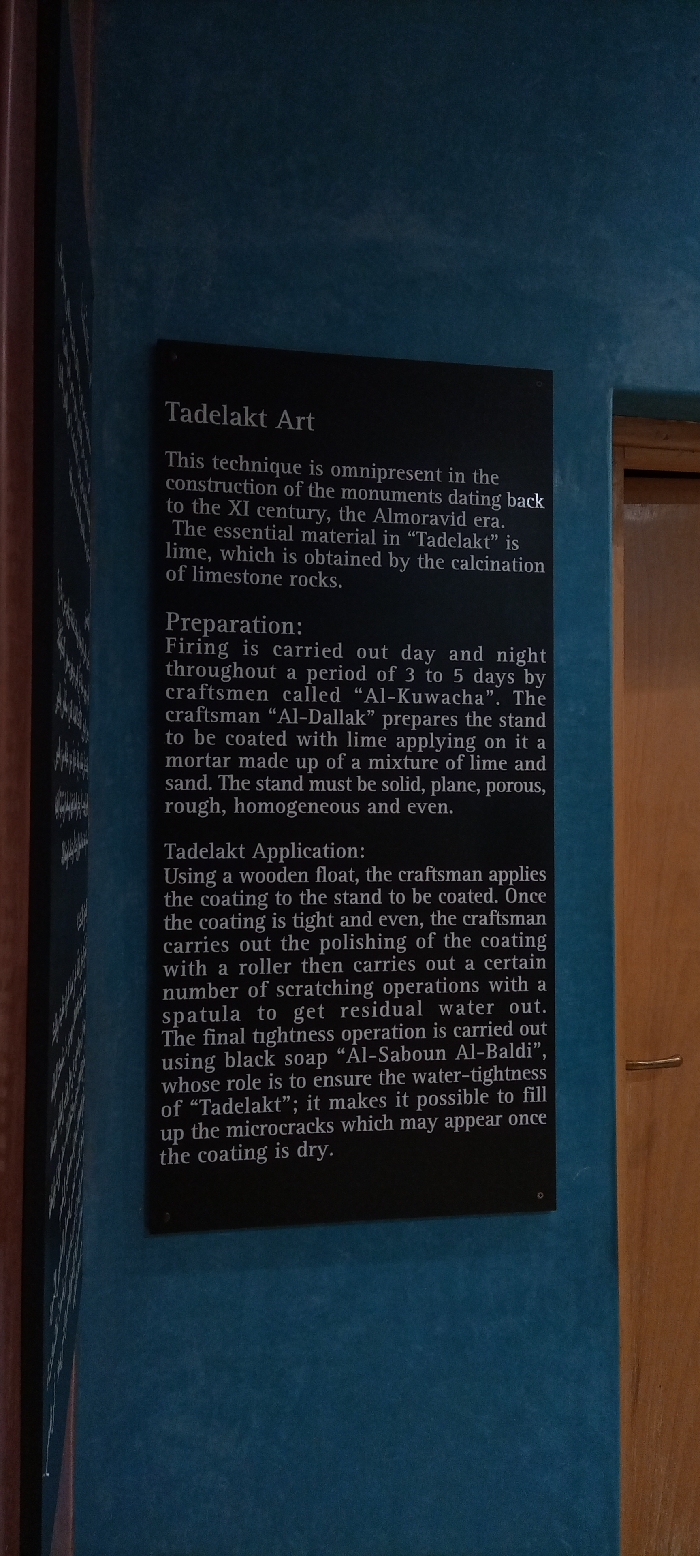
The image features an informational sign about "Tadelakt Art" mounted on a textured, deep teal-blue wall. The sign is a black rectangular panel with white text, detailing the history and process of Tadelakt, a traditional Moroccan plastering technique. To the right of the sign, a section of a light brown wooden door frame is visible.

The sign's text explains that Tadelakt is a technique dating back to the 11th-century Almoravid era, with lime, obtained from limestone rocks, as its essential material. It describes the "Preparation" process, involving firing for 3-5 days by craftsmen called "Al-Kuwacha," and a craftsman "Al-Dallak" preparing the stand with a lime and sand mortar, specifying the stand must be solid, plane, porous, rough, homogeneous, and even. The "Tadelakt Application" section details using a wooden float, polishing with a roller, scratching with a spatula to remove residual water, and a final tightening step with black soap, "Al-Saboun Al-Baldi," to ensure water-tightness and fill microcracks.

The setting appears to be an indoor environment, possibly a museum or cultural exhibit in Casablanca, Morocco, given the context of the Tadelakt art form. No individuals or specific activities are depicted within the frame, but the sign itself serves to educate visitors about the traditional craft.
AYOUB

Jan 10, 2025, 3:55 PM

Casablanca, Morocco

Stake attention in this memory

The image features an informational sign about "Tadelakt Art" mounted on a textured, deep teal-blue wall. The sign is a black rectangular panel with white text, detailing the history and process of Tadelakt, a traditional Moroccan plastering technique. To the right of the sign, a section of a light brown wooden door frame is visible. The sign's text explains that Tadelakt is a technique dating back to the 11th-century Almoravid era, with lime, obtained from limestone rocks, as its essential material. It describes the "Preparation" process, involving firing for 3-5 days by craftsmen called "Al-Kuwacha," and a craftsman "Al-Dallak" preparing the stand with a lime and sand mortar, specifying the stand must be solid, plane, porous, rough, homogeneous, and even. The "Tadelakt Application" section details using a wooden float, polishing with a roller, scratching with a spatula to remove residual water, and a final tightening step with black soap, "Al-Saboun Al-Baldi," to ensure water-tightness and fill microcracks. The setting appears to be an indoor environment, possibly a museum or cultural exhibit in Casablanca, Morocco, given the context of the Tadelakt art form. No individuals or specific activities are depicted within the frame, but the sign itself serves to educate visitors about the traditional craft.

Loading AttnAds…

transactions
revenues
stakers
Earliest
Latest
Highest stake

No transactions found

More from this user

More from Casablanca

AYOUB

Jan 10, 2025, 3:55 PM

Casablanca, Morocco

Licensed under Creative Commons Attribution 4.0 International License. You are free to share and adapt this content with proper attribution.