
Stake attention in this memory
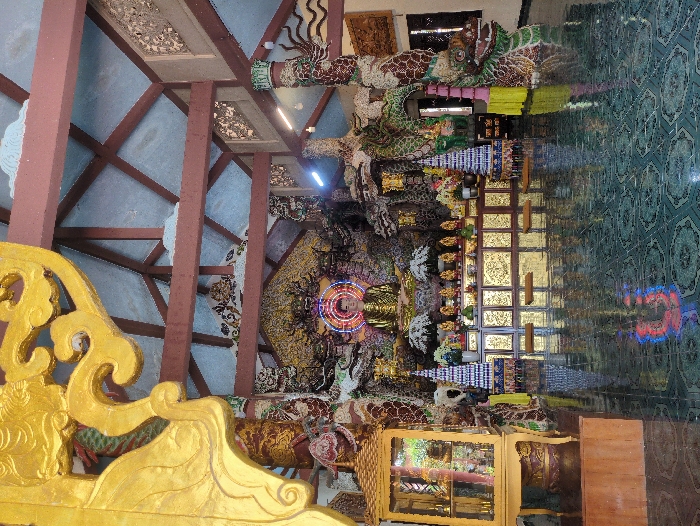
The image depicts the interior of Linh Phuoc Pagoda (Chùa Linh Phước), also known as the "Glass Pagoda," located in Thành phố Đà Lạt, Lâm Đồng Province, Vietnam. The scene presents a highly ornate Buddhist temple hall, characterized by extensive and intricate mosaic work covering the walls, pillars, and backdrop of the central altar. The main focal point is a large, seated golden Buddha statue positioned centrally at the rear of the hall. This Buddha is illuminated by a vibrant, multi-colored neon halo, predominantly featuring red and blue light. The statue is set against a backdrop of mosaic artwork depicting mountainous or natural landscapes. In front of the main Buddha, a long, low offering table with dark wood and golden patterned panels at its base holds multiple smaller golden Buddha statues, vases containing large white floral arrangements (resembling chrysanthemums), and various offerings, including fruit. Flanking this offering table are two tall, conical structures composed of stacked blue and white elements, likely symbolic stupas or decorative offerings. The walls and several large columns are covered in detailed mosaic artistry, featuring mythical creatures such as dragons in shades of green, brown, and red, along with intricate patterns. On the far left, a tall, multi-tiered golden cabinet with glass panels and ornate carvings stands on a wooden base. The floor is covered with highly reflective, dark teal-blue and light blue tiles arranged in hexagonal and octagonal patterns, clearly reflecting the ambient light and the neon halo from the main Buddha statue. Several small, square, golden-colored mats or cushions are visible on the floor directly in front of the altar. The upper portion of the image reveals a pitched roof structure supported by dark brown wooden beams forming a lattice pattern against a light blue ceiling. Elaborate golden, curvilinear decorative elements are prominent in the upper left foreground, partially obscuring the roof structure. The hall is brightly illuminated by various visible and unseen light sources, contributing to the reflective qualities of the tiled floor. No individuals are present in the scene, and no specific actions are occurring.
Symbol
A5FD1
Volume
5,489
Creator
+$0.03
Revenue
+$0.02
TVL
$1.50
Loading AttnAds…