
Stake attention in this memory
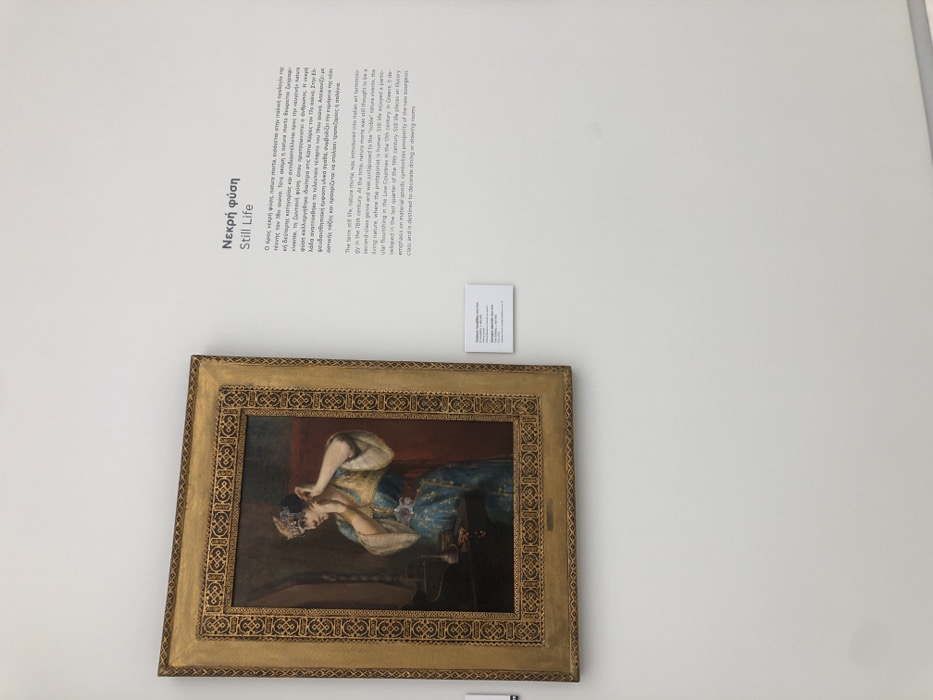
This media file captures a painting displayed on a white wall in what appears to be a museum or art gallery in Athina, Greece. The painting, housed in an ornate golden frame with intricate patterns, depicts a woman seated. She is dressed in elaborate attire, primarily in shades of blue and gold, with white fur trim on her garments and a decorative headpiece. Her hands are positioned near her face, possibly adjusting an item of jewelry or in a contemplative gesture. The background of the painting is dark, showing subtle shifts in color from deep red to brown. Adjacent to the painting, on the white wall, are two blocks of text. The prominent text is titled "Νεκρή φύση" in Greek and "Still Life" in English. Below this title, two paragraphs (one in Greek, one in English) provide historical and contextual information about the still life art genre. The text explains that the term "still life" (or "nature morte") was introduced in the 18th century, initially considered a secondary genre compared to "living nature" (depicting human figures). It highlights its popularity in the Low Countries in the 17th century and its development in Greece during the last quarter of the 19th century, noting its emphasis on material goods, symbolism of bourgeois prosperity, and use in decorating dining or drawing rooms. Below the main text and above the painting, a small white card is attached to the wall, likely providing specific details about the artwork itself (artist, title, date, medium), but the text on this card is too small to be legible. The scene is evenly lit, typical of an indoor exhibition space.
No transactions found