Sign in
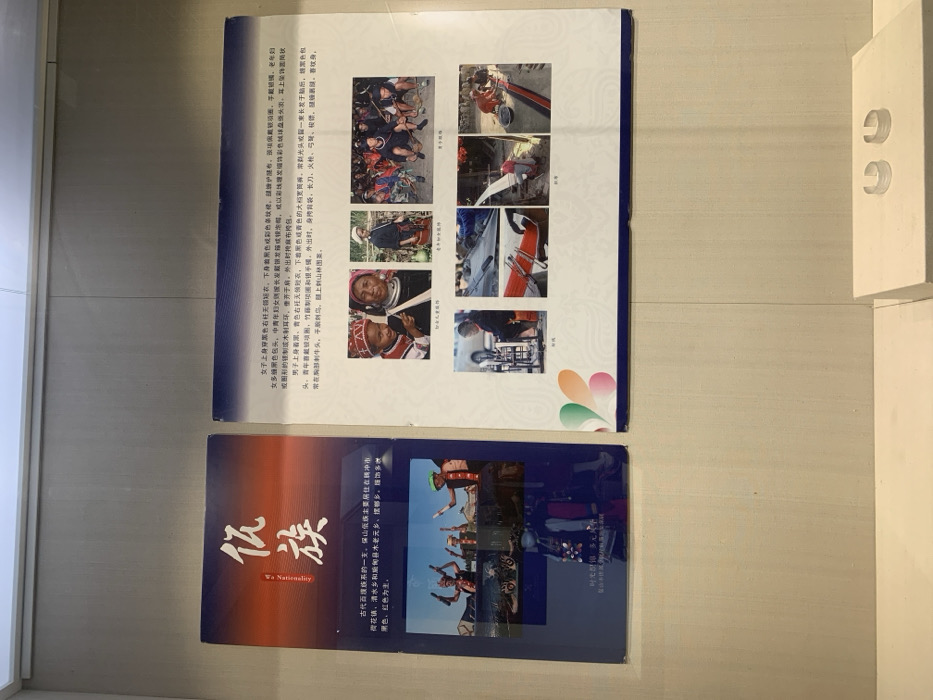
Two books or brochures are displayed side-by-side on a light-colored surface. The bottom book, positioned on the left, features a dark cover transitioning from red to blue. Its title is prominently displayed in large Chinese characters, "佤族" (Wǎ zú), with the English translation "Wa Nationality" directly below. Smaller Chinese text on the cover states that the Wa ethnic group is a branch of an ancient lineage and that the Wa people in Baoshan mainly reside in townships and villages within Tengchong City and Shidian County, noting black and red as dominant colors in their culture. An image on this cover shows several people in traditional attire, possibly dancing or performing with instruments. The top book, on the right, is open, displaying a page with extensive Chinese text and a grid of eight smaller photographs. The text provides a detailed description of the traditional attire and customs of the Wa people. For women, it describes black, right-collared short tops, black or colorful striped skirts, green leg wraps, iron neck rings, and silver bracelets. Elderly women often wear black headscarves, while younger women adorn their long hair with silver ornaments or elaborate hats, often featuring colorful pompom-like balls and hanging earrings made of metal or wood. For men, the text details black or blue right-collared, collarless short tops, black or blue loose trousers, and mentions their practice of shaving their heads or keeping a long lock of hair at the back. They wear black headscarves, and young men often sport neck rings (including bamboo cane ones) and silver bracelets. Both men and women carry bags when going out, with men also carrying long knives, firearms, crossbows, and wearing leg wraps, often adorning their chests with carved ox heads, dried bird feathers, and patterns of mountains and forests on their legs. The photographs on the open page depict various cultural activities and daily life scenes of the Wa people. These include: * Two individuals, likely Wa, with elaborate traditional headwear and neck jewelry. * A group of people in traditional clothing, some seated, possibly engaged in a communal activity or performance. * Several images showing crafting processes, such as a person working with wood or bamboo, another weaving textiles, and individuals engaged in what appears to be instrument making or other intricate handcrafts. * One photo shows a group of people performing or dancing. The overall context suggests these materials are informative pieces
Emma🇨🇳💕

Feb 1, 2025, 6:22 AM

Da Li Bai Zu Zi Zhi Zhou, China

Stake attention in this memory

Two books or brochures are displayed side-by-side on a light-colored surface. The bottom book, positioned on the left, features a dark cover transitioning from red to blue. Its title is prominently displayed in large Chinese characters, "佤族" (Wǎ zú), with the English translation "Wa Nationality" directly below. Smaller Chinese text on the cover states that the Wa ethnic group is a branch of an ancient lineage and that the Wa people in Baoshan mainly reside in townships and villages within Tengchong City and Shidian County, noting black and red as dominant colors in their culture. An image on this cover shows several people in traditional attire, possibly dancing or performing with instruments. The top book, on the right, is open, displaying a page with extensive Chinese text and a grid of eight smaller photographs. The text provides a detailed description of the traditional attire and customs of the Wa people. For women, it describes black, right-collared short tops, black or colorful striped skirts, green leg wraps, iron neck rings, and silver bracelets. Elderly women often wear black headscarves, while younger women adorn their long hair with silver ornaments or elaborate hats, often featuring colorful pompom-like balls and hanging earrings made of metal or wood. For men, the text details black or blue right-collared, collarless short tops, black or blue loose trousers, and mentions their practice of shaving their heads or keeping a long lock of hair at the back. They wear black headscarves, and young men often sport neck rings (including bamboo cane ones) and silver bracelets. Both men and women carry bags when going out, with men also carrying long knives, firearms, crossbows, and wearing leg wraps, often adorning their chests with carved ox heads, dried bird feathers, and patterns of mountains and forests on their legs. The photographs on the open page depict various cultural activities and daily life scenes of the Wa people. These include: * Two individuals, likely Wa, with elaborate traditional headwear and neck jewelry. * A group of people in traditional clothing, some seated, possibly engaged in a communal activity or performance. * Several images showing crafting processes, such as a person working with wood or bamboo, another weaving textiles, and individuals engaged in what appears to be instrument making or other intricate handcrafts. * One photo shows a group of people performing or dancing. The overall context suggests these materials are informative pieces

Loading AttnAds…

transactions
revenues
stakers
Earliest
Latest
Highest stake

No transactions found

More from this user

More from Da Li Bai Zu Zi Zhi Zhou

Emma🇨🇳💕

Feb 1, 2025, 6:22 AM

Da Li Bai Zu Zi Zhi Zhou, China

Licensed under Creative Commons Attribution 4.0 International License. You are free to share and adapt this content with proper attribution.