Sign in
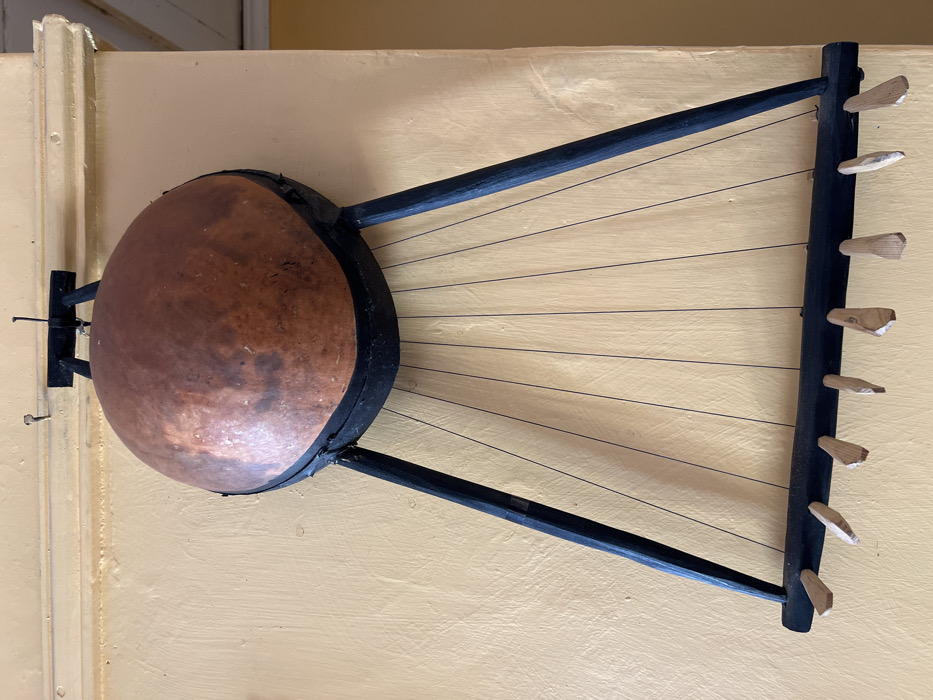
The image displays a traditional stringed musical instrument, resembling a lyre or harp-lute, positioned against a textured, light yellow-ochre wall. The instrument is stationary and appears to be on display indoors.

The primary subject is the instrument itself, which features a large, round resonator made from a reddish-brown gourd or calabash. This natural material exhibits variations in color and texture. Two sturdy, dark (likely black-painted) wooden arms extend outwards from the resonator, forming an open V-shape. These arms converge at a vertical dark wooden crossbar, which is affixed to their ends.

Seven thin, dark strings are stretched tautly from an anchor point on the resonator, across the arms, to the crossbar. Each string is secured to a distinct, light-colored, roughly carved wooden tuning peg inserted into the crossbar. The construction suggests a handmade origin using natural and rustic materials.

In the upper left corner, a light-colored architectural detail, possibly a molding or beam, is partially visible, hinting at the room's structure. The lighting is uniform, and no people or active events are depicted. There is no visible text in the image. The instrument's design aligns with types found in East African cultures, consistent with the Ruiru, Kenya context.
F
FM-5BNyB3

Dec 18, 2024

Ruiru, Kenya

Stake attention in this memory

The image displays a traditional stringed musical instrument, resembling a lyre or harp-lute, positioned against a textured, light yellow-ochre wall. The instrument is stationary and appears to be on display indoors. The primary subject is the instrument itself, which features a large, round resonator made from a reddish-brown gourd or calabash. This natural material exhibits variations in color and texture. Two sturdy, dark (likely black-painted) wooden arms extend outwards from the resonator, forming an open V-shape. These arms converge at a vertical dark wooden crossbar, which is affixed to their ends. Seven thin, dark strings are stretched tautly from an anchor point on the resonator, across the arms, to the crossbar. Each string is secured to a distinct, light-colored, roughly carved wooden tuning peg inserted into the crossbar. The construction suggests a handmade origin using natural and rustic materials. In the upper left corner, a light-colored architectural detail, possibly a molding or beam, is partially visible, hinting at the room's structure. The lighting is uniform, and no people or active events are depicted. There is no visible text in the image. The instrument's design aligns with types found in East African cultures, consistent with the Ruiru, Kenya context.

transactions
revenues
stakers
Earliest
Latest
Highest stake

No transactions found

More from this user

More from Ruiru

FFM-5BNyB3

Dec 18, 2024

Ruiru, Kenya

Licensed under Creative Commons Attribution 4.0 International License. You are free to share and adapt this content with proper attribution.