
Sign in
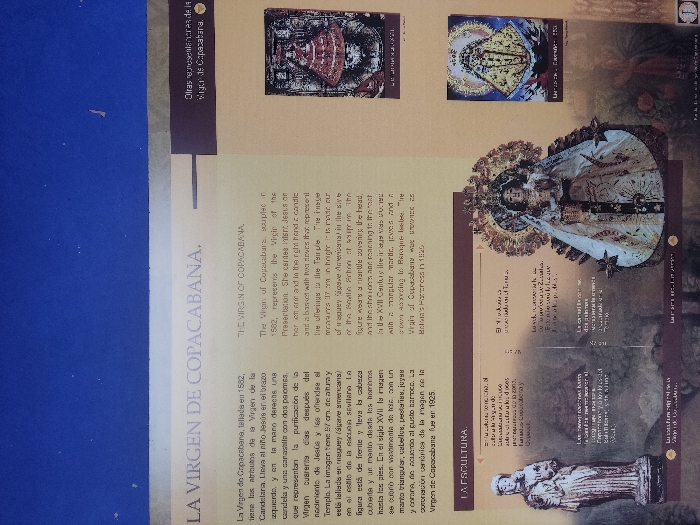
This image displays an informational exhibit board, likely from a museum or cultural center in La Paz, Bolivia, dedicated to "La Virgen de Copacabana" (The Virgin of Copacabana). The board is predominantly brown on the right, featuring text and multiple images, while the left side is a solid blue wall.

The central subject is the statue of the Virgin of Copacabana, presented through a large, prominent image of a highly decorated figure wearing a crown, elaborate vestments, and a radiating halo or mandorla. She appears to be holding the Baby Jesus. Below this, a smaller, simpler sculpture of the Virgin and Child is shown under the heading "LA ESCULTURA" (The Sculpture), depicting an older style, possibly the original carving. In the upper right section, titled "Otras representaciones de la Virgen de Copacabana," two smaller images offer different artistic renditions or historical versions of the Virgin.

The visible text, in both Spanish and English, describes the history and attributes of the Virgin of Copacabana:
*   Carved in 1582, she represents the Virgin of the Presentation.
*   She holds Baby Jesus in her left arm and a candle with a basket of two doves in her right hand, symbolizing the purification of the Virgin and offerings to the Temple.
*   Her height is listed as 97 cm in Spanish and 117 cm in English, indicating a discrepancy.
*   The statue is made of maguey (agave americana) wood, crafted in the style of the Sevillian school.
*   Originally, the figure wore a mantilla and a mantle; in the 17th century, it was adorned with a triangular mantle, jewels, and a crown in Baroque style.
*   The Virgin of Copacabana was canonically crowned in 1925.

The setting is an indoor display, providing historical and artistic context for this significant religious icon. No specific time of day or weather is discernible.
FM-2vcBI3

Dec 21, 2024, 6:10 PM

La Paz, Bolivia

Stake attention in this memory

This image displays an informational exhibit board, likely from a museum or cultural center in La Paz, Bolivia, dedicated to "La Virgen de Copacabana" (The Virgin of Copacabana). The board is predominantly brown on the right, featuring text and multiple images, while the left side is a solid blue wall. The central subject is the statue of the Virgin of Copacabana, presented through a large, prominent image of a highly decorated figure wearing a crown, elaborate vestments, and a radiating halo or mandorla. She appears to be holding the Baby Jesus. Below this, a smaller, simpler sculpture of the Virgin and Child is shown under the heading "LA ESCULTURA" (The Sculpture), depicting an older style, possibly the original carving. In the upper right section, titled "Otras representaciones de la Virgen de Copacabana," two smaller images offer different artistic renditions or historical versions of the Virgin. The visible text, in both Spanish and English, describes the history and attributes of the Virgin of Copacabana: * Carved in 1582, she represents the Virgin of the Presentation. * She holds Baby Jesus in her left arm and a candle with a basket of two doves in her right hand, symbolizing the purification of the Virgin and offerings to the Temple. * Her height is listed as 97 cm in Spanish and 117 cm in English, indicating a discrepancy. * The statue is made of maguey (agave americana) wood, crafted in the style of the Sevillian school. * Originally, the figure wore a mantilla and a mantle; in the 17th century, it was adorned with a triangular mantle, jewels, and a crown in Baroque style. * The Virgin of Copacabana was canonically crowned in 1925. The setting is an indoor display, providing historical and artistic context for this significant religious icon. No specific time of day or weather is discernible.

Loading AttnAds…

transactions
revenues
stakers
Earliest
Latest
Highest stake

No transactions found

More from this user

More from La Paz

FM-2vcBI3

Dec 21, 2024, 6:10 PM

La Paz, Bolivia

Licensed under Creative Commons Attribution 4.0 International License. You are free to share and adapt this content with proper attribution.