Sign in
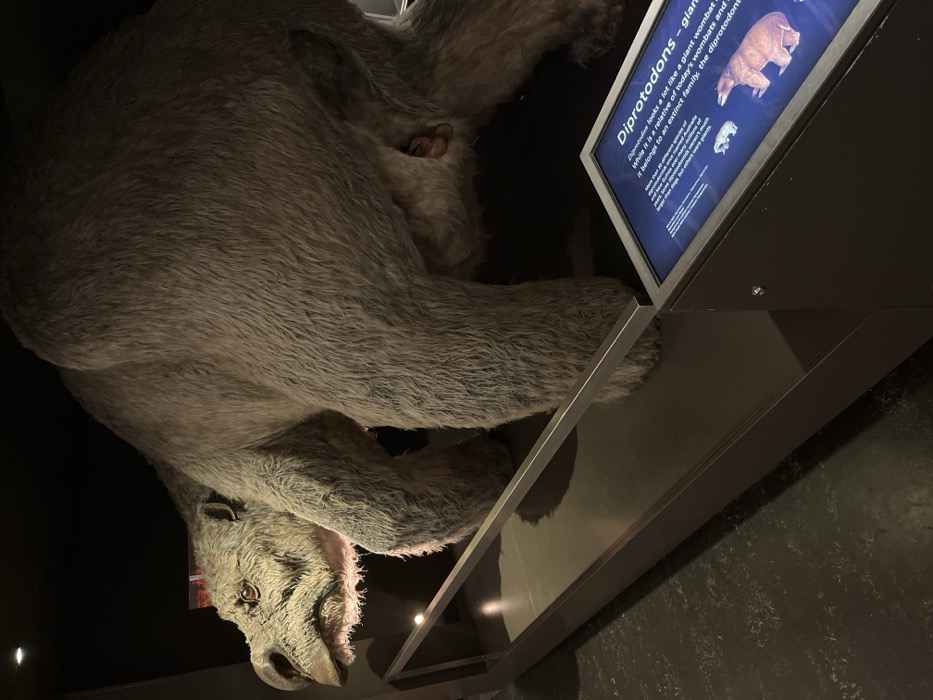
The image captures a large, furry model of an extinct Diprotodon, displayed within a dimly lit museum or exhibition setting. The model, rendered in shades of grey and brown with shaggy fur, appears to be lying on its side. Its head, featuring small eyes and a broad snout, is visible towards the bottom left, while its massive body extends upwards and to the right, conveying its substantial size.

Adjacent to the Diprotodon model, an illuminated informational display panel is prominently featured on the right side of the frame. The panel has a dark background with white text and includes at least two graphic illustrations: one depicting the full-body form of a Diprotodon and another smaller, possibly skeletal, image.

Visible text on the panel reads: "Diprotodons - giant." Further details state, "Diprotodon looks a lot like a giant wombat. While it is a relative of today's wombats and it belongs to an extinct family, the diprotodont." Other discernible phrases mention that Diprotodons "lived here on mainland Australia," "ate leaves from shrubs and trees," were "much larger than today's modern wombats," and that "Diprotodon is the largest known marsupial ever to walk the Earth. It stood over 2 metres tall at the shoulders and weighed around 3 tonnes, roughly the size of a modern" (the rest is cut off).

The setting suggests a natural history museum in Sydney, Australia, dedicated to showcasing ancient fauna. The dark environment with spotlights emphasizes the exhibit, highlighting the scale and details of the megafauna model.
FM-VfnHd2

Jan 9, 2025

Sydney, Australia

Stake attention in this memory

The image captures a large, furry model of an extinct Diprotodon, displayed within a dimly lit museum or exhibition setting. The model, rendered in shades of grey and brown with shaggy fur, appears to be lying on its side. Its head, featuring small eyes and a broad snout, is visible towards the bottom left, while its massive body extends upwards and to the right, conveying its substantial size. Adjacent to the Diprotodon model, an illuminated informational display panel is prominently featured on the right side of the frame. The panel has a dark background with white text and includes at least two graphic illustrations: one depicting the full-body form of a Diprotodon and another smaller, possibly skeletal, image. Visible text on the panel reads: "Diprotodons - giant." Further details state, "Diprotodon looks a lot like a giant wombat. While it is a relative of today's wombats and it belongs to an extinct family, the diprotodont." Other discernible phrases mention that Diprotodons "lived here on mainland Australia," "ate leaves from shrubs and trees," were "much larger than today's modern wombats," and that "Diprotodon is the largest known marsupial ever to walk the Earth. It stood over 2 metres tall at the shoulders and weighed around 3 tonnes, roughly the size of a modern" (the rest is cut off). The setting suggests a natural history museum in Sydney, Australia, dedicated to showcasing ancient fauna. The dark environment with spotlights emphasizes the exhibit, highlighting the scale and details of the megafauna model.

transactions
revenues
stakers
Earliest
Latest
Highest stake

No transactions found

More from this user

More from Sydney

FM-VfnHd2

Jan 9, 2025

Sydney, Australia

Licensed under Creative Commons Attribution 4.0 International License. You are free to share and adapt this content with proper attribution.