Sign in
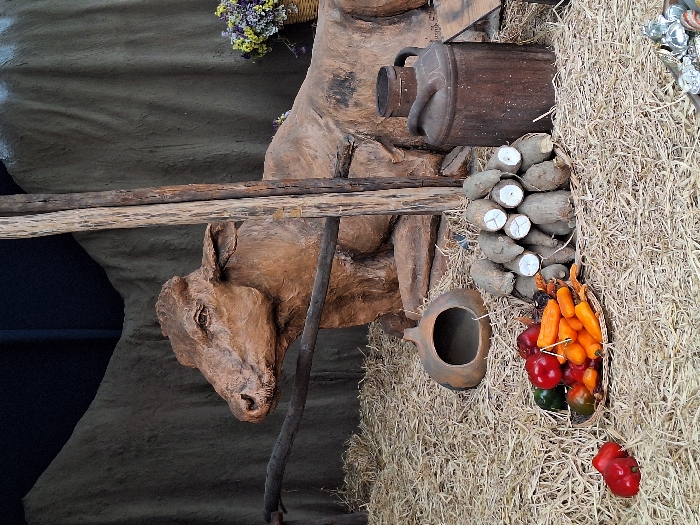
This media file captures a detailed still-life diorama, likely depicting a traditional rural or pastoral scene, set in Arequipa, Peru. The image is oriented vertically (when viewed as originally presented), but appears to be horizontally composed as a display.

The primary subject is a lifelike, sculpted animal, resembling a brown donkey or calf, positioned on the left side of the scene. It appears to be made of wood or a similar natural material, with a rustic, textured finish. Wooden beams run horizontally above and behind the animal, suggesting part of a simple shelter or fence.

To the right, a large, rusted metal jug or canteen rests on a surface, next to a significant pile of greyish-brown root vegetables, possibly yams or yuca, some of which are cut to reveal white interiors. Below these roots is a small, rustic terracotta or clay pot. Further to the right, a woven basket overflows with colorful produce, including bright orange carrots, vivid red bell peppers, and possibly green peppers. A single red bell pepper lies loose on the surface below the basket.

The ground and a vertical element on the right are covered with dried straw or hay, creating a textured, natural backdrop. In the upper part of the scene, partially visible behind the animal and above the other elements, is a small basket containing dried purple and yellow flowers, adding a touch of color. The background consists of earthy-toned sculpted or painted elements, suggesting a cave wall or a simple dwelling.

The scene portrays a snapshot of rustic life, emphasizing natural materials, agricultural produce, and handcrafted items. There is no overt activity, but rather a carefully arranged display. No visible text is present. The overall impression is one of simple living and connection to the land, typical of traditional settings in the Andean region.
L E E L O O 🇵🇪

Dec 10, 2024

Arequipa, Peru

Stake attention in this memory

This media file captures a detailed still-life diorama, likely depicting a traditional rural or pastoral scene, set in Arequipa, Peru. The image is oriented vertically (when viewed as originally presented), but appears to be horizontally composed as a display. The primary subject is a lifelike, sculpted animal, resembling a brown donkey or calf, positioned on the left side of the scene. It appears to be made of wood or a similar natural material, with a rustic, textured finish. Wooden beams run horizontally above and behind the animal, suggesting part of a simple shelter or fence. To the right, a large, rusted metal jug or canteen rests on a surface, next to a significant pile of greyish-brown root vegetables, possibly yams or yuca, some of which are cut to reveal white interiors. Below these roots is a small, rustic terracotta or clay pot. Further to the right, a woven basket overflows with colorful produce, including bright orange carrots, vivid red bell peppers, and possibly green peppers. A single red bell pepper lies loose on the surface below the basket. The ground and a vertical element on the right are covered with dried straw or hay, creating a textured, natural backdrop. In the upper part of the scene, partially visible behind the animal and above the other elements, is a small basket containing dried purple and yellow flowers, adding a touch of color. The background consists of earthy-toned sculpted or painted elements, suggesting a cave wall or a simple dwelling. The scene portrays a snapshot of rustic life, emphasizing natural materials, agricultural produce, and handcrafted items. There is no overt activity, but rather a carefully arranged display. No visible text is present. The overall impression is one of simple living and connection to the land, typical of traditional settings in the Andean region.

transactions
revenues
stakers
Earliest
Latest
Highest stake

No transactions found

More from this user

More from Arequipa

L E E L O O 🇵🇪

Dec 10, 2024

Arequipa, Peru

Licensed under Creative Commons Attribution 4.0 International License. You are free to share and adapt this content with proper attribution.